
GD Culture Group’s Strategic Pivot in TikTok Livestream E-Commerce and Treasury Management
GD Culture Group is reshaping its business from gaming livestreams to TikTok e-commerce while managing significant Bitcoin holdings amid financial and regulatory challenges.
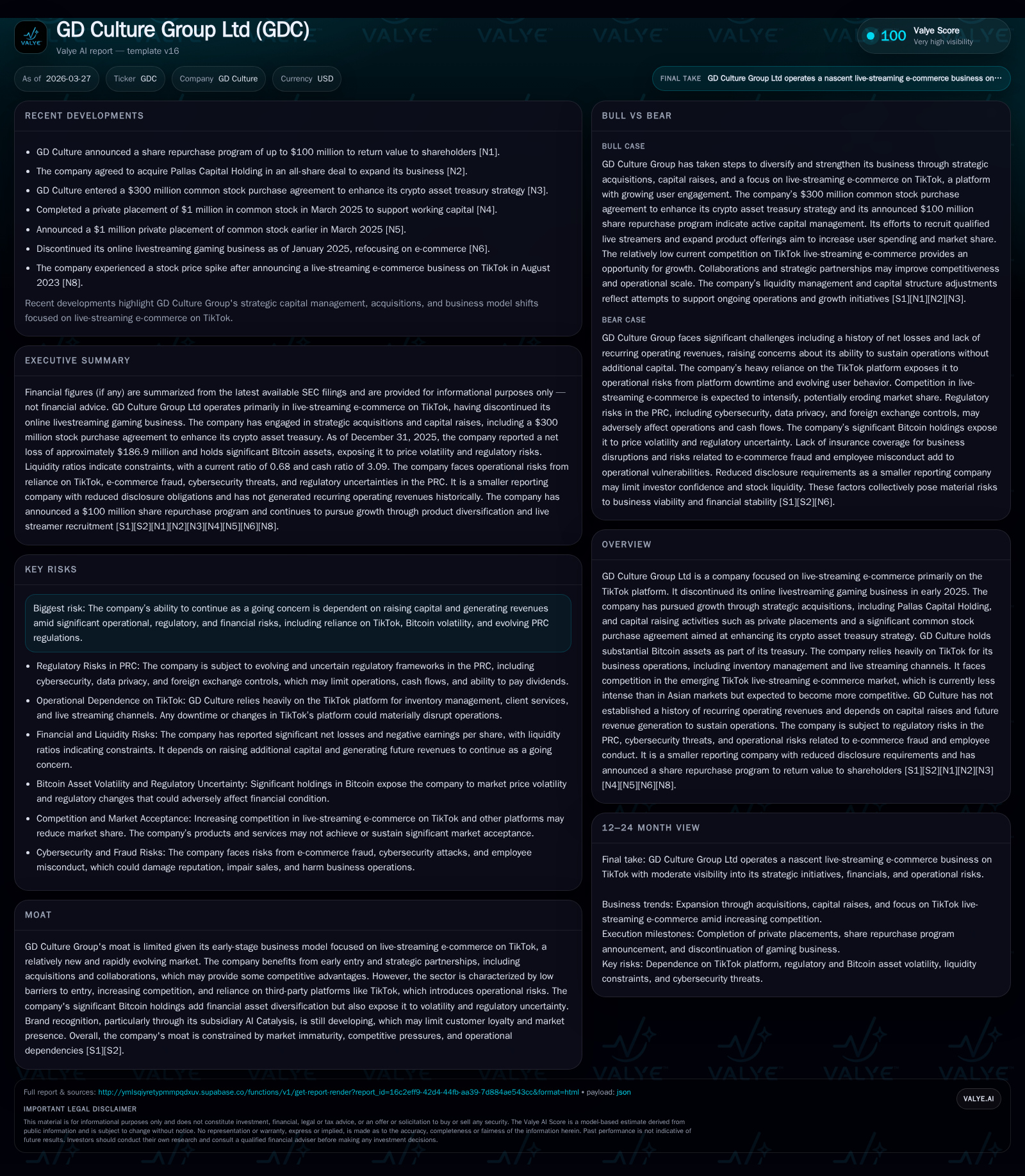
GD Culture Group Ltd has undergone a dramatic business transformation, discontinuing its core gaming livestream segment by early 2025 to focus on live-streaming e-commerce primarily on TikTok. This pivot coincides with strategic acquisitions and capital raises aimed at supporting growth, alongside a notable investment in Bitcoin as part of its treasury strategy. The company faces steep revenue declines following the gaming exit, operational dependence on the TikTok platform, escalating competition, and substantial regulatory risks tied to its China-based subsidiaries. Its financial profile reveals mounting operating losses, severe net income deterioration, and constrained liquidity amid an aggressive share repurchase authorization.
From Gaming to E-Commerce: Charting GD Culture’s Revenue Trajectory and Major Drivers
GD Culture Group Ltd (GDC) has undergone a profound business transformation over recent years. Historically dependent on online livestreaming gaming operations—which generated substantial revenue of approximately $25 million in fiscal year 2021—the company decisively exited this segment by early 2025 [F1][S1]. This pivot toward live-streaming e-commerce centered predominantly on the TikTok platform precipitated an extreme contraction in reported revenues, with top-line figures plummeting by approximately 99.4% year-over-year from $25 million in FY2021 to about $153 thousand in FY2022 [F1].
Despite this precipitous falloff in revenue attributable to the gaming exit, operational losses surged markedly—operating income deteriorated from a loss of roughly $423 thousand in FY2022 to an operating deficit exceeding $8.4 million by FY2025 [F1]. The transition economy has yet to stabilize or generate meaningful sustainable revenues. Growth drivers now hinge primarily on expanding the nascent TikTok e-commerce business through incremental channel development and strategic acquisitions.
Historical performance (annual)
| FY | Net ($mm) | CFO ($mm) | OpInc ($mm) | Net YoY |
|---|---|---|---|---|
| 2025 | -187 | -7 | -8 | -1250.6% |
| 2024 | -14 | -6 | -14 | -10.5% |
| 2023 | -13 | -13 | -12 | +59.4% |
| 2022 | -31 | -1 | 0 |
Source: SEC companyfacts cache [F1].
Capital returns and efficiency (annual)
| FY | ROE% |
|---|---|
| 2025 | -28.0 |
| 2024 | 4911.5 |
| 2023 | -150.0 |
| 2022 | -889.0 |
Source: SEC companyfacts cache [F1].
Note: Revenue figures beyond FY2022 are unavailable as commercializing e-commerce remains at an early stage.
TikTok Reliance and Market Competition: Growth Opportunities and Operational Constraints
Central to GDC's strategic realignment is an intense operational dependency on TikTok’s platform infrastructure. The company utilizes TikTok not only as its primary live-stream sales channel but also relies on it for inventory management systems and client engagement [S1][S15]. This tight integration enables efficiencies but also magnifies vulnerabilities; any disruption or policy change by TikTok could severely curtail GDC's business continuity.
The live-streaming e-commerce sector via platforms like TikTok is growing rapidly yet faces intensifying competition [S4]. Success depends heavily on raising user engagement metrics such as increasing channel frequency of live streams and diversifying product catalogs offered via key opinion leaders (KOLs), influential content creators who significantly affect consumer purchasing decisions within social commerce segments [S4]. GDC's subsidiary AI Catalysis is actively working to build brand recognition within this ecosystem; however brand loyalty remains embryonic.
While Asian markets exhibit highly competitive structures for live-stream commerce—with numerous established players—TikTok's western penetration is less saturated but evolving quickly. Thus GDC faces a window of opportunity tempered by increasing market entrants and technological shifts that necessitate continuous innovation.
Assessing the Impact of Crypto Treasury Strategy on Financial Stability
Differentiating itself from purely operational peers is GDC’s incorporation of a crypto asset treasury approach focusing heavily on Bitcoin holdings [N1][S6]. The company has substantially augmented its treasury assets with Bitcoin purchases funded through capital raises including private placements and a common stock purchase agreement aimed at bolstering this unconventional hedge strategy.
While diversifying into digital assets offers potential upside via appreciation during favorable market cycles—and could serve as a store of value against cash devaluation—the inherent volatility of cryptocurrency exposes GDC’s balance sheet to pronounced fluctuations [S19]. Moreover regulatory environments governing crypto asset ownership remain fluid globally; evolving rules from U.S. authorities or other jurisdictions could materially constrain the ability to hold or monetize these positions.
The crypto strategy reflects management’s broader capital allocation philosophy seeking asset diversification amidst low recurring operating income prospects [S6]. However exact allocations or Bitcoin amounts are undisclosed publicly.
Capital Structure and Share Repurchase Program: Decoding Cash Flow and Capital Allocation
Financially constrained but intent on supporting shareholder value enhancement initiatives despite operating adversity is reflected in GDC's approval of an up-to-$100 million share repurchase program expiring August 17, 2026 [N1][S3]. This sizeable buyback authorization underscores management confidence or tactical efforts to bolster equity valuation amid depressed fundamentals.
Nonetheless liquidity metrics flag caution: at fiscal year-end 2025 GDC reported about $456 thousand in cash & equivalents against current liabilities surpassing $1.2 million resulting in a current ratio of approximately 0.68 — indicating working capital deficits [F1]. Operating cash flow continues negative trends with CFO at about minus $6.8 million in FY2025 exacerbating free cash flow pressures after minimal Capex expenditure [$14 thousand reported prior year] [F1].
Equity totaled nearly $668 million at end-2025 but this figure may be materially influenced by accounting treatments around crypto assets valuations; correspondingly net losses swelled dramatically to nearly $187 million that year suggesting an approximate negative ROE around -28% reflecting loss-making status [F1].
The juxtaposition of buybacks against constrained cash flow typifies high-risk capital allocation under financial stress conditions.
Regulatory Landscape in PRC and Beyond: Risks Shaping GD Culture’s Operating Environment
As an overseas-listed company with substantial PRC-based operations through subsidiaries such as Shanghai Xianzhui Technology Co., Ltd., GDC faces an increasingly complex regulatory environment marked by evolving compliance standards [S1][S7][S16]. Recent PRC legislative developments impose restrictions on dividend remittances from PRC entities—dividends can only be paid out from accumulated profits after mandatory contributions to statutory reserves reaching prescribed thresholds (generally up to half registered capital) [S1].
Further constraints stem from cybersecurity laws including the Cybersecurity Review Measures effective since February 2022 and Personal Information Protection Law introduced late 2021 that mandate stringent controls over data privacy and security practices that GDC’s operating subsidiaries must adhere to rigorously [S23][S24]. Failure or delays in compliance could entail penalties ranging from fines to suspension or forced restructuring.
Additionally complicating factors include recent PRC oversight intensification over overseas-listed Chinese companies triggered by regulatory authorities like CSRC imposing trial measures regulating cross-border offerings potentially impacting fundraising capabilities [S7].
The company unwound previous Variable Interest Entity (VIE) structures used for consolidated accounting treatment by September 2023 further removing certain liability exposures but possibly eroding some operational flexibility relevant under PRC law enforcement regimes [S11][S16].
Financial Performance at a Glance: Historical Trends and Key Financial Metrics to Watch
A snapshot across recent fiscal years highlights sharp declines in revenue post-gaming exit accompanied by widening losses:
- Revenues dropped from nearly $25 million in FY21 to under $200 thousand two years later.
- Operating losses escalated from under half a million dollars in FY22 to more than $8 million by FY25.
- Net income margins skewed deeply negative reflecting impairments or additional non-operational charges pushing losses close to $187 million in FY25.
- Cash flows remain persistently negative dwindling liquidity buffers; Capex has been tightly controlled restricting reinvestment capacity.
- Working capital pressures evident given subunity current ratio warrant close scrutiny.
Tracking future improvements requires monitoring top-line recovery within live-stream e-commerce alongside margin improvements achieved through scale efficiencies or cost controls.
What Comes Next: Milestones and Investor Considerations for GD Culture
Looking ahead involves monitoring several potential inflection points:
- Revenue generation: Critical milestones include stabilizing monthly gross merchandise value (GMV) via expanded TikTok engagement frequency and diversified product offerings supported by KOL partnerships.
- Capitalization events: Successive funding rounds may be necessary given ongoing cash flow deficits; how management balances equity dilution versus debt financing will impact shareholder risks.
- Share repurchase execution: Monitoring pace at which authorized buyback deploys liquidity relative to cash availability serves as proxy for confidence level assumptions.
- Regulatory developments: Vigilance towards PRC cybersecurity reviews or dividend remittance policies is essential given impacts on cross-border fund flows.
- Competitive positioning: Ability to defend early mover advantage before increased TikTok ecommerce competition intensifies will shape medium-term prospects.
- Crypto treasury impact: Emerging regulation on digital assets may compel mark-to-market volatility influencing reported equity adversely while potential upside remains speculative.
In sum,GDC’s journey underscores an ambitious yet high-risk pivot leveraging social commerce innovation compounded by unorthodox treasury strategies amid challenging macro-regulatory headwinds.
This analysis is based solely on publicly available information without offering investment advice. Readers should consider the company’s disclosures carefully alongside their risk tolerance.
Disclaimer: This is research-only, informational analysis and not investment advice. It may include AI-generated interpretation and general industry context. Always verify important details using primary sources.

Comments