
GoodRx Holdings’ Transition from Growth to Profitability Highlights Emerging Challenges
GoodRx is shifting from rapid expansion towards profitability amid intensifying regulatory scrutiny and evolving market dynamics.
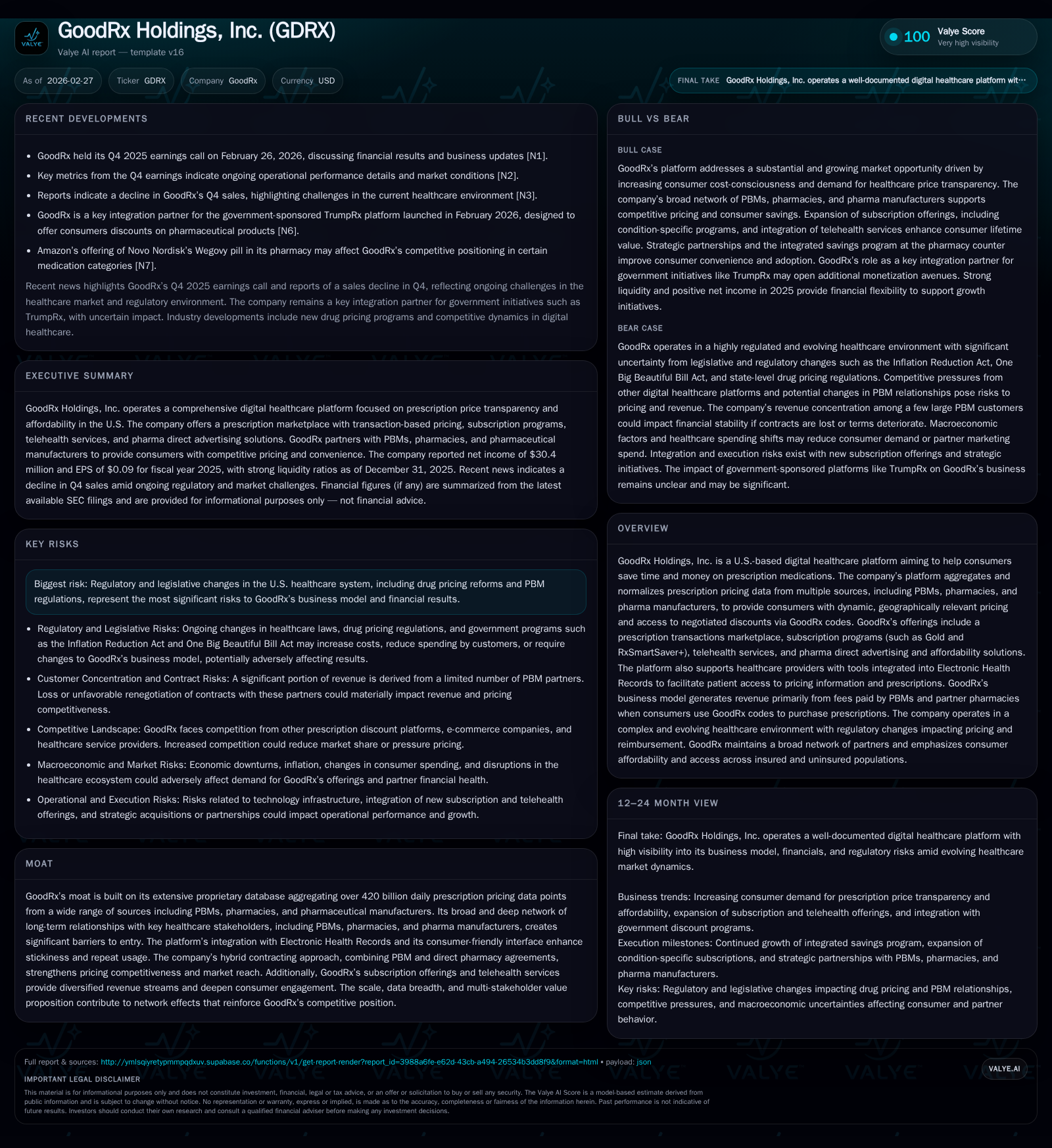
GoodRx Holdings has progressed from modest operating income in 2022 to a notably profitable position in 2025, driven by improved margin management and platform diversification. Despite recent revenue pressures tied to concentration risks among PBM partners and macroeconomic headwinds, the company is expanding subscription and telehealth offerings that bolster consumer lifetime value. Regulatory uncertainties around drug pricing reforms and PBM regulation loom as key challenges, while capital allocation favors robust share repurchases sustained by stable free cash flow.
From Expansion to Earnings: Tracking GoodRx’s Growth Journey
GoodRx Holdings, Inc. has traversed a significant strategic inflection point over recent fiscal years, moving from a period marked by modest or negative operating earnings toward consistent profitability by year-end 2025. The company's operating income rose sharply to $87.5 million in FY2025, representing a 32.9% increase over FY2024's $65.8 million, which itself reflected an improvement following a -$27 million loss in FY2023 and minimal profits in FY2022 [F1]. Net income followed a similar trajectory, scaling by approximately 85.7% year-over-year from $16.4 million in FY2024 to $30.4 million at the end of FY2025 after recovering from prior net losses.
This financial turnaround stems largely from GoodRx’s improved margin management combined with the economies of scale afforded by its extensive prescription pricing database processing over 420 billion data points daily [S1],[S6]. The company’s ability to provide geographically relevant pricing through dynamic aggregation of PBM, pharmacy, and pharma manufacturer data underpins its core prescription transactions marketplace business — historically driving consumer savings that unlock repeat usage and platform stickiness.
Operating cash flows exhibited relative stability but declined slightly (-8.7%) from $183.9 million to $167.9 million across this period [F1]. Meanwhile, capital expenditures accelerated markedly (+184%) as GoodRx reinvested $3.52 million into technology infrastructure enhancements vital for maintaining competitive positioning against evolving consumer expectations and complex healthcare regulations.
Historical performance (annual)
| FY | Net ($mm) | CFO ($mm) | OpInc ($mm) | Capex ($mm) | Net YoY |
|---|---|---|---|---|---|
| 2025 | 30 | 168 | 87 | 4 | +85.7% |
| 2024 | 16 | 184 | 66 | 1 | +284.8% |
| 2023 | -9 | 138 | -27 | 1 | +73.0% |
| 2022 | -33 | 147 | 2 | 4 |
Source: SEC companyfacts cache [F1].
Capital returns and efficiency (annual)
| FY | Buybacks ($mm) | FCF ($mm) | ROE% |
|---|---|---|---|
| 2025 | 216 | 164 | 4.9 |
| 2024 | 159 | 183 | 2.3 |
| 2023 | 104 | 137 | -1.2 |
| 2022 | 102 | 143 | -4.0 |
Source: SEC companyfacts cache [F1].
Financial figures sourced from SEC filings [F1]
Core Drivers Behind Revenue Shifts and Cost Dynamics
Recent reports indicate GoodRx faced headwinds with sales declining or plateauing as of late 2025 [N5], reflecting pressures tied to its concentrated PBM partnerships structure where the top three PBMs accounted for roughly one-fifth of revenue in FY2025 compared with approximately one-third in FY2023 [S25]. Although diversification efforts have modestly reduced reliance on any single PBM partner, these relationships remain critical to both price availability and transaction volume.
The proprietary aggregation technologies that enable real-time normalization of varied PBM cash network pricing have preserved GoodRx's competitiveness despite macroeconomic strain on consumer healthcare spending noted in recent economic downturns [S2]. Subscription adoption — particularly through offerings like Gold that bundle mail delivery with deep discounts — emerged as an important lever buffering transaction revenue softness [N1],[S6]. These subscriptions not only increase customer lifetime value due to lower churn but also shift revenue composition towards higher margins.
Additionally, cost dynamics have been influenced by increased regulatory compliance expenses related to healthcare fraud prevention, HIPAA security obligations, and adapting tech infrastructure amidst growing state privacy law enactments such as Washington’s My Health My Data Act (MHMDA) [S4],[S24]. These factors drive greater operational complexity but also underscore GoodRx’s commitment to robust risk management.
Emerging Opportunities in Subscription and Telehealth Services
Capitalizing on consumer demand for affordability paired with convenience, GoodRx has expanded margin-accretive subscription services including condition-specific bundles that encompass clinician visits, prescriptions, and delivery at fixed prices [S17]. The Gold subscription program enhances savings on select medications while integrating discounted telehealth visits without additional fees [S6],[N1]. This hybrid offering effectively raises average consumer lifetime value without proportional increases in acquisition costs, fostering stickier engagement.
Moreover, strategic partnerships with retail pharmacy chains for programs like RxSmartSaver+ broaden reach into specific medication categories while supporting pharma manufacturer direct affordability initiatives integrated within the platform [S15],[S16]. These diversified offerings position GoodRx not merely as a savings tool but as an end-to-end consumer health engagement platform — an attractive narrative amid recession-resilient health tech trends.
Regulatory Landscape: Implications for Strategic Positioning
Regulatory environment shifts represent one of the most significant strategic uncertainties confronting GoodRx [S4],[N5]. The One Big Beautiful Bill Act (OBBBA), enacted mid-2025, curtailed Medicaid rebate funding mechanisms affecting some pricing dynamics critical to PBMs and their downstream networks [S1]. Combined with heightened governmental scrutiny around pharmacy benefit managers’ anti-competitive practices — exemplified by ongoing FTC investigations culminating in consent agreements — these factors introduce potential cost pressures and necessitate adaptation of existing revenue-sharing arrangements [S21],[S23].
Further complicating matters are increasingly stringent state-level drug pricing oversight policies aimed at transparency and affordability enforcement that may limit negotiated discount flexibility or impose reporting burdens on digital platforms like GoodRx [S20],[S22]. Robust compliance infrastructure is thus essential not only for legal adherence but also to sustain partnership trust with PBMs, pharmacies, and pharmaceutical manufacturers who remain wary of regulatory exposures.
Competitive Framework: PBM Partnerships and Market Concentration
GoodRx operates within a compressed competitive landscape dominated by a limited cohort of large PBMs wielding considerable bargaining power [S5]. Nearly all PBMs maintain cash discount networks enabling out-of-insurance purchases which GoodRx leverages through its platform integration — a critical mechanism given that many consumers circumvent traditional insurance due to high deductibles or coverage gaps [S16]. The company’s hybrid contracting approach combining traditional PBM agreements with direct pharmacy contracts enhances pricing competitiveness across geographies while fostering incremental transaction volume through stronger retailer relationships [S13],[S17].
However, competition also arises from large e-commerce platforms such as Amazon entering pharmacy discount arenas [N8] as well as direct-to-consumer pharma advertising channels vying for pharmaceutical manufacturers' budgets [S11]. Notably, sector nuances like PBM 'cash networks' mechanics create complexities where negotiated discounts must be carefully balanced against platform fees without eroding consumer appeal or partner revenues.
Capital Allocation Strategy: Buybacks, Cash Flow, and Return on Equity
GoodRx’s capital deployment leans heavily towards share repurchases which reached $216 million in FY2025 — a substantial increase of approximately 36% from the prior year’s $159 million outlay — reflecting confidence in long-term shareholder value creation amid market uncertainties [F1],[S29]. Free cash flow remains robust at roughly $164 million after CapEx deductions despite a slight decline (-8.7%) in operating cash flow primarily due to increased investment activity.
ROE stands near a modest but improving ~4.9%, anchored by net gains paired with solid equity levels near $616 million at year-end FY2025 [F1]. Liquidity metrics are healthy; GoodRx reported current assets exceeding liabilities substantially (current ratio ~2.61), supporting continued opportunistic buybacks rather than initiating dividends at this stage.
Operational Efficiency: Managing Risks Amid Evolving Healthcare Policies
Given its vast aggregation of sensitive health-related data spanning multiple stakeholders including consumers, PBMs, pharmacies, and pharma manufacturers ([S14]), GoodRx places considerable emphasis on cybersecurity rigor consistent with stringent HIPAA regulations relevant across all US states including new data protection mandates like MHMDA [S24]. Investments in scalable compliance systems aim to preemptively address fraud & abuse risks flagged by federal oversight bodies while ensuring operational continuity—even under natural disaster scenarios impacting its California headquarters region known for seismic activity [S2].[N2]
Emergent complexities surrounding telehealth service integration further necessitate ongoing technological innovation balanced against regulatory demands thereby shaping cost structures within SG&A lines without impairing user experience.
What to Watch Next: Catalysts and Milestones for 2026
Key events poised for market attention include contract renewals with major PBMs where terms could materially reshape transactional fee structures or pricing exclusivity provisions influencing platform breadth ([N1],[N5]). Subscriber uptake trajectories for Gold and RxSmartSaver+ subscriptions will serve as barometers for sustainable margin expansion beyond volatile transaction volumes.
Regulatory developments post-OBBBA implementation remain pivotal; ongoing assessment of impacts stemming from federal legislative initiatives targeting drug pricing transparency coupled with potential state-level prescription drug affordability board actions merit close monitoring ([N5],[S20]). Competitive responses—especially those triggered by non-traditional entrants such as Amazon’s pharmacy expansion—could precipitate defensive product innovation or adjusted marketing spends.[N8]
Absent explicit forward guidance beyond standard disclosures, these factors constitute primary catalysts shaping GoodRx's near-term operational landscape.
Disclaimer: This report is prepared solely for informational purposes based on public filings and news sources available as of February 27, 2026; it does not constitute investment advice or recommendations regarding securities of GoodRx Holdings, Inc.
Disclaimer: This is research-only, informational analysis and not investment advice. It may include AI-generated interpretation and general industry context. Always verify important details using primary sources.

Comments