
GE Aerospace: Navigating Commercial and Defense Engine Markets Amid Operational Transitions
GE Aerospace leverages technological prowess and service contracts to maintain a leading position in aircraft engines, balancing pricing pressures and spin-off complexities.
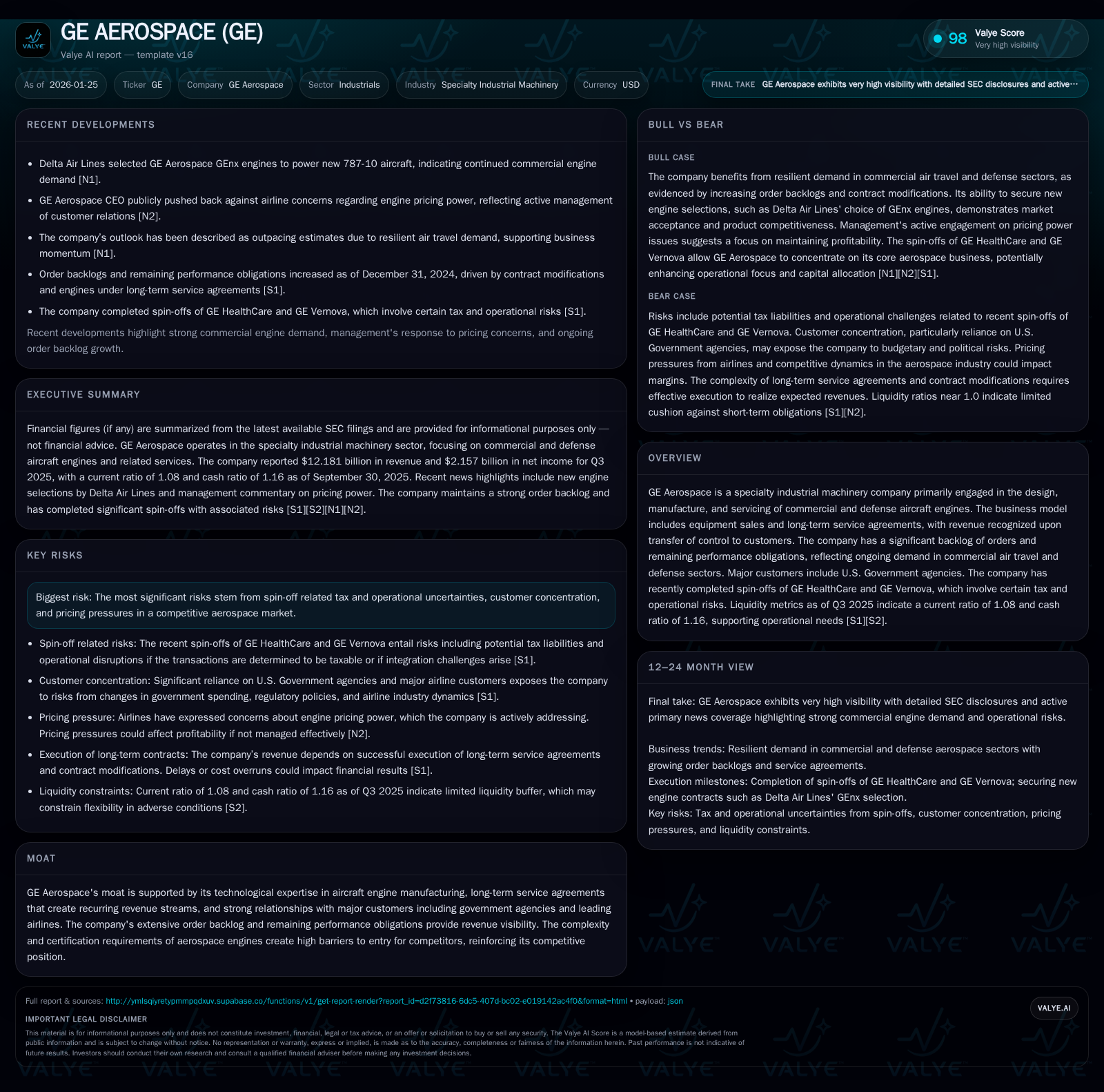
GE Aerospace remains a dominant player in commercial and defense aircraft engines, supported by a deep technological moat and recurring service revenues. Recent earnings beat and resilient air travel demand underpin a stable outlook, although the company faces headwinds from customer pricing pushback and risks related to recent spin-offs. Its complex business model, driven by equipment sales and long-term service agreements, requires careful navigation of operational and tax uncertainties amid competitive dynamics.
What Changed Recently
In January 2026, GE Aerospace reported Q4 2025 earnings that beat market expectations and reiterated 2026 guidance inline with prior forecasts. This performance was supported by resilient demand in commercial air travel, which continues to recover post-pandemic, and steady defense spending. Notably, CEO Jonathon Adams publicly pushed back against airline industry complaints alleging excessive engine pricing power, underscoring ongoing tensions in customer negotiations over contract terms and aftermarket services [N2][N3][N5].
Additionally, the company continues to manage operational and financial complexities following the spin-offs of GE HealthCare and GE Vernova. These separations, completed recently, carry the risk that tax authorities might reclassify them as taxable transactions, potentially creating significant liabilities for GE Aerospace and its shareholders [S2].
Delta Air Lines' recent selection of GE's GEnx engines for new 787-10 aircraft reinforces commercial demand for GE's technology and supports the company’s commercial backlog [N11]. These developments reflect a steady commercial aerospace market, albeit with emerging competitive and regulatory scrutiny.
Business Model as a System
GE Aerospace operates primarily in the specialty industrial machinery sector, focusing on the design, manufacture, and servicing of commercial and defense aircraft engines. Its revenue model combines upfront sales of high-complexity engine equipment with long-term service agreements (LTSAs) that generate recurring aftermarket revenue over multi-year horizons [S1][S5].
Revenue recognition for engine sales is point-in-time, typically upon customer physical possession and acceptance, with some arrangements subject to acceptance provisions that delay revenue until objective criteria are met. Service revenues, by contrast, are recognized over time, reflecting ongoing maintenance, repairs, and overhaul activities [S5].
The system hinges on a virtuous cycle where engine sales underpin a backlog of service contracts, which provide steady cash flow and margin stability. These service agreements lock in customers for long periods, often linked to engine flight hours or cycles, incentivizing GE to maintain high reliability and performance standards. This creates a barrier to entry given the certification complexity and customer relationships involved [S1][S4].
Major customers include large commercial airlines and U.S. Government agencies, particularly within defense. This customer concentration provides substantial revenue visibility but also exposes GE Aerospace to risks from budgetary shifts or contract renegotiations [S4].
The company maintains joint ventures globally, sometimes with limited control, adding operational and reputational risks. Managing these relationships requires allocation of management bandwidth and strategic focus, which could be strained by portfolio transactions or market shifts [S2].
Recent spin-offs have redefined the company’s portfolio, isolating aerospace from healthcare and energy businesses. While the spin-offs were intended to be tax-free, uncertainty remains, posing potential financial and operational risk if reclassification occurs [S2].
Industry Map & Competitive Battlefield
The aerospace engine market is oligopolistic, dominated by GE Aerospace, Rolls-Royce, and Pratt & Whitney (a Raytheon Technologies subsidiary). These players compete across commercial, military, and business aviation segments. The industry is characterized by high barriers to entry due to the intense R&D investment, rigorous certification processes, long product development cycles, and entrenched customer relationships [S1][S15].
Competitors differentiate through technology innovation (e.g., fuel efficiency, emissions reduction), aftermarket service capabilities, and integrated solutions. GE’s extensive service network and technological expertise underpin its moat, especially in commercial widebody and narrowbody aircraft engines.
The commercial segment is driven by airline fleet renewals and air travel demand recovery, which have been resilient but remain sensitive to macroeconomic cycles and fuel prices. Defense demand hinges on government budgets and geopolitical factors, which can create lumpy order patterns.
Pricing power is contested; airlines have recently decried GE’s engine pricing and aftermarket charges, creating public relations and negotiation challenges. The CEO’s pushback signals GE’s intent to defend margins but suggests potential for ongoing friction [N2].
Technological trends such as sustainable aviation fuels, hybrid-electric propulsion, and digital engine health monitoring are reshaping competitive dynamics. GE is investing to maintain leadership but must balance capital intensity with returns [S1].
Where the Economics Become Real
Unit economics in aerospace engines are complex. Initial engine sales carry significant costs due to precision manufacturing, materials, and certification. Margins on these sales vary but are generally lower than service margins.
Service contracts, often multi-decade, represent the high-margin recurring revenue base. Profitability depends on cost control in maintenance and parts supply, engine reliability, and contract structure (e.g., power-by-the-hour models). The service backlog provides revenue visibility and cash flow stability [S1][S8].
Liquidity as of late 2025 is adequate, with a current ratio of approximately 1.08 and substantial cash balances supporting operational needs and capital expenditures [S11]. However, the company has ongoing obligations from equipment projects, commercial liabilities, and dividends payable that require monitoring [S12].
Debt maturities appear manageable, but capital contributions to run-off insurance subsidiaries—part of broader corporate financial management—totaled over $15 billion in recent years, highlighting the importance of capital allocation discipline [S13].
Pricing pressures from airlines and competitive bids could erode margins, especially in aftermarket services. Managing these pressures without sacrificing service quality or technological investment is critical to sustaining unit economics.
Diligence Questions / Disconfirming Signals
- What is the status and possible financial impact if tax authorities reclassify the HealthCare/Vernova spin-offs as taxable? How prepared is GE Aerospace for this contingency?
- How concentrated is the backlog by customer and product line? Is there risk of material order cancellations or deferrals, especially from government or large airline clients?
- What are the contract terms around service agreements? Are there clauses that could limit pricing flexibility or expose GE to warranty or performance penalties?
- How is GE managing joint ventures with limited control? Are there operational or reputational risks that could materialize?
- Does the CEO’s public defense against pricing criticism signal a potential escalation in customer disputes that could pressure margins or lead to regulatory scrutiny?
- How resilient is the aftermarket service revenue against evolving technological disruptions such as digital engine monitoring or competing propulsion technologies?
- Are there emerging supply chain constraints or cost inflation in key manufacturing inputs that could compress margins?
- What is the outlook for defense spending from major government customers, and how might geopolitical shifts affect order patterns?
This analysis is based on publicly available information as of January 2026 and does not constitute investment advice. It synthesizes SEC filings and recent news, highlighting key operational and financial considerations relevant to understanding GE Aerospace’s strategic positioning and risks.
Disclaimer: This is research-only, informational analysis and not investment advice. It may include AI-generated interpretation and general industry context. Always verify important details using primary sources.

Comments