
CalEthos and the Race to Onsite Power: Can a Microgrid-First Model Disrupt Data Center Development?
CalEthos is betting on onsite natural gas power to solve hyperscale data center bottlenecks, but its early-stage status, capital intensity, and regulatory headwinds present steep hurdles. The next 18 months will reveal whether its infrastructure-as-a-service approach can attract major tenants and survive industry turbulence.
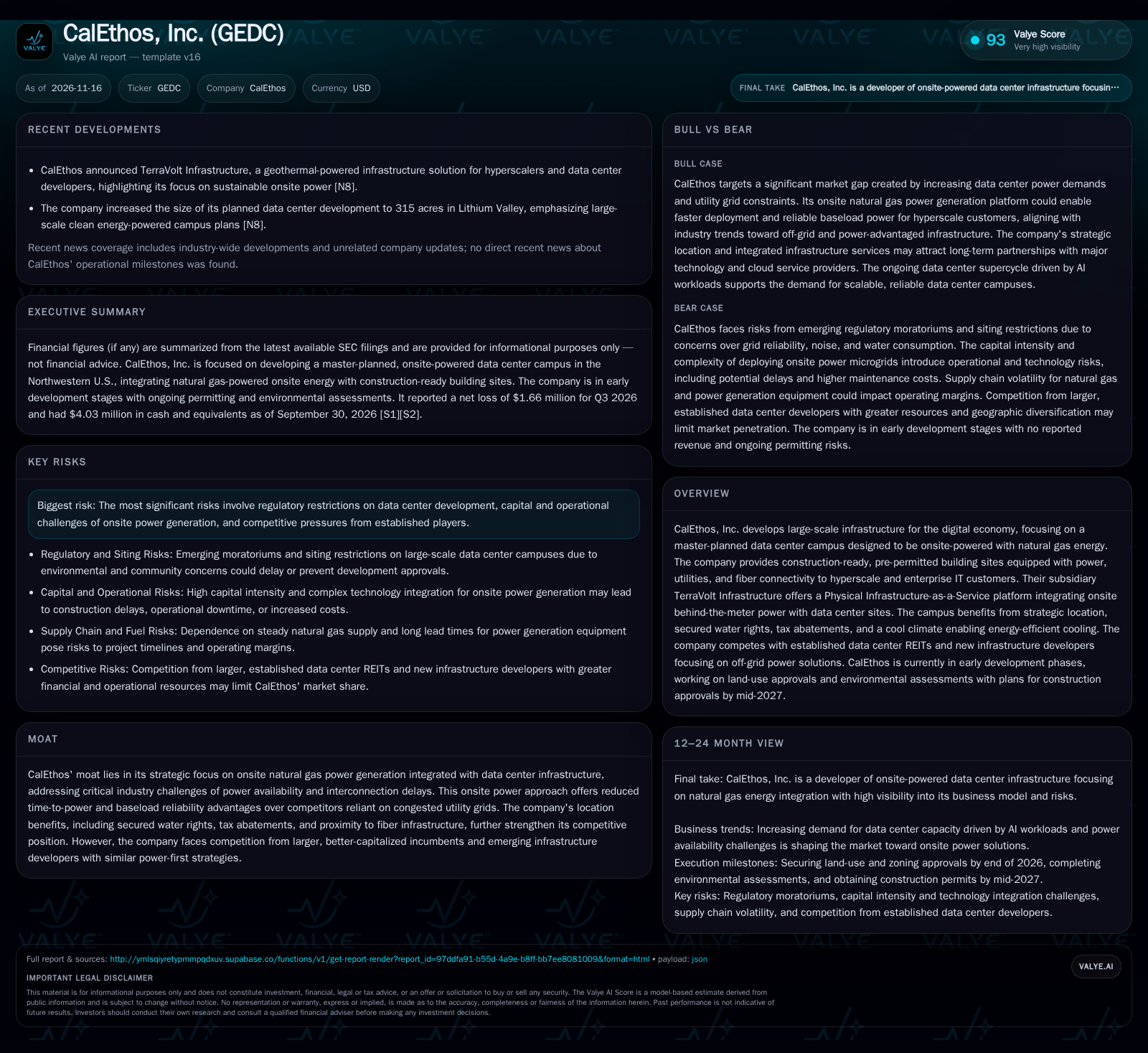
CalEthos, Inc. is developing a master-planned data center campus in the Northwestern U.S. designed to offer dedicated onsite natural gas power, aiming to bypass utility interconnection delays and capitalize on soaring data center demand. While the company touts advantages like secured water rights, tax abatements, and a scalable site, it remains pre-revenue, with permitting and environmental approvals still pending and only $4.03 million in cash as of September 2026. With no customers or revenue yet, and significant execution and regulatory risks ahead, CalEthos must rapidly demonstrate permitting progress and secure anchor tenants to validate its infrastructure-as-a-service model.
CalEthos, Inc. is positioning itself at the intersection of two urgent industry trends: the explosive growth in data center demand driven by AI workloads and the acute shortage of reliable grid power for hyperscale deployments. By planning a data center campus with dedicated onsite natural gas generation, CalEthos aims to bypass utility interconnection queues and provide immediate, dependable power — a proposition that could appeal to cloud giants and enterprise IT customers. However, as of late 2026, the company remains in the pre-revenue, pre-construction phase, with capital needs, regulatory approvals, and competitive challenges all looming large. The next 12-24 months will be pivotal to determine whether CalEthos can move from concept to commercial reality.
Permitting, Cash Burn, and Zero Revenue: CalEthos’s Current Reality
As of September 30, 2026, CalEthos reported $4.03 million in cash and equivalents, $4.20 million in current assets, and $3.08 million in current liabilities, yielding a current ratio of 1.36 and a cash ratio of 1.47 [S2]. The company recorded a net loss of $1.66 million for the third quarter of 2026 and basic and diluted EPS of -$0.06 [S2]. Critically, CalEthos reported no revenue as of September 2024, reflecting its early development status [S2].
Operationally, CalEthos is still focused on land-use applications, zoning changes, and environmental assessments for its Northwestern U.S. data center campus, aiming for approvals by year-end 2026 and construction permits by mid-2027 [S2]. The company remains pre-customer and pre-revenue, with its business model and value proposition not yet tested in the market.
Infrastructure-as-a-Service: Capital Intensity and Pathways to Monetization
CalEthos’s core business model is to sell or lease pre-permitted, construction-ready data center sites with dedicated, onsite natural gas power and high-speed fiber connectivity. The company’s subsidiary, TerraVolt Infrastructure, is positioned to offer these services as a Physical Infrastructure-as-a-Service (PIaaS) platform. If successful, this approach could appeal to hyperscalers and enterprises seeking to avoid grid interconnection delays and ensure reliable power for AI and cloud workloads.
However, the economics of this model are highly capital intensive. Onsite gas-fired power plants require significant upfront investment in land, natural gas pipelines, generation equipment, and permitting. Ongoing operating costs include fuel procurement (with exposure to natural gas price volatility), maintenance of power infrastructure, and site operations. Revenue may be generated through long-term leases, power purchase agreements (PPAs), or turnkey site sales, but the company must first secure anchor tenants and demonstrate its value proposition.
Operating leverage could be substantial if CalEthos achieves scale—once the fixed costs of land, permitting, and infrastructure are absorbed, incremental sites or megawatts could generate strong margins. But until construction begins and tenants are secured, fixed costs will dominate. The business will likely need external funding to bridge the gap between development milestones and cash flow breakeven.
Bypassing the Grid: Is Onsite Power Enough to Outflank Larger Data Center Developers?
CalEthos competes directly with established data center REITs and developers, many of whom have deep customer relationships, capital resources, and multi-market footprints. The company’s pitch—a campus with immediate, behind-the-meter natural gas power—targets a structural pain point as utility interconnection queues lengthen and grid reliability becomes a gating factor for new data center projects.
Potential advantages include rapid time-to-power, baseload reliability, and the ability to offer scalable, contiguous sites in a pro-business jurisdiction with tax abatements, secured water rights, and fiber access. The cool semi-arid climate supports energy-efficient free-air cooling, further enhancing operational appeal.
Yet, CalEthos must contend with both legacy incumbents and a new wave of infrastructure players pursuing similar power-first or off-grid strategies. Larger competitors may have superior access to capital, established permitting track records, and the ability to bundle power, real estate, and connectivity at scale. If grid constraints persist or worsen, CalEthos’s differentiated offering could gain traction—but if siting or sustainability regulations tighten, or if utilities accelerate grid upgrades, its advantage may erode.
Securing Permits and Landing an Anchor Tenant: The Path to Commercial Validation
The clearest route to value creation is for CalEthos to secure all necessary land-use, environmental, and construction approvals by mid-2027, then rapidly sign an anchor tenant—ideally a hyperscale cloud provider or major enterprise—willing to commit to a long-term lease or PPA for a significant portion of the site’s capacity.
This would validate the PIaaS model and demonstrate that immediate, onsite power supply is a compelling differentiator in a power-constrained market. Such a deal could unlock access to project financing, allow phased site buildout, and attract additional tenants seeking similar advantages.
Evidence confirming this scenario would include regulatory approval milestones, announced customer commitments, groundbreaking or construction starts, and disclosure of signed revenue-generating contracts. If CalEthos can show progress on these fronts in the next 12-18 months, it could transition from speculative concept to credible disruptor in the data center infrastructure space.
Permitting Drags, Capital Stretches: A Long Road to First Revenue
The most plausible scenario is a protracted development timeline where CalEthos gradually works through permitting, zoning, and environmental hurdles, but does not secure all approvals or major tenant commitments until late 2027 or beyond.
During this phase, the company may announce incremental progress—such as zoning approvals or non-binding expressions of interest from potential customers—but will remain pre-revenue and exposed to regulatory, supply chain, and competitive risks. The absence of large, binding tenant contracts would limit access to non-dilutive project financing and could delay construction starts.
Confirmation of this base scenario would be steady, but slow, progress on regulatory milestones, periodic capital raises, and continued net losses without substantive revenue. Falsification would require evidence of accelerated permitting, unexpected customer wins, or a major strategic partnership.
Regulatory Moratoriums or Funding Shortfalls Derail the Project
A credible downside risk is that CalEthos encounters regulatory setbacks—such as local or state moratoriums on new data center builds, water use restrictions, or environmental opposition—that delay or block necessary permits. Simultaneously, if capital markets tighten or the company is unable to raise sufficient funds, it may be forced to halt development or cede control of the project to better-capitalized partners.
Supply chain disruptions for natural gas or power generation equipment could further extend timelines and increase costs, eroding the business case. In this scenario, CalEthos may face the risk of insolvency, asset fire sales, or project abandonment if it cannot demonstrate clear progress and secure anchor customers.
Evidence confirming this scenario would be missed permitting deadlines, public opposition or regulatory rejections, failure to raise new capital, or disclosures of ‘going concern’ risks or project impairments.
Milestones That Will Define CalEthos’s Leap from Blueprint to Builder
Progress on land-use, zoning, and environmental approvals—disclosed milestones or regulatory filings would signal project momentum.
Announcement of anchor tenant commitments or signed power purchase agreements, which would validate customer demand for the onsite power model.
Evidence of construction financing or strategic investment, such as debt facilities, joint ventures, or equity raises beyond current cash resources.
Initiation of site work or groundbreaking ceremonies, which would indicate movement from planning to execution.
Updates on natural gas supply contracts and pipeline access—renewed or expanded agreements would mitigate fuel risk.
Permitting or regulatory delays, moratoriums, or public opposition—any such developments would increase project risk.
Disclosure (if any) of project-level cost estimates, capital expenditure schedules, or projected cash burn rates to test funding sufficiency.
A useful metric would be the volume of pre-leased or pre-sold megawatts versus total planned capacity, which would gauge market traction.
Disclaimer: This is research-only, informational analysis and not investment advice. It may include AI-generated interpretation and general industry context. Always verify important details using primary sources.

Comments