
Gevo Advances Renewable Fuel Production Leveraging Proprietary ATJ Technology Despite Ongoing Losses
Gevo, Inc. pursues growth in sustainable aviation fuels and carbon capture with modular plants and a vertically integrated model amid notable net losses.
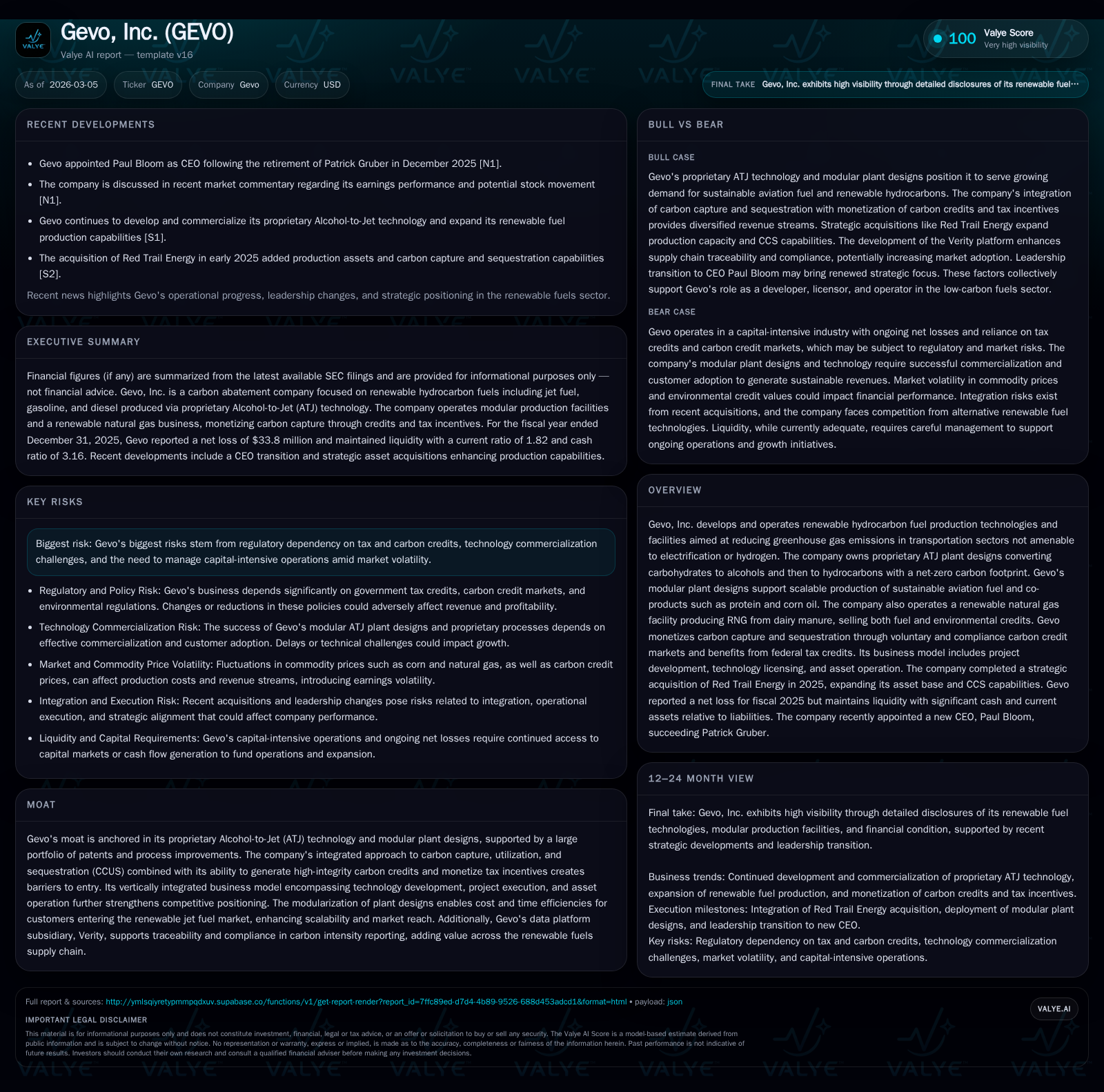
Gevo has built a specialized niche in renewable hydrocarbon fuels through its proprietary Alcohol-to-Jet (ATJ) process and modular plant designs, targeting sectors where electrification is unfeasible. Despite sustained operating losses and negative cash flows, its expanded asset base and technology portfolio position the company for future scaling. Regulatory incentives, carbon credit monetization, and project development/licensing form the financial pillars supporting Gevo's long-term strategy. Investors should monitor execution on capacity expansions, regulatory frameworks, and integration of recently acquired assets.
Company Overview
Gevo, Inc. operates at the intersection of renewable fuel production and carbon abatement technologies. The company’s core differentiator is its proprietary Alcohol-to-Jet (ATJ) process enabling conversion of renewable carbohydrates into hydrocarbons suitable for transportation sectors difficult to electrify or switch to hydrogen. Gevo’s approach integrates modular plant designs targeting scalable production of sustainable aviation fuels alongside co-products like high-value protein and corn oil. In addition, Gevo owns and operates renewable natural gas (RNG) facilities producing biogas from dairy manure with sales supported by environmental credit markets. Its vertical integration spans technology development, project execution, licensing, and asset operation bolstered by a sizable patent portfolio [S1][S6][S26].
Historical Financial Performance
Gevo's financial data shows significant revenue volatility with a sharp contraction between 2020 and 2021. According to available data [F1], revenue declined by approximately 87% year-over-year from $5.54 million in FY2020 to $711 thousand in FY2021:
Historical performance (annual)
| FY | Net ($mm) | CFO ($mm) | OpInc ($mm) | Capex ($mm) | Net YoY |
|---|---|---|---|---|---|
| 2025 | -34 | -13 | -20 | 30 | +57.0% |
| 2024 | -79 | -57 | -91 | 51 | -18.8% |
| 2023 | -66 | -54 | -82 | 54 | +32.4% |
| 2022 | -98 | -53 | -103 | 76 |
Source: SEC companyfacts cache [F1].
Capital returns and efficiency (annual)
| FY | Buybacks ($mm) | FCF ($mm) | ROE% |
|---|---|---|---|
| 2025 | 5 | -44 | -7.3 |
| 2024 | 5 | -108 | -16.1 |
| 2023 | -108 | -11.9 | |
| 2022 | -128 | -16.2 |
Source: SEC companyfacts cache [F1].
Operating losses have narrowed considerably from previous years’ depths; operating income improved by nearly 78% year-over-year as of FY2021 but remains negative reflecting continued investment in commercialization.
Operating cash flows are persistently negative but showed improvement in FY2025 compared to prior years:
| FY | Operating Cash Flow (USD '000) |
|---|---|
| 2025 | -13,401 |
| 2024 | -57,383 |
| 2023 | -53,719 |
| 2022 | -52,613 |
Capital expenditures remain sizable though reduced from earlier peaks as the company shifts focus from heavy investment toward operational scale-up:
| FY | Capital Expenditures (USD '000) |
|---|---|
| 2025 | 30,113 |
| 2024 | 51,085 |
| 2023 | 54,455 |
| 2022 | 75,775 |
Equity stood at $466 million at FY2025-end with an approximate return on equity near negative 7.3%, consistent with ongoing net losses against invested capital [F1].
Business Model & Core Technologies
Gevo’s proprietary Alcohol-to-Jet technology converts carbohydrates fermented into alcohols which are chemically transformed into olefins before synthesis into hydrocarbons serving as drop-in jet fuel and other transport fuels [S26][S27]. Modular plant designs target scalable production capacities including ATJ-30 (30 MMGPY), ATJ-60 (60 MMGPY), with plans toward larger facilities (ATJ-150). These also produce ancillary outputs such as animal feed proteins and corn oil that diversify revenue streams.
The acquisition of Red Trail Energy in early 2025 added the Gevo North Dakota facility featuring an ethanol plant with ~67 million gallons per annum capacity plus an onsite carbon capture and sequestration well injecting roughly 165k metric tons CO2 annually underground [S7][S8]. This enhances Gevo’s capability to produce low-carbon fuels supported by carbon credits.
The renewable natural gas business focuses on biogas derived from dairy manure upgraded for sale primarily into California compressed natural gas trucking markets via agreements with BP affiliates [S7]. This segment generates multiple environmental attributes including Low Carbon Fuel Standard credits (LCFS), D3 Renewable Identification Numbers (RINs), and Clean Fuel Production Credits (CFPC).
Verity Holdings LLC develops a data platform enabling lifecycle traceability of carbon intensity metrics across the renewable fuels supply chain facilitating compliance with federal Section 45Z tax credits and state LCFS programs [S26]. This software asset aligns with increasing regulatory demands for verifiable environmental claims.
Growth Outlook & Risks
Growth hinges on scaling ATJ platform commercialization through standardized modular plants aiming to lower barriers for customers entering sustainable aviation fuel markets [N1][S27]. Federal tax credits linked to low-carbon volume production alongside regulated carbon markets are critical economic supports [S24].
Risks include dependency on evolving regulatory incentives; any changes or lapses could materially impact margins. Scaling novel biochemical conversion technologies presents execution challenges [S4]. Capital intensity remains high requiring ongoing financing amid persistent negative free cash flows [F1][S16]. Commodity price volatility for feedstocks like corn adds cost uncertainty mitigated partly by hedging strategies [S19].
Recent Milestones & Capital Allocation
In late 2025/early 2026 Gevo completed refinancing transactions including retirement of certain bonds related to RNG projects improving liquidity [S12][S27]. The sale of the Luverne ethanol facility reduced operational overhead while retaining rights to isobutanol-related equipment focusing resources on core businesses [S10].
Capital expenditures have declined reflecting transition from construction phases toward ramping existing plants while selective investments continue in project development and technology enhancements [F1][S14]. Despite net losses totaling $33.8 million in FY2025, operating loss narrowed significantly signaling gradual progress toward normalization [F1][N1].
No dividends or stock repurchases occurred recently; capital deployment prioritizes growth investments amid continuing financing needs typical for cleantech innovators [F1].
Summary Table: Selected Financial Metrics (USD thousands)
| Metric | FY2018 | FY2019 | FY2020 | FY2021 | FY2025 |
|---|---|---|---|---|---|
| Revenue | 32,863 | 24,487 | 5,536 | 711 | N/A |
| Operating Income | -102,686 | -81,835 | -90,824 | -20,212 | -20,212 |
| Net Income | -98,007 | -66,215 | -78,640 | -33,836 | -33,836 |
| Operating C.F. | N/A | N/A | -52,613 | -53,719 | -13,401 |
| Capital Expenditures | 75,775 | 54,455 | 51,085 | 30,113 | 30,113 |
| Equity | 605,477 | 557,389 | 489,488 | 466,337 | 466,337 |
This analysis is based solely on publicly available financial disclosures up to March 5th, 2026 and recent earnings commentary. It does not represent investment advice but provides insight grounded in verifiable financial facts.
Disclaimer: This is research-only, informational analysis and not investment advice. It may include AI-generated interpretation and general industry context. Always verify important details using primary sources.

Comments