
Good Gaming, Inc.: Strategic Pivots, Mobile Gaming Ambitions, and the Realities of Development-Stage Economics
Good Gaming’s journey from amateur esports and blockchain gaming to mobile games illustrates both adaptability and the persistent challenges of achieving revenue traction and operational sustainability.
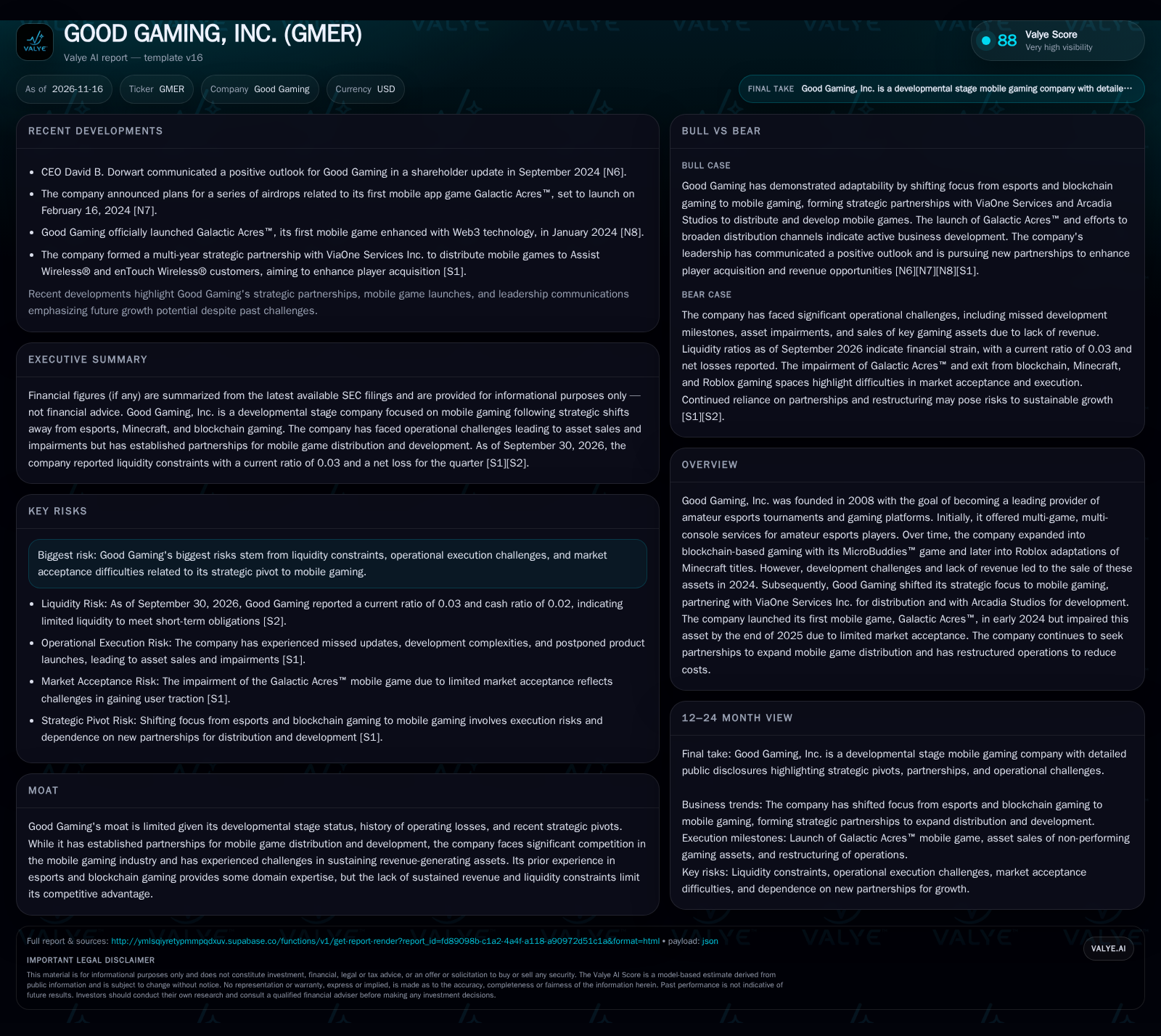
Its mobile game, Galactic Acres™, was impaired within a year of launch due to limited acceptance. The company’s future hinges on the success of new partnerships and its ability to execute in a capital-constrained environment. [S1] [S2]
Good Gaming, Inc.’s evolution from an amateur esports tournament platform to a mobile gaming hopeful underscores both the adaptability and the fragility of early-stage digital entertainment companies. After exiting its original markets due to operational and commercial headwinds, the company launched its first mobile game, Galactic Acres™, only to fully impair the asset within a year, reflecting the unforgiving nature of the mobile games market.
Recent Asset Sales, Impaired Launch, and Liquidity Strain Define the Operating Backdrop
Three facts frame Good Gaming’s current condition: First, the company exited its blockchain, Minecraft, and Roblox gaming segments in July 2024, selling all related assets after failing to generate revenue and maintain necessary development. Second, its flagship mobile game, Galactic Acres™, launched in early 2024, was fully impaired by December 2025 due to limited market acceptance, signaling a lack of traction in its latest pivot. The company reported cash and liquidity metrics for the period; these figures do not by themselves establish operating runway, investment capacity, financial flexibility, or financing capacity. [S1] [S2]
The impact of these asset sales and impairments extends beyond immediate financial metrics, influencing investor confidence and strategic flexibility. In development-stage companies like Good Gaming, the ability to pivot and adapt is often constrained by the depletion of capital and the erosion of stakeholder trust. The impairment of flagship products within a short timeframe can signal underlying challenges in product-market fit, development execution, or market timing, which may not be easily reversible without significant reinvestment or strategic realignment.
Revenue Prospects and Cost Realities in a Partnership-Driven Mobile Gaming Model
Good Gaming’s business model has shifted from direct-to-gamer platform operations to a partnership-led approach, focusing on mobile game development and distribution. Historically, the company struggled to convert development efforts into sustainable revenue—a pattern underscored by the rapid asset impairments and absence of meaningful sales from recent titles. The economics of mobile gaming at this scale tend to be binary: successful titles can generate outsized returns through in-app purchases, advertising, and licensing, but the vast majority fail to achieve break-even due to high user-acquisition costs and intense competition.
The company’s current partnership with ViaOne Services aims to leverage telecom channels for game distribution, potentially reducing customer acquisition costs and offering access to captive user bases. However, without evidence of recurring contracts, minimum guarantees, or revenue-sharing terms, the commercial mechanics and upside remain speculative. The recent workforce reduction and shift to consulting support further signal an emphasis on variable-cost structures, but also highlight the company’s limited internal capacity to drive development, marketing, and support autonomously. Capital needs remain acute, as even modest mobile gaming launches require ongoing investment in content, user acquisition, and live-ops support to compete effectively.
A critical factor in the viability of Good Gaming’s partnership-driven model is the alignment of incentives and risk-sharing mechanisms with its partners. Without minimum revenue guarantees or performance-based milestones, the company may bear disproportionate downside risk, especially if partners prioritize other titles or shift strategic focus. Additionally, the reliance on external consulting and reduced internal capabilities could hamper agile development cycles and rapid iteration, both essential in the fast-moving mobile gaming market. The cost structure shift towards variable expenses may preserve cash in the short term but could limit the company’s ability to build proprietary assets or develop competitive advantages that require sustained investment.
Navigating a Crowded Mobile Gaming Landscape Without a Defensible Moat
Good Gaming operates in one of the most saturated and competitive sectors of digital entertainment: mobile gaming. The company’s prior experience with esports and blockchain games provided limited transferable advantage, as evidenced by its struggle to retain users and monetize new titles. Its current distribution partnerships with telecom companies offer a potential channel edge, but such partnerships are non-exclusive and can be accessed by larger, better-resourced studios.
In the absence of proprietary IP, established brands, or unique technology, Good Gaming faces significant barriers to user acquisition, retention, and monetization. Established competitors—including both major mobile publishers and nimble indie studios—compete aggressively for player attention and wallet share, often backed by larger marketing budgets and deeper content libraries. Without evidence of network effects, high switching costs, or sticky engagement mechanics, Good Gaming’s position is highly vulnerable to both direct competition and platform policy changes.
In the absence of a defensible moat, Good Gaming’s ability to differentiate hinges on innovation in game design, user experience, or monetization strategies that resonate uniquely with target demographics. However, achieving such differentiation is capital-intensive and time-consuming, often requiring iterative testing and substantial marketing support. The mobile gaming market’s low barriers to entry paradoxically increase competition, as new entrants can rapidly emerge with novel concepts, further fragmenting user attention. Additionally, platform policies and algorithmic changes by app stores can unpredictably affect visibility and monetization, disproportionately impacting smaller players without diversified distribution channels or scale economies.
If Telecom Partnerships Drive User Adoption, Revenue Leverage Could Follow
A positive outcome for Good Gaming hinges on its ability to translate telecom distribution partnerships into meaningful user acquisition at reduced cost. If the company successfully launches new mobile games—potentially with exclusive or high-engagement IP—through carriers like Assist Wireless® and enTouch Wireless®, it could benefit from lower CAC, higher install rates, and improved monetization through in-app purchases or advertising.
Confirmation of this scenario would require evidence of: a) new titles launching with measurable user bases via telecom channels; b) recurring or growing revenue streams tied to these launches; and c) the establishment of additional partnerships with device manufacturers or other distribution partners. Signs of user retention, positive player feedback, or viral growth could further validate the company’s ability to break through the noise of the mobile app stores.
Most Likely Trajectory: Slow Progress, High Dependence on External Partners, Ongoing Capital Constraints
The most plausible scenario is one of incremental progress punctuated by continued financial strain. Good Gaming may secure additional distribution or development partners, launch new titles, or modestly improve player acquisition through telecom relationships. However, without a breakout hit or a structural improvement in commercial terms, revenues are likely to remain sporadic and insufficient to cover fixed costs, especially given the company’s reported cash balance and lack of demonstrated operating leverage.
Evidence supporting this scenario would include: modest but inconsistent revenue growth; continued asset impairments or small-scale launches; further restructuring or cost-cutting; and ongoing reliance on new partnerships for both development and distribution. Conversely, evidence of a major new revenue stream or a high-profile partnership with minimum guarantees could falsify this view.
Failure to Achieve Traction or Raise Capital Could Force Further Asset Sales or Wind-Down
The downside scenario features continued inability to generate meaningful revenue from new titles, further impairments, and failure to secure additional capital or strategic partners. Under this trajectory, Good Gaming could be forced to sell remaining assets, further reduce operations, or pursue a formal restructuring or wind-down if it cannot meet obligations or fund ongoing development.
Confirmation would come from additional asset sales, the absence of new product launches, deepening net losses, or explicit going concern warnings in future filings. A lack of partnership announcements, shrinking employee or consultant headcount, or delisting from public markets would also indicate mounting distress.
What Will Determine Whether Good Gaming’s Mobile Pivot Succeeds or Stalls
Quarterly disclosure of new mobile game launches, including download counts and active user metrics if disclosed, would help test whether new titles are gaining traction.
Evidence of recurring revenue streams, such as in-app purchases or advertising revenue generated from telecom-distributed games, would clarify the sustainability of the new model.
Details on the terms, duration, and exclusivity (if any) of telecom and device manufacturer partnerships would be instrumental in assessing channel leverage.
Any announcements regarding the acquisition or development of proprietary IP, or exclusive rights to popular franchises, would be a potential catalyst for improved competitive positioning.
Updates on workforce composition—particularly reliance on consultants versus internal staff—would signal the company’s operating capacity and cost structure flexibility.
If disclosed, user retention rates and average revenue per user (ARPU) for new titles would provide insight into the effectiveness of monetization and engagement strategies.
Any statements regarding possible capital raises, debt financing, or going concern risks would be critical for evaluating the company’s financial runway.
Disclaimer: This is research-only, informational analysis and not investment advice. It may include AI-generated interpretation and general industry context. Always verify important details using primary sources.

Comments