
Global Net Lease's Strategic Focus on Portfolio Diversification and Leverage Reduction Amid Market Challenges
Global Net Lease, Inc. operates a diversified global net lease real estate portfolio with a focus on long-term leases to creditworthy tenants across the U.S., Canada, and Europe.
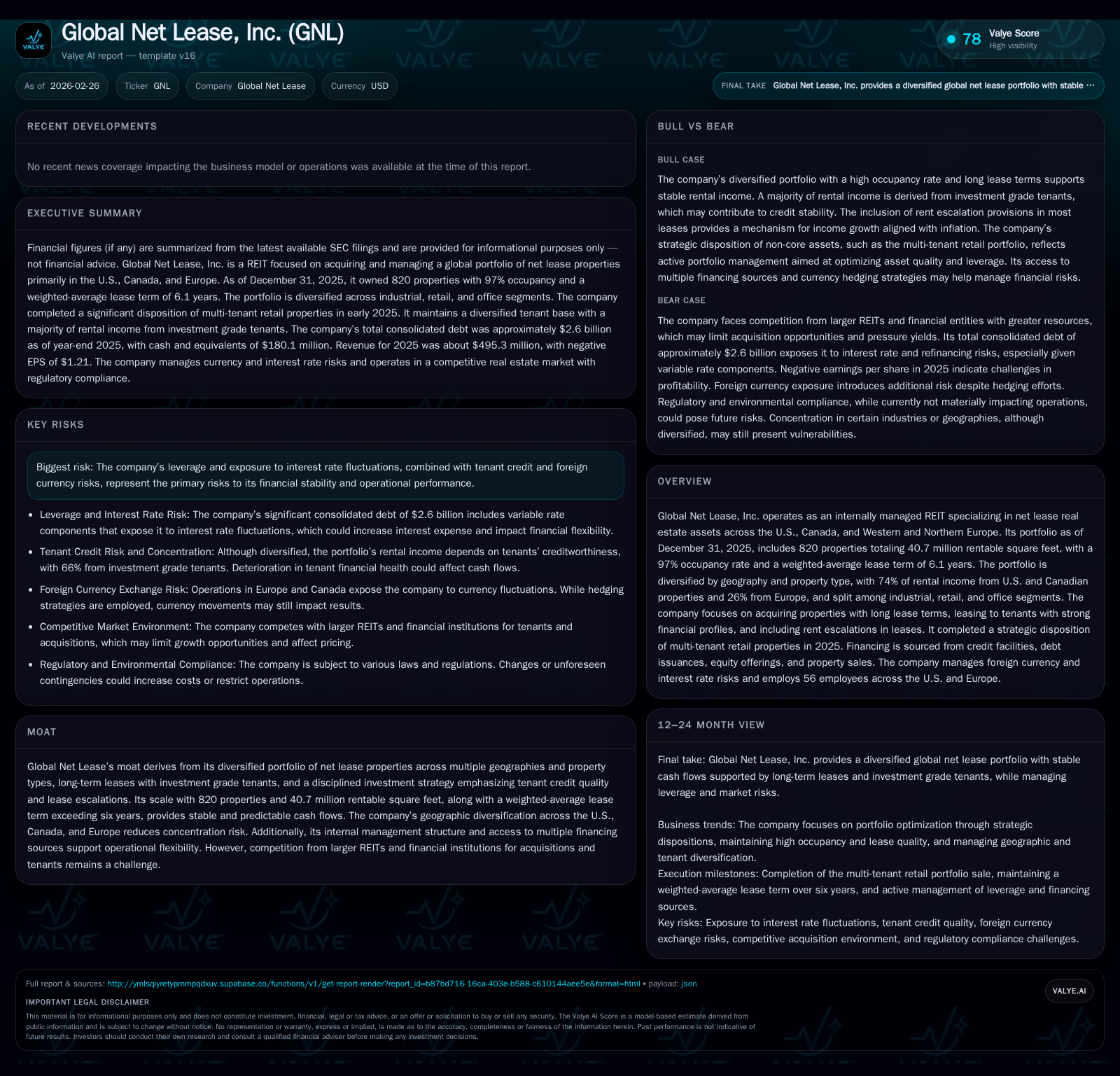
Global Net Lease (GNL) manages a sizable, geographically and sector-diversified net lease portfolio totaling 820 properties with a strong occupancy rate of 97% and weighted-average lease terms of 6.1 years. The firm’s historical growth has been shaped by acquisitions, internalization, and a strategic disposition of non-core assets such as multi-tenant retail properties in 2025, which have impacted revenue recognition. Going forward, GNL emphasizes tenant credit quality, geographic diversification, and active leverage management to sustain stable cash flows amid interest rate and currency risks. Capital allocation has included modest buybacks and regular dividends, with a cautious approach to refinancing given ongoing market uncertainties.
Company Overview
Global Net Lease, Inc. (GNL) operates as an internally managed real estate investment trust (REIT) specializing in net lease real estate assets spanning the United States, Canada, and Western/Northern Europe [S1],[S4]. As of December 31, 2025, the company owned 820 properties comprising approximately 40.7 million rentable square feet with a high occupancy rate of 97% [S1]. The weighted-average remaining lease term was stable at about 6.1 years [S1].
The company's portfolio is geographically diversified with about three-quarters located in North America (U.S. and Canada) and roughly one-quarter in Europe [S4]. Sector-wise, it comprises industrial & distribution properties (46%), retail (27%), and office space (27%), segmented by annualized straight-line rent including tenant concessions translated into USD [S4].
Historical Performance Drivers
GNL's revenue trend reflects significant operational shifts including acquisition activities such as the internalization merger dated September 12, 2023, and a strategic reduction of non-core assets highlighted by the disposal of a sizeable multi-tenant retail portfolio during the first half of 2025 [S1],[S4]. This disposition represented the sale of 99 properties to RCG Venture Holdings and is accounted for within discontinued operations [S1].
Financially, total revenue for fiscal year ending December 31, 2025 dropped sharply to approximately $495 million from $805 million in 2024—a decline driven largely by asset sales reducing recurring rental income streams [F1]. Operating income fell from $206 million in FY2024 to $111 million in FY2025 reflecting both reduced scale post-disposition and restructuring costs associated with portfolio optimization [F1]. Despite this contraction in earnings metrics, operating cash flow remained relatively strong at nearly $223 million underscoring solid underlying cash generation supported by long-term leases [F1].
The company's equity base contracted from around $2.19 billion in FY2024 to $1.66 billion by fiscal end 2025 correlating with asset sales that reduced net assets but helped deleverage balance sheet pressures [F1]. Buybacks increased significantly to approximately $120 million in FY2025 as part of capital return initiatives while dividend policy remained consistent within typical REIT payout ranges [F1],[S12].
Historical performance (annual)
| FY | Rev ($mm) | CFO ($mm) | OpInc ($mm) | Rev YoY |
|---|---|---|---|---|
| 2025 | 495 | 223 | 111 | -38.5% |
| 2024 | 805 | 299 | 206 | +56.3% |
| 2023 | 515 | 144 | -15 | +36.0% |
| 2022 | 379 | 182 | 101 |
Source: SEC companyfacts cache [F1].
Capital returns and efficiency (annual)
| FY | Buybacks ($mm) |
|---|---|
| 2025 | 120 |
| 2024 | 1 |
| 2023 | 1 |
| 2022 | 1 |
Source: SEC companyfacts cache [F1].
Note: Dividend amounts shown are qualitative; exact recent annual totals were not fully detailed.
Future Growth Prospects
Global Net Lease's growth strategy remains anchored on acquiring high-quality net lease assets with long-duration leases involving tenants possessing strong financial profiles—typically investment grade or implied investment grade credit ratings derived from proprietary analytics employing Moody’s Analytics tools [S4],[S9]. The company also pursues contractual rent escalations generally averaging cumulative increases near 1.4% per year embedded within lease agreements providing built-in inflation protection [S7],[S9].
Geographic diversification continues to be a focal point—balancing exposure across North American stable markets while maintaining selective presence in Europe where sovereign risk ratings are strong [S4],[S9]. This diversification mitigates concentration risks tied to economic cycles or regulatory environments differing by country.
Opportunistic dispositions targeting non-core or lower-yielding assets are likely to persist as management prioritizes leverage reduction amid volatile interest rates impacting refinancing costs [S4],[S7],[N2]. Enhanced underwriting discipline aims to improve portfolio quality even if acquisition volumes moderate due to competitive pressures from larger REITs or capital-rich financial institutions seeking similar assets [S13],[S14].
The company’s ability to navigate future interest rate fluctuations is somewhat supported through hedging strategies—interest rate swaps fix approximately four-fifths of foreign mortgage debt interest costs while managing variable exposures via derivative instruments [S14],[S17]. Currency hedging also serves as a partial offset against fluctuations in EUR, GBP, and CAD that affect European and Canadian assets denominated in local currencies but reported in USD functional currency [S8],[S17].
Attrition risk exists given some tenant industries may face disruption; however GNL asserts no single industry accounts for more than 10% of annualized rental income enhancing resilience against sector-specific downturns [S9]. Monitoring tenant credit quality remains ongoing leveraging Moody’s Analytics forecasts.
Forecasts / Milestones / Expectations
The explicit guidance or forecast metrics for upcoming periods have not been publicly disclosed beyond current strategic objectives emphasizing continued deleveraging and acquiring long-duration leased properties with creditworthy tenants [N2],[S1],[S4]. Forward-looking statements denote dependency on market conditions influencing acquisition or disposition timing plus capital availability constraints affecting refinancing initiatives [S15],[S16]. External economic factors such as rising interest rates or currency volatility remain critical watchpoints affecting forecasted earnings volatility.
Investors should watch for updates on quarterly leasing spreads (new leases vs expirations), further asset sales particularly non-core holdings reshaping portfolio composition, changes in debt maturity profiles through refinancing transactions scheduled within the next five years ($606 million principal due cumulatively between now and then), along with disclosure regarding tenant credit performance trends post-pandemic recovery cycles [S10],[S17],[N2].
Returns / Capital Allocation
While detailed ROE specifics are unavailable directly due to the nature of REIT accounting intricacies, an approximate return on equity can be inferred using available fiscal year-end numbers: net income compared to total equity signals around a modest ~2.8% ROE for fiscal year ending December 31, 2025—this modest figure reflects depressed net income levels partially attributable to transitional dynamics including asset dispositions influencing GAAP profitability metrics [F1].
Despite recent operational contractions impacting reported earnings, operating cash flows provide strong liquidity support at $223 million enabling steady dividends alongside opportunistic share repurchases totaling $120 million in FY2025 versus minimal buybacks previously reflecting disciplined capital management responsive to balance sheet health priorities [F1],[S12],[S26]. Dividend declarations continue aligned with REIT payout mandates; a press release dated January 2, 2026 affirmed a common stock dividend payment reflective of ongoing free cash flow distribution capacity toward shareholders [N2],[S26].
Debt profile management involves balancing fixed-rate mortgage notes—with annual interest rates ranging from low-to-mid single digits—and variable-rate borrowings mitigated via swap agreements to insulate against steep cost variability should benchmark rates rise further [S14],[S7]. Refinancing strategies will critically influence interest expenses going forward; fixed-to-variable composition averages approximate a two-thirds preference toward fixed or economically fixed rates via derivatives reducing exposure volatility.
Competitive Positioning & Moat Analysis
GNL’s moat revolves around its broad geographic scope combined with diversified asset class exposure balancing industrial/logistics growth trends against traditional retail-office holdings undergoing structural adjustment post-pandemic disruptions [S1],[S13]. High occupancy rates (~97%) coupled with long weighted-average lease durations position the company effectively toward predictable cash flow generation—a pillar many net lease-focused REITs emphasize.
The reliance on investment-grade tenants fortifies credit risk management reducing probability-weighted default exposure relative to peers focusing on lower-tier tenants or shorter lease structures less resilient during downturns [S9]. Industrial property segment strength aligns well with global e-commerce logistical needs—notably robust demand drivers for distribution centers—offsetting some office/retail cyclicality inherent within commercial real estate portfolios.
Nonetheless competition is fierce; larger REIT players benefit from heftier capital bases enabling quicker bidding or acceptance of suboptimal yields whereas smaller entities may lack scale advantages making asset sourcing more fragmented [S13]. In this environment GNL’s internal management framework yielding nimble decision-making combined with multi-faceted financing access—credit facilities, unsecured notes issuance channels, public equity offerings—affords some flexibility tackling valuation hurdles.
Risks Summary
Key risks center around leveraged debt exposure impacted substantially by interest rate volatility creating uncertainty over interest expense burdens particularly on unhedged variable-rate debt components potentially altering profitability significantly per each percentage point rate movement [$480M annual interest adjustment estimate per +/–1% change] [S14]. Foreign currency exchange fluctuations introduce translation risk despite hedge programs currently holding minimal residual exposure beyond net investment hedge scope [S8,S17]. Tenant credit deterioration especially outside investment-grade profiles could reduce rental collections impacting cash flows even if currently limited concentration exists among major industries/tenants [S9,S6]. Regulatory environment risks related mostly to environmental compliance costs appear contained presently but remain unpredictable variables requiring ongoing monitoring especially across multiple jurisdictions spanning continents.
Conclusion
Global Net Lease presents as a mature global net lease platform characterized by disciplined underwriting standards targeting long-dated leases backed principally by creditworthy tenants across diverse geographies encompassing North America and Europe. The transformation initiated through significant asset dispositions notably the multi-tenant retail sale completed mid-2025 caused sharp visible impacts on top line revenue growth trajectories but aligned with stated objectives seeking safer cash flow streams while addressing balance sheet leverage.
Going forward success hinges on sustaining leasing momentum amid evolving market conditions including post-pandemic workspace usage trends coupled with effectively managing financing cost risks tied to interest rate movements alongside mitigating foreign currency fluctuations arising from international property holdings. Management's engagement in buybacks alongside consistent dividend payments demonstrates stewardship aimed at returning capital within REIT structural norms restraining rapid growth impulses but favoring stability.
Watching key milestones involving refinancing outcomes ahead plus leasing results will shed light on GNL’s capacity not only to maintain current income stability but potentially reaccelerate accretive investments enhancing shareholder value over time despite competitive pressures prevalent within the global net lease arena.
Disclaimer: This report is for informational purposes only and does not constitute investment advice or recommendations.
Disclaimer: This is research-only, informational analysis and not investment advice. It may include AI-generated interpretation and general industry context. Always verify important details using primary sources.

Comments