
Gossamer Bio’s Clinical Momentum Meets Financial Strain: Assessing Seralutinib’s Journey and Capital Outlook
Seralutinib’s near-term regulatory path and collaboration terms shape Gossamer Bio’s growth prospects amid mounting operating losses and financing needs.
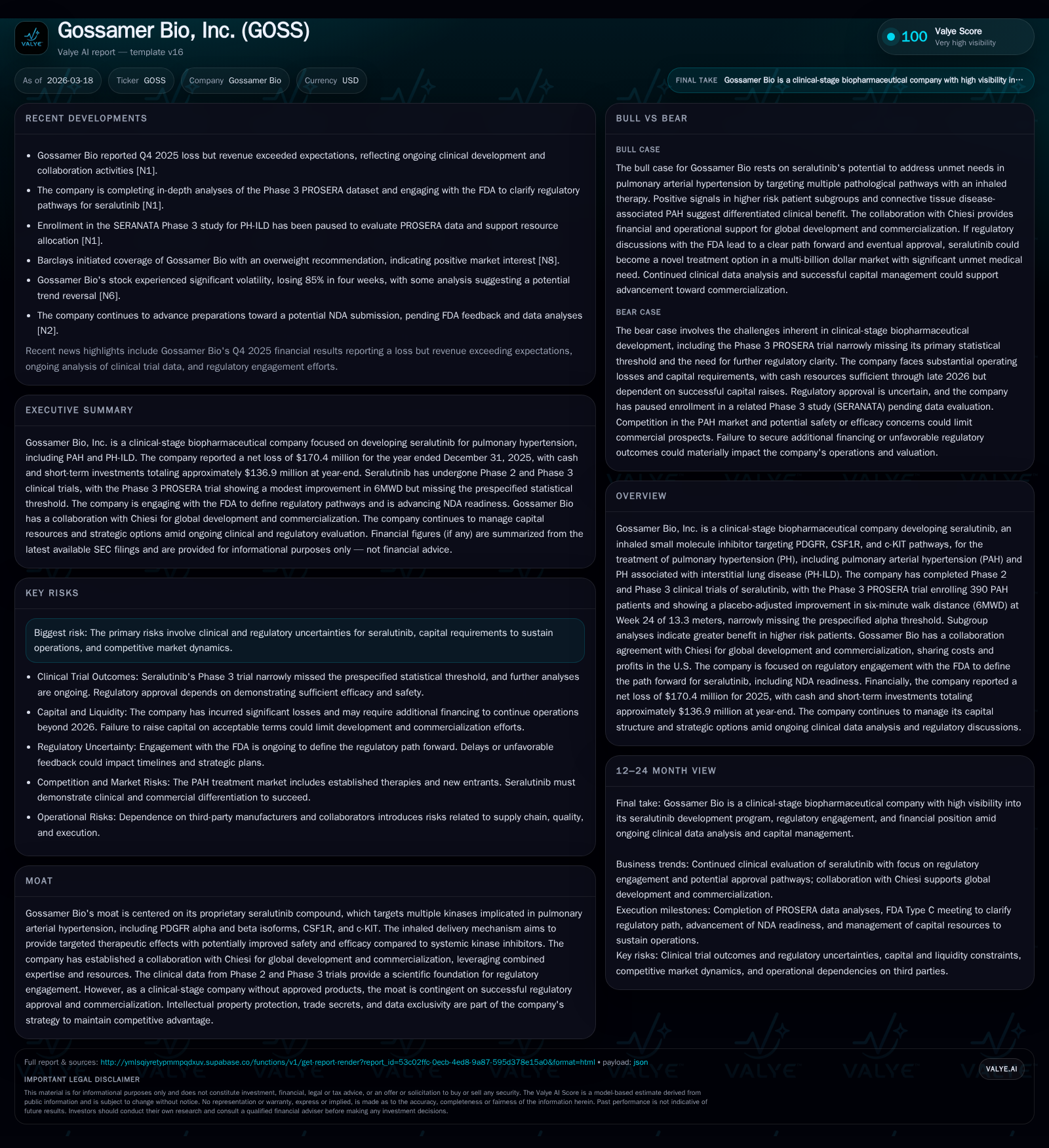
Gossamer Bio advances its inhaled kinase inhibitor seralutinib through pivotal Phase 3 data for pulmonary hypertension, showing clinically meaningful albeit narrowly missed statistical endpoints. The company’s strategic alliance with Chiesi mitigates development costs while sharing commercialization profits in the U.S. However, escalating R&D expenses deepen operating deficits, challenging cash reserves despite sizeable past equity raises and convertible note issuance. Near-term outcomes hinge on FDA interactions and seralutinib’s regulatory approval prospects, balanced against substantial capital requirements and intrinsic industry risks.
Clinical Progress Shaping Gossamer's Growth Trajectory
Gossamer Bio anchors its pipeline around seralutinib, an inhaled small molecule kinase inhibitor targeting PDGFR isoforms (alpha/beta), CSF1R, and c-KIT pathways implicated in pulmonary arterial hypertension (PAH). The inhaled delivery concentrates drug effect within pulmonary tissue while minimizing systemic exposure to improve safety and efficacy compared to systemic kinase inhibitors.
The PROSERA Phase 3 trial enrolled approximately 390 PAH patients to assess efficacy using the six-minute walk distance (6MWD) endpoint at 24 weeks. Results indicated a placebo-adjusted average improvement of 13.3 meters; however, this narrowly missed the statistically prespecified alpha threshold for primary endpoint significance [N1][S1]. Subgroup analyses revealed greater benefit among higher risk patients, pointing toward potentially definable responder segments critical in PAH drug development where heterogeneous patient responses can mask subgroup efficacy signals.
This clinical milestone positions seralutinib as a differentiated candidate; however, regulatory endorsement depends heavily on the interpretation of the narrowly missed endpoint alongside supportive subgroup findings.
Financial Performance Review: Losses Amid Advancing Trials
Gossamer has experienced significantly increasing operating losses paralleling its intensive R&D initiatives. In FY2025, the company reported an operating loss of approximately $171.7 million—nearly triple the prior year’s deficit (-$59.9 million in FY2024) [F1]. Net losses followed a similar steep trajectory reaching about -$170.4 million in FY2025.
Operating cash flow deteriorated markedly from -$3.5 million in FY2024 to -$171.3 million in FY2025, reflecting escalated spend on clinical development activities including global trials beyond PROSERA. Capital expenditures remained minimal ($79 thousand), consistent with clinical-stage companies focusing on research rather than asset-heavy investments.
These financial dynamics highlight strain typical for biopharmaceutical ventures nearing commercialization yet still pre-revenue.
Historical performance (annual)
| FY | Net ($mm) | CFO ($mm) | OpInc ($mm) | Capex ($) | Net YoY |
|---|---|---|---|---|---|
| 2025 | -170 | -171 | -171 | 79000 | -201.4% |
| 2024 | -57 | -3 | -60 | 0 | +68.6% |
| 2023 | -180 | -159 | -184 | 0 | +21.6% |
| 2022 | -229 | -187 | -219 | 410000 |
Source: SEC companyfacts cache [F1].
Capital returns and efficiency (annual)
| FY | FCF ($mm) | ROE% |
|---|---|---|
| 2025 | -171 | 138.8 |
| 2024 | -3 | -191.7 |
| 2023 | -159 | -286.5 |
| 2022 | -187 | -1899.3 |
Source: SEC companyfacts cache [F1].
Despite intensifying losses impacting shareholder equity—which turned negative to about -$123 million by end-2025—these financial commitments underscore Gossamer's dedication to advancing seralutinib's clinical program [F1].
Seralutinib’s Regulatory Path and Key Upcoming Milestones
Following PROSERA results that narrowly missed predefined statistical thresholds yet showed suggestive subgroup advantages, Gossamer’s engagement with FDA is pivotal. The regulator will weigh whether the totality of evidence—including subgroup data—justifies approval or warrants further investigation [N1][S1].
Regulatory pathways for pulmonary hypertension drugs emphasize robust functional endpoints like 6MWD along with acceptable safety profiles. Missing the prespecified alpha value complicates standard approval frameworks but is not uncommon in specialty indications with complex pathophysiology; regulators may consider adaptive approaches or require post-marketing confirmatory studies.
Upcoming milestones include planned FDA meetings expected to clarify necessary additional data or confirm endpoints acceptable for potential approval. These interactions will frame launch timelines significantly—delays or requests for further trials could extend time-to-market whilst early approval decisions could accelerate revenue generation pathways.
Capital Structure and Liquidity Position
As of December 31, 2025 Gossamer held approximately $37.7 million in cash and equivalents [F1][S1], a runway bolstered by collaboration receipts and prior capital raises but pressured by high burn rates exceeding $170 million annually.
The company’s funding history includes a $200 million convertible senior note issuance due in 2027 carrying a fixed coupon rate of 5%, alongside multiple equity private placements cumulatively raising several hundred million dollars over recent years [S1][F1]. Cash inflows were further augmented by an upfront nonrefundable payment of $160 million from Chiesi under their collaboration agreement signed in May 2024.
Despite these capital infusions mitigating immediate liquidity risk and enabling sustained clinical investment, shareholder returns remain constrained by persistent net losses expanding accumulated deficit levels well beyond initial equity capital contributions leading to negative book equity by FY2025 [F1].
At present no dividends or share buybacks have been declared although management retains flexibility through Rule 10b5-1 plans enabling opportunistic repurchases subject to evolving market conditions [S1].
Collaboration with Chiesi: Cost Sharing and Commercial Strategy
In May 2024 Gossamer entered a strategic partnership with Chiesi Farmaceutici S.p.A., under which Chiesi made an upfront payment of $160 million as reimbursement for development expenses related to seralutinib [S1]. Beyond initial proceeds, the companies share equally ongoing global development costs excluding the PROSERA Phase 3 trial already underway. This partnership divides commercialization responsibilities with Chiesi holding exclusive rights outside the United States while sharing U.S. profits equally alongside co-funded commercialization costs.
This arrangement reduces solo financial exposure risks for Gossamer while embedding commercial expertise particularly valuable against entrenched competitors in pulmonary hypertension therapeutics. Such licensing deals offering cost/profit sharing arrangements have become an established industry norm facilitating resource allocation between innovative biotech developers and multinational pharma partners capable of launching specialized therapies globally.
The collaboration offsets part of Gossamer's otherwise high cash burn associated with comprehensive late-stage trials and preparations for market entry.
Risks from Clinical Outcomes and Financing Needs
Key risks facing Gossamer Bio reflect inherent challenges common to clinical-stage biopharmaceutical companies:
- Regulatory outcome for seralutinib remains uncertain given PROSERA trial failure to reach primary statistical significance despite meaningful functional gains; ongoing FDA dialogue is critical but unpredictable [S4][N1].
- Continued net losses contribute to accumulating deficits; future operations will require substantial additional financing possibly dilutive to existing shareholders or increasing leverage [F1][S23].
- Patient enrollment complexities during trials or further delays could affect timelines adding financial strain and prolonging time without revenue streams [S4].
- Pharmaceutical pricing pressures domestically and abroad introduce reimbursement uncertainties impacting projected margins post-launch [S15][S20].
- Competitive dynamics within pulmonary hypertension therapy space are intense including existing multi-agent regimens limiting new entrants' market penetration potential.
- Compliance burdens related to healthcare laws—anti-kickback statutes, data privacy regulations like GDPR—and international trade controls pose ongoing operational challenges [S6][S24][S25].
- Recent significant stock price volatility including share declines exceeding eighty-five percent over short periods reflects investor apprehension; potential buy-the-bottom narratives carry high risk given opaque near-term catalysts [N7][N8].
Navigating these multiple dimensions requires vigilant capital allocation, timely operational execution, and sustained clinical validation efforts before achieving transformative commercial success.
This analysis synthesizes publicly filed financial disclosures and recent market developments without providing investment recommendations or price forecasts. Investors should consider additional sources when evaluating Gossamer Bio's corporate prospects.
Disclaimer: This is research-only, informational analysis and not investment advice. It may include AI-generated interpretation and general industry context. Always verify important details using primary sources.

Comments