
GridAI Technologies Focuses on AI Data Center Energy Orchestration Amid Early Commercial Challenges
GridAI continues to develop its AI-optimized energy orchestration platform while managing legacy biopharma and navigating competitive, regulatory, and liquidity constraints.
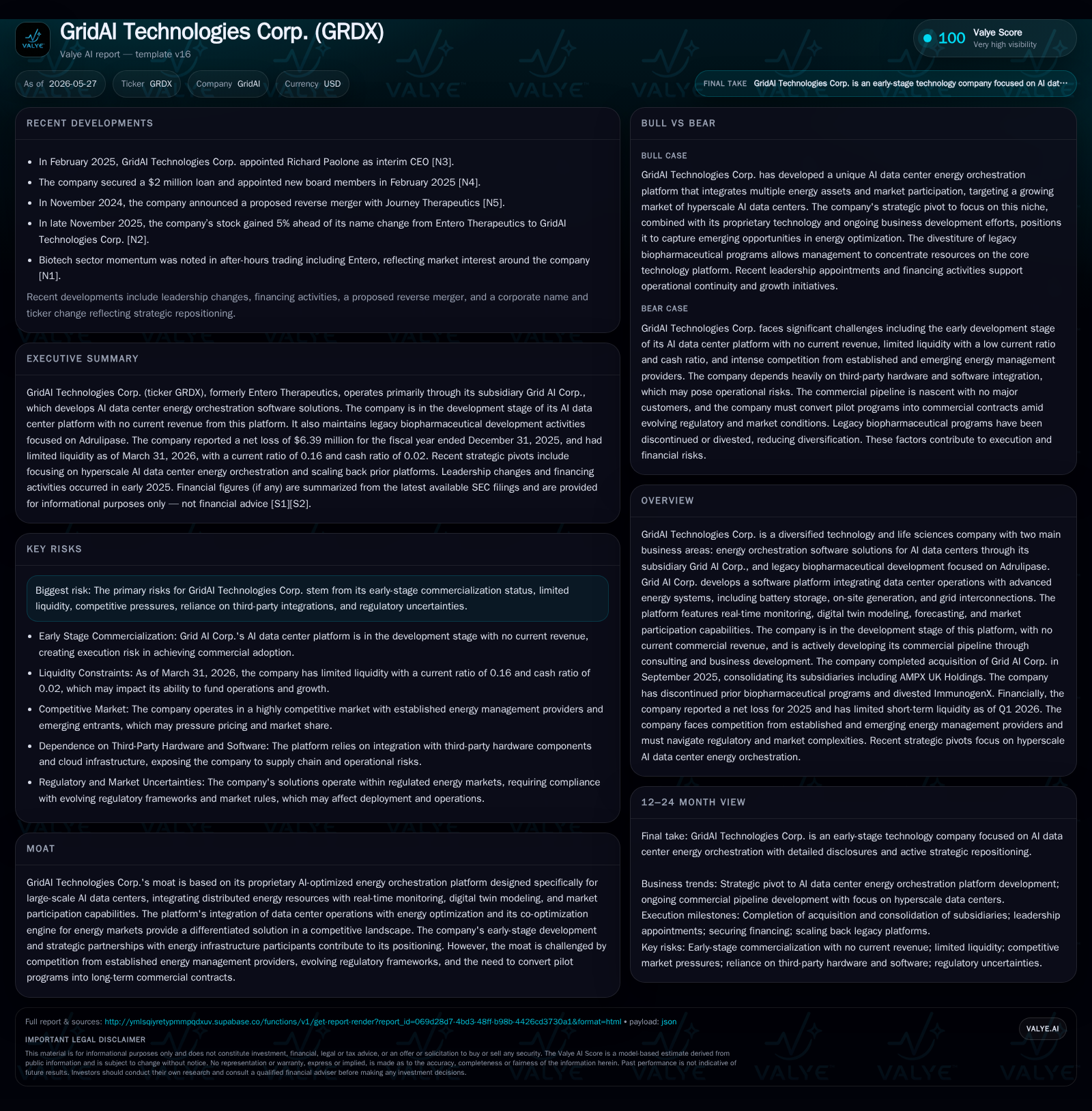
Following its strategic pivot in 2025, GridAI Technologies Corp. (GRDX) has concentrated efforts on its subsidiary Grid AI Corp.'s innovative software platform targeting hyperscale AI data centers. The platform integrates distributed energy assets with real-time orchestration and market participation capabilities but remains at an early stage without commercial revenue. GridAI's business model hinges on future platform fees and performance-based contracts. While the underlying technology is distinctive within a fragmented competitive landscape, execution risks include converting pilots into contracts amid regulatory complexity and limited liquidity. Legacy biopharmaceutical activities persist but are largely non-core.
Recent Operating Update: Strategic Pivot Anchors Near-Term Priorities
GridAI Technologies Corp.'s latest quarterly filing dated May 27, 2026 ([S2]) reiterates the company’s early-stage commercialization status following its significant transition in late 2025 post-acquisition of Grid AI Corp. The latest operational disclosure affirms that while the subsidiary’s AI-optimized energy orchestration platform remains under active development with no current commercial revenue or binding contracts, management focus sharpens on converting pilot programs into scalable deployments. This evolving dynamic underscores the deterministic importance of sales pipeline progression along with successful customer integrations as immediate catalysts.
Historically biopharmaceutical-focused as Entero Therapeutics until rebranding effective December 2025 ([S8]), GridAI has repositioned entirely toward technology-driven solutions targeting hyperscale AI data centers through intelligent integration of distributed energy resources (DERs). The strategic pivot involved substantial operational restructuring including significant reductions in headcount and a scale-back of prior software projects (DLS and ALICE platforms), reflecting sharpened capital discipline.
Business Model: Dual Legacy but Singular Focus on Energy Orchestration
The company's operating architecture currently comprises two distinct businesses: the emerging Grid AI Corp. segment developing a sophisticated AI data center energy orchestration software suite, and legacy biologics development centered on Adrulipase—a recombinant lipase treatment for exocrine pancreatic insufficiency ([S14], [S21]). Nonetheless, the primary strategic emphasis and projected revenue engine reside in the former.
Grid AI Corp.'s business model revolves around monetizing its proprietary platform through recurring base fees tied to operational visibility/services combined with performance-based fees that capture value from cost optimizations in power markets ([S25]). This model depends heavily on securing long-term contracts with hyperscale cloud providers (“hyperscalers”), large enterprise governments running extensive data center campuses requiring massive power draws, and strategic partnerships with energy infrastructure companies such as battery storage integrators.
Revenue mechanics are volume-and-price sensitive: fees scale by number of managed assets/sites and contractual performance incentives linked to realized savings or market revenues from grid participation. Customer retention will depend on consistent system reliability, demonstrated cost benefits via real-time optimization, and seamless integration with third-party hardware/systems across site-level assets (batteries, engines, substations) ([S20], [S25]).
Industry Structure and Competitive Position
The emerging ecosystem of energy management for hyperscale AI data centers straddles software platforms dedicated to distributed energy resource optimization, virtual power plant operators (VPPs), integrated hardware-software energy service providers, utilities expanding into DER management, engineering consultancies offering bespoke solutions, and internal customer-developed systems among hyperscalers themselves ([S20]).
GridAI stands apart by its design philosophy: it seeks to fuse comprehensive data center asset orchestration (power & cooling infrastructure) directly with DER management under an AI-driven co-optimization framework capable of participating dynamically across multiple wholesale energy markets (day-ahead/spots/reserves), while prioritizing uninterrupted operation ([S25], [S20]). This breadth goes beyond discrete offerings available from more piecemeal competitors.
Yet this moat is nascent: GridAI's fully integrated solution remains unproven commercially; pilot deployments such as those attempted in Australia yielded minimal commercial traction ([S16]). Entrenched incumbents benefit from deep customer relationships, proven products controlling specific layers of the value chain (software-only or hardware-integrated), scale efficiencies, regulatory expertise across multi-jurisdictional markets, and broad service portfolios ([S20]). Customer hesitancy over replacing existing stable systems introduces adoption friction that GridAI plans to counteract by targeting geographies/use cases allowing faster uptake based on local regulatory incentives or demand profiles ([S19], [S16]).
Growth Drivers
Development Stage but Significant Market Opportunity
GridAI targets a structural growth vector rooted in accelerating global investment in hyperscale AI infrastructure—data centers consuming vast quantities of electricity increasingly face pressure to integrate sustainable DERs such as onsite solar/battery storage to reduce costs and carbon footprints. The criticality of optimized orchestration software that dynamically manages complex site-level assets alongside real-time market conditions should increase accordingly.
Product Innovation with Digital Twin & Market Participation Capabilities
The platform's proprietary digital twin modeling enables scenario simulations underpinning optimized dispatch decisions. Coupled with load/generation forecasting engines feeding a co-optimization control layer interfacing directly with wholesale markets ([S25]), this technological sophistication could provide durable differentiation enabling customers to unlock latent DER economics.
Expanding Pipeline Through Consulting & Partnerships
While lacking contracting scale presently ([S11]), GridAI has revived its commercial pipeline via consulting-led engagements focusing on BESS vendors like Mango Power and Nomad Transportable Power Systems—players pivotal in deploying battery assets within targeted markets ([S16], [S11]). Success here would build track record credibility vital for scaling sales to hyperscalers who require demonstrable outcomes before commitment.
Geographic Prioritization & Regulatory Favorability
Regional market conditions vary widely; focusing sales efforts on areas like North America where incentives for battery storage optimization exist could shorten sales cycles. Regulatory stability around DER integration and market participation frameworks critically influence adoption pace ([S22]).
Risks / Watchpoints / Growth Constraints
Execution Risk in Pilots to Commercial Contracts Transition
The company faces typical development-stage risk wherein technological validation must translate into signed multi-year contracts generating recognized revenue. Extended sales cycles common in energy infrastructure exacerbate this challenge ([S2], [S16]). Customer inertia around incumbent systems forms an intrinsic barrier.
Competitive Pressures and Market Fragmentation
Established vendors backed by financial scale pose pricing pressure risks. Additionally, customers' option to build internal solutions or partner elsewhere dilutes market share potential. Continuous innovation investments will be needed to maintain relevance ([S20]).
Regulatory Complexity & Approval Dependencies
Complexity arises as platforms operate within heterogeneous regulated markets requiring permits, interconnection agreements, compliance certification—which may fall variably on customers/partners but affect timing/profitability indirectly for GridAI’s deployments ([S22]). Shifts in these rules or delays could impair commercial progress.
Liquidity Constraints Amid High Liability Profile
As of Q1 2026 end-date, GridAI holds approximately $386k in cash and equivalents against current liabilities of over $16 million, resulting in a current ratio near 0.16, which indicates significant near-term liquidity pressure ([F1]). The original revolving loan matured January 31, 2026 per public disclosures; details on refinancing or liquidity arrangements have not been disclosed ([S3]).
Limited Revenue Base & Customer Concentration Risks Currently Absent but Potentially Material If Customers Emerge Soon ([S11],[S16])
What to Watch Next
- Progression from consulting-led engagements to binding contracts specifying subscription revenue timelines for the AI data center platform.
- Demonstrations/pilots reaching operational readiness milestones indicating scalability potential.
- Updates regarding liquidity arrangements or refinancing addressing current cash shortfalls relative to near-term liabilities.
- Regulatory advancements or approvals facilitating smoother market participation pathways for clients.
- Announcements of any new strategic partnerships expanding distribution or integration footprint.
- Developments in Adrulipase clinical trials or licensing that may affect legacy operations though likely peripheral to GridAI’s core tech pivot.
Brief Financial Overview
This analysis summarizes publicly filed documents as of May 27th, 2026 concerning GridAI Technologies Corp. It reflects operating realities without investment research views or price valuation insights.
Disclaimer: This is research-only, informational analysis and not investment advice. It may include AI-generated interpretation and general industry context. Always verify important details using primary sources.

Comments