
GridAI Technologies: Commercialization Delays, Liquidity Pressure, and the Challenge of Biotech Execution
The company's future pivots on converting technology assets into viable contracts amid sector volatility and capital scarcity.
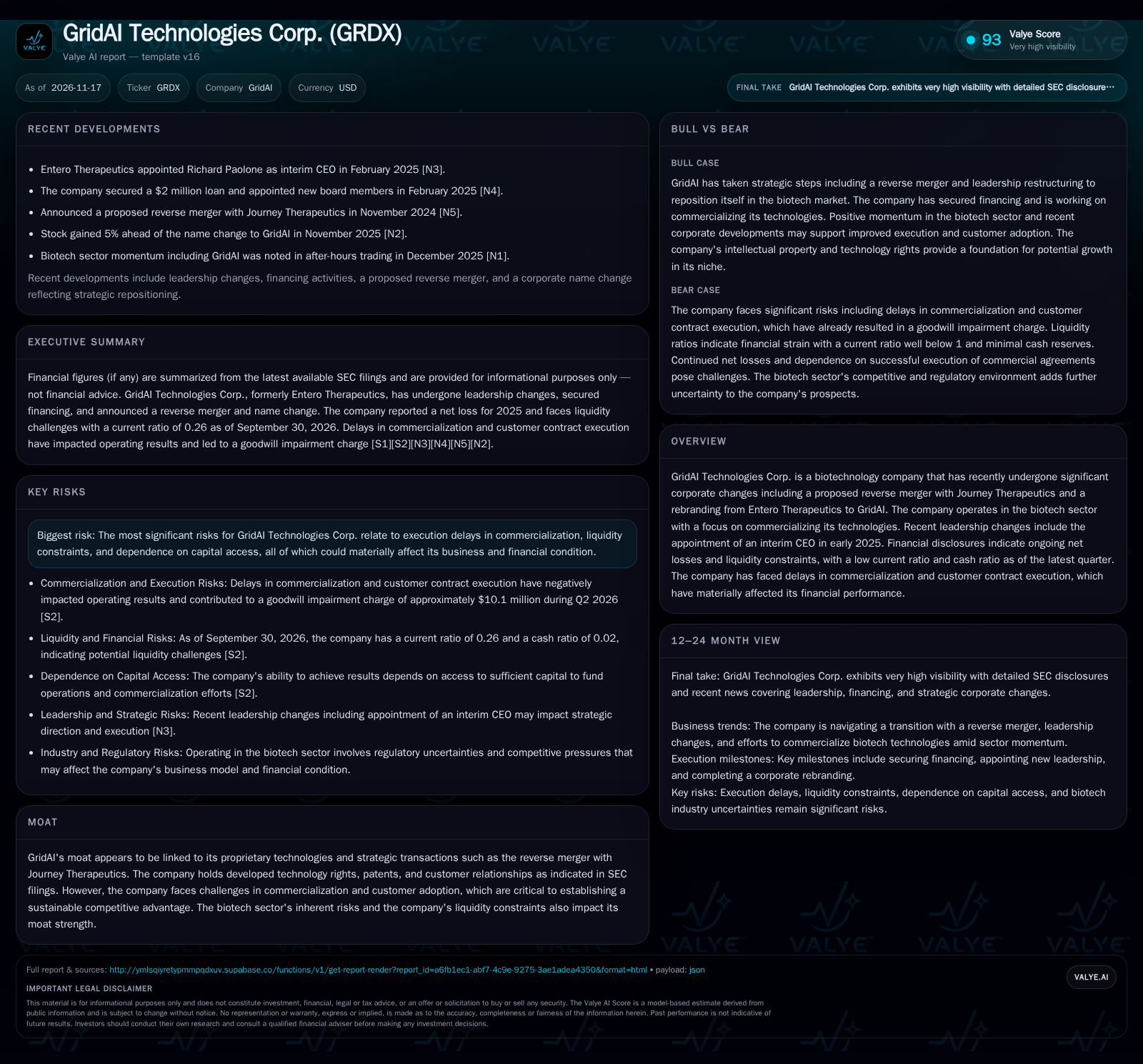
GridAI Technologies Corp. The company’s prospects depend on its ability to secure capital, accelerate contract signings, and achieve customer adoption in a competitive biotech landscape with uncertain regulatory dynamics. [S2]
GridAI Technologies Corp., the biotech company formerly known as Entero Therapeutics, finds itself at a critical inflection point following a strategic rebrand and leadership overhaul in late 2025. [S2]
Liquidity Strain and Commercialization Setbacks Define the Present
The company reported cash and liquidity metrics for the period; these figures do not by themselves establish operating runway, investment capacity, financial flexibility, or financing capacity. The company’s net loss for 2025 stood at $6.55 million, and negative earnings per share persisted into Q3 2026. Critically, GridAI incurred a $10.1 million goodwill impairment in Q2 2026, directly tied to delays in executing commercial contracts and launching products. These facts underscore the company’s acute liquidity challenges and the operational impact of failing to translate its biotech assets into commercial success. [S1] [S2]
For instance, understanding the timing and predictability of cash inflows from any existing contracts or grants, as well as the cadence of cash outflows related to R&D milestones, supplier payments, and payroll, could clarify the immediacy of liquidity pressures. Additionally, the company’s ability to optimize working capital—such as accelerating receivables collection or extending payables without damaging supplier relationships—would influence its short-term survival prospects. If GridAI’s cash conversion cycle is elongated due to commercialization delays, this would exacerbate liquidity strain and limit potential financial flexibility.
How GridAI’s Model Could Convert Technology into Cash Flow
GridAI’s business economics likely revolve around developing proprietary biotech solutions and monetizing them through licensing, technology transfer, or direct sales to healthcare or research organizations. In theory, successful commercialization would bring high-margin revenue streams once fixed R&D and regulatory costs are absorbed. However, the company’s current inability to secure customer contracts suggests that fixed overhead—such as ongoing research, regulatory compliance, and administrative expenses—remains high relative to incoming cash. This creates negative operating leverage: as revenue delays persist, each dollar of fixed cost weighs more heavily on net results.
Capital requirements are significant in biotech, especially for companies without recurring revenue or established commercialization channels. GridAI’s acute liquidity strain means it may face unfavorable terms if seeking bridge financing or equity dilution to fund ongoing operations. Without near-term contract wins or licensing deals, the risk of further impairments or operational cutbacks rises. If the company can secure even a single material contract, the economics could shift rapidly due to potential high gross margins typical in successful biotech platforms, but until then, cash burn and capital scarcity dominate the business equation.
The pathway from technology development to sustainable cash flow in biotech typically involves multiple sequential value inflection points, including successful clinical validation, regulatory approval, and market adoption. Each stage carries distinct cost structures and risk profiles that impact the economics. For GridAI, the absence of recurring revenue or a diversified product portfolio increases dependency on singular contract wins or licensing deals to achieve positive operating leverage. Moreover, the company’s fixed cost base—comprising regulatory compliance, quality assurance, and specialized personnel—may not scale down easily in the short term, limiting cost flexibility. If GridAI cannot demonstrate a clear path to scalable revenue, its capital providers may demand higher risk premiums or impose restrictive covenants, further constraining operational freedom.
Assessing Moat, Sector Headwinds, and Biotech Substitution Risks
GridAI’s competitive position is built on its technology rights, patents, and existing customer relationships, but these assets have yet to yield sustainable revenue streams. The biotech sector is characterized by intense competition, with many firms racing to commercialize similar technologies or targeting overlapping indications. Larger, better-capitalized peers often have established regulatory pathways, scale advantages, and deeper commercial networks, making it harder for GridAI to win contracts or secure licensing deals.
Switching costs for customers in biotech can be high due to regulatory approvals and integration into clinical workflows; however, these frictions only benefit GridAI if it can establish itself as a supplier of record. Given current delays, the risk is that potential customers may opt for more mature, de-risked alternatives, or that substitute technologies could leapfrog GridAI’s offerings before it achieves meaningful adoption. The company’s ability to defend its intellectual property and demonstrate clear clinical or economic advantages will be critical to building a moat in this environment.
In evaluating GridAI’s competitive moat, it is important to consider the durability and enforceability of its intellectual property portfolio under evolving regulatory and technological landscapes. Patent lifecycles, potential challenges from generics or biosimilars, and the pace of scientific innovation can rapidly alter competitive dynamics. Furthermore, the company’s ability to establish strategic partnerships or co-development agreements could mitigate some competitive disadvantages by leveraging external resources and market access. However, such collaborations often require upfront concessions or revenue sharing, which may dilute long-term margins. The risk of substitution is heightened if alternative modalities or platforms demonstrate superior efficacy, safety, or cost-effectiveness, underscoring the need for GridAI to continuously innovate and validate its value proposition to customers.
What Would It Take for GridAI to Reverse Course and Unlock Value?
A favorable scenario for GridAI hinges on the company rapidly securing one or more commercial agreements—either through direct sales, licensing, or partnerships—that validate its technology and provide recurring or milestone-based revenues. This would likely require demonstrating clinical efficacy, regulatory progress, or tangible cost savings for potential customers. If GridAI can close a flagship contract, it could unlock operating leverage by spreading fixed costs over a growing revenue base, improve its negotiating position for future deals, and potentially attract new investment on better terms.
Evidence confirming this scenario would include public announcements of significant customer wins, non-dilutive funding tied to commercial milestones, or positive regulatory developments that de-risk the company’s pipeline. Accelerating cash receipts and a reversal of recent impairment charges would further validate a turnaround.
Realistic Outlook: Prolonged Cash Burn and Incremental Progress
The most plausible short- to medium-term outcome is that GridAI continues to struggle with cash burn and faces incremental, rather than transformative, progress. The company may secure small-scale pilot contracts or research collaborations, but these are unlikely to cover fixed costs or materially improve liquidity in the near term. Management may resort to additional dilutive financing or cost-cutting measures to extend runway, but these moves would not fundamentally alter the commercial trajectory without proof of technology adoption.
Confirmation of this scenario would come via continued weak contract flow, further net losses, or announcements of bridge financing or down-round equity raises. Signs of incremental improvement—such as minor contract wins or technology validation studies—would be positive but insufficient to offset underlying financial strain.
Failure to Secure Capital or Contracts Could Force Restructuring
In a negative scenario, GridAI is unable to secure new capital or convert its technology assets into commercial contracts before cash runs out. Continued delays in customer adoption or regulatory setbacks could precipitate further write-downs and force the company to pursue strategic alternatives such as asset sales, licensing-out intellectual property at distressed valuations, or even formal restructuring.
Evidence confirming this scenario would include further goodwill or asset impairments, going-concern warnings in filings, missed payroll or vendor payments, or the announcement of a strategic review or bankruptcy proceedings. The absence of new contract wins or financing rounds in the coming quarters would materially increase this risk.
Milestones That Will Determine Whether GridAI Can Survive and Scale
New commercial contract announcements, especially those with disclosed revenue or milestone payments, would signal progress in commercialization.
Disclosure of additional financing—either dilutive or non-dilutive—would test the company’s ability to extend runway and avoid operational disruption.
Updates on regulatory submissions, approvals, or clinical validation studies could help de-risk the technology and attract customer interest.
Quarterly cash burn and changes in cash and current ratios (if disclosed) will indicate whether financial strain is abating or intensifying.
Any reversals or reductions of prior impairment charges would suggest improved visibility or contract execution.
Management commentary on pipeline prioritization, cost containment, or strategic alternatives would provide insight into near-term survival strategy.
Sector-wide developments in biotech funding or customer adoption trends may influence GridAI’s ability to compete and partner.
Disclaimer: This is research-only, informational analysis and not investment advice. It may include AI-generated interpretation and general industry context. Always verify important details using primary sources.

Comments