
Green Thumb Industries Executes Brand Licensing Amid Modest Revenue Growth and Rising Regulatory Risks
The company’s shift to licensing key consumer cannabis brands to RYTHM, Inc. contrasts with slowing operating income despite expanding retail footprint.
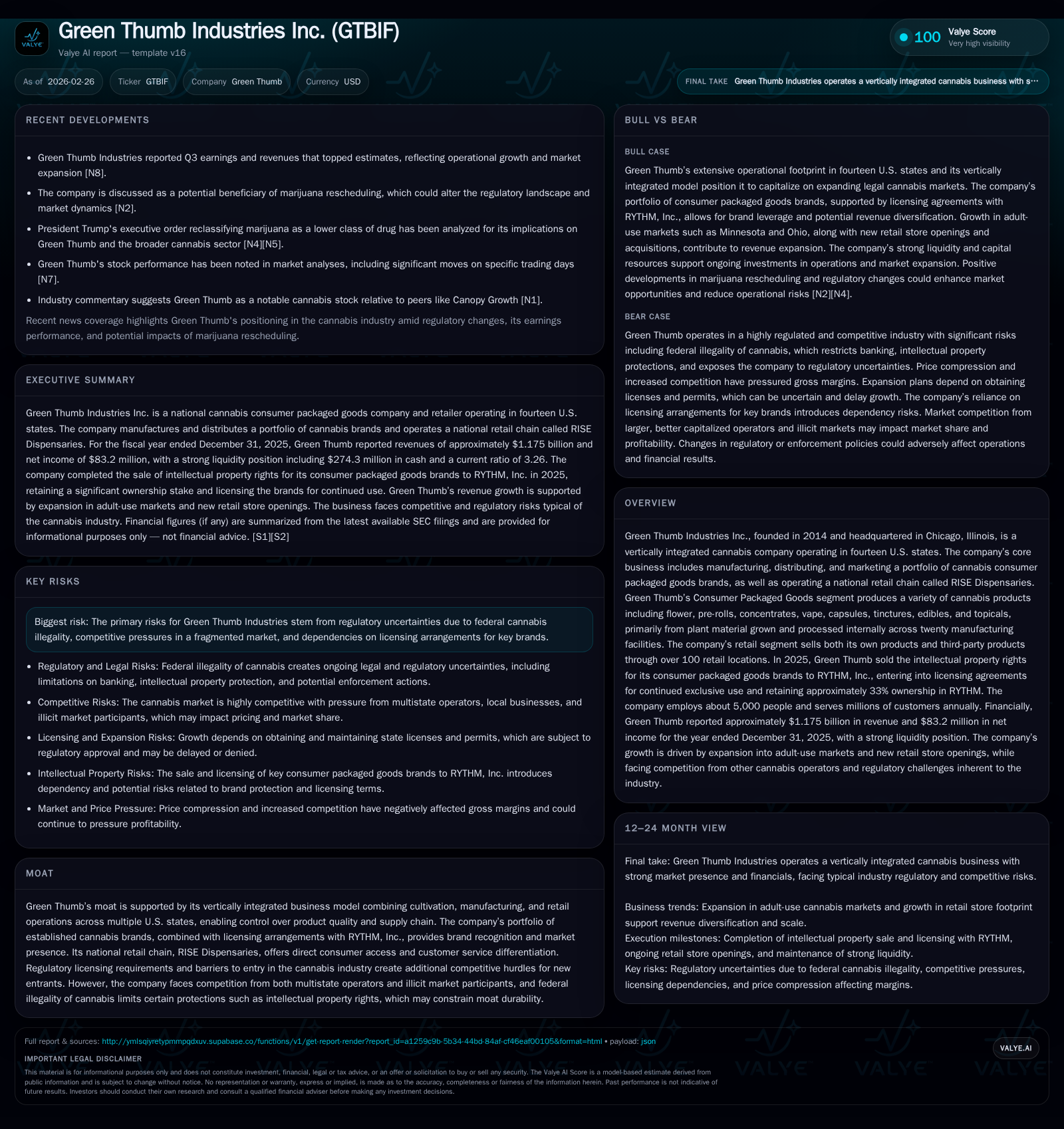
Green Thumb Industries Inc. reported $1.18 billion in revenue for 2025, reflecting steady top-line growth driven by retail expansion and adult-use market entries across fourteen U.S. states. Operating income declined sharply year-over-year amid heightened selling costs and brand licensing transitions, limiting margin expansion despite favorable net income gains buoyed by non-operating items. The firm’s vertically integrated model remains a competitive moat, though regulatory uncertainties including federal prohibition and recent hemp-derived product restrictions introduce notable risk. Capital discipline is evident with stable capital expenditures and strong operating cash flow generating substantial free cash flow, alongside strategic share repurchases and debt refinancing.
Company Overview and Vertically Integrated Model
Founded in 2014 and headquartered in Chicago, Green Thumb Industries Inc. (GTBIF) operates a vertically integrated cannabis business with operations across fourteen U.S. states as of December 31, 2025 [S1]. The company’s core segments include manufacturing and distributing branded consumer packaged goods (CPG) such as flower, pre-rolls, concentrates, vapes, edibles, and topicals produced primarily from plant material cultivated internally across twenty manufacturing facilities.
In addition to its CPG business—which includes owned brands like &Shine, Beboe, Dogwalkers, Doctor Solomon’s, Good Green, incredibles, and formerly RYTHM—Green Thumb owns a national retail chain under the RISE Dispensaries banner comprising 113 stores that sell a mix of company-produced as well as third-party cannabis products [S1][N1]. The vertical integration strategy grants the company control over quality and supply chain consistency while providing direct-to-consumer access.
A significant strategic shift occurred in mid-2025 when Green Thumb sold the intellectual property rights for its major CPG brands to RYTHM Inc., retaining exclusive licenses allowing continued use within existing markets [S1][N2]. This transition monetizes valuable brand assets while maintaining revenue streams through licensing arrangements; the company now holds approximately one-third ownership of RYTHM's common shares [S1].
Historical Financial Performance
Green Thumb demonstrated consistent top-line growth over the past four years driven by geographic expansion and rising cannabis acceptance. Revenue climbed steadily from approximately $1.02 billion in 2022 through $1.18 billion in 2025—a cumulative growth rate exceeding 15% over four years [F1]. The increase is principally attributed to expanding adult-use markets coverage including Illinois (initial market), New York, Florida, Minnesota (adult-use launched Sep 2025), Ohio (adult-use launched Aug 2024), among others.
However, operating income fluctuated significantly: after a negative operating loss of about -$44.5 million in FY2022—reflecting early stage expenses—the company returned to profitability with operating income rising to $57.1 million in FY2024 before declining sharply by nearly two thirds to just $19 million in FY2025 [F1]. This decline is tied partially to the brand licensing transactions which shifted expense recognition timing and increased marketing spend amid intensifying competition [S14][S16].
Remarkably, net income grew substantially from barely above breakeven ($3.2 million) in FY2023 to an impressive $83.2 million in FY2025 despite the drop in reported operating profit [F1]. This swing is explained by significant other income—largely from equity stakes in RYTHM—and favorable tax positions realized post-licensing arrangements [S7][S9].
Operating cash flow showed a healthy upward trend increasing over 50% YoY from $195 million in FY2024 to nearly $295 million in FY2025 [F1], highlighting effective cash generation amid relatively stable capital expenditure levels around $81 million per annum [F1]. The resulting free cash flow stands near $214 million for FY2025.
Annual Financial Summary
Historical performance (annual)
| FY | Rev ($mm) | Net ($mm) | CFO ($mm) | OpInc ($mm) | Rev YoY | Net YoY |
|---|---|---|---|---|---|---|
| 2025 | 1175 | 83 | 295 | 19 | +3.4% | +556.2% |
| 2024 | 1137 | 13 | 195 | 57 | +7.8% | +294.2% |
| 2023 | 1055 | 3 | 225 | 50 | +3.7% | +106.3% |
| 2022 | 1017 | -51 | 159 | -45 |
Source: SEC companyfacts cache [F1].
Capital returns and efficiency (annual)
| FY | FCF ($mm) | ROE% |
|---|---|---|
| 2025 | 214 | 4.4 |
| 2024 | 115 | 0.7 |
| 2023 | 5 | 0.2 |
| 2022 | -21 | -3.1 |
Source: SEC companyfacts cache [F1].
Financials presented in millions USD; Free Cash Flow approximated as Operating Cash Flow less Capex.
Growth Drivers and Market Expansion Prospects
Green Thumb’s future growth prospects hinge on several key factors:
Retail Footprint Expansion: The company increased its retail locations from approximately 108 at Q3'25 to 113 by year-end [S2][S1], continuing development plans carefully calibrated against state regulatory approvals.
Market Launches: Entry into new adult-use markets such as Minnesota (adult use started Sep ’25) and Ohio (adult use started Aug ’24) contribute incremental revenue streams albeit accompanied by price compression effects due to heightened competition [S16][N2].
Brand Licensing Model: Licensing of core CPG brands to RYTHM allows Green Thumb to monetize intangible assets upfront while maintaining operational continuity of those brands through licensing fees and equity participation.
Product Innovation: Continuing introduction of diverse cannabis products across categories positions the firm well against competitors; however individual SKU categories remain immaterial relative to total revenues indicating broad-based rather than concentrated demand patterns.
Regulatory Developments: Potential federal reclassification or rescheduling of cannabis could materially enhance access to banking services and intellectual property protections [N2]. However lingering federal illegality maintains high compliance costs and limits certain operational freedoms.
Counterbalancing these positives are constraints including regulatory hurdles delaying store openings or license awards; increasing competition both from other multistate operators and illicit markets; margin pressure from discounting; as well as potential brand dilution risks inherent with licensing structures.
Operating Dynamics and Margins
Gross margins fluctuate due to the highly regulated sourcing environment that restricts procurement flexibility; compliance costs remain significant given multi-state operating licenses [S14][S21]. Selling costs scale proportionally with retail revenues but newer stores incur higher start-up syndromes elevating expense ratios temporarily.
General & administrative expenses also increased driven partly by stock-based compensation designed to attract industry talent—a reflection of labor competition intensified by union activities impacting approximately 20% of workforce representation already [S6].
Despite these headwinds on operating efficiency contributing to lower operating profits, management’s emphasis remains focused on maintaining sustainable profitable growth while investing prudently for expansion.
Liquidity Position and Capital Allocation
As of end-2025 reporting:
- Cash & equivalents totaled approximately $274 million against current liabilities near $177 million yielding a strong current ratio above three times [F1], underscoring sufficient near-term liquidity.
- The existing credit facility was drawn up to $150 million at close of reporting period with an amendment borrowing additional $50 million completed February ’26 increasing total facility usage toward $200 million; interest rates are at SOFR plus approximately 500 basis points reflecting market conditions for cannabis industry debt pricing [S10][S20].
- Capital expenditures held steady around $81 million reflecting investments across manufacturing expansions and retail infrastructure build-outs balanced against cautious deployment amid uncertain economic outlooks [F1][S4][S11].
- Share repurchase programs have been actively executed with approximately >5.7 million shares repurchased recently suggesting disciplined capital returns where appropriate within liquidity constraints [S4][S7].
Given the company operates as a holding entity relying on subsidiary cash flows for distributions coupled with regulatory mandates requiring maintenance of separate corporate identities for licenses per jurisdictional rules complicates capital movement but no material off-balance sheet obligations were present per disclosures [S20][S28].
Risks: Regulatory Complexity and Competitive Pressures
The foremost risk profile stems from the discordant legal landscape where cannabis remains federally illegal under U.S law imposing uncertainty on enforcement regimes that may change abruptly affecting state market viability or imposing constraints on bank access impacting liquidity management [S12][S17][N2].
Recent legislative actions such as section 781 of the November ‘25 Appropriations Act amending hemp definitions threaten commercial viability of hemp-derived THC products that the company’s minority investments rely upon adding volatility risk around those operations [S17].
Licensing requirements are rigorous often necessitating exhaustive personal data disclosure for owners/executives potentially affecting ownership structures or costing operational agility particularly when applied heterogeneously across states [S18].
Additional risk includes exposure to labor union organizing activity potentially affecting labor costs or operation stability given approximately 20% workforce representation already organized with demands impacting financial results or reinvestment capacity [S6].
Intellectual property challenges persist since federal illegality limits trademark enforcement options confining protections mostly reliance on common law precedents until legalization evolves further internally mitigating risks via redacting proprietary cultivation/extraction processes during applications [S10][S12].
Cybersecurity threats represent emerging risk vectors given dependency on seed-to-sale tracking software vendors and payment systems whose disruption could impair business continuity seriously [S22].
Legal proceedings remain sparse but tangible; notable lease litigation settled resulted in accrued liabilities strongly monitored though no threatening lawsuits currently pending likely of material effect besides typical course-of-business claims disclosed [S9][S29].
What To Watch — Milestones & Industry Variables (Analysis)
The company's explicit forward guidance remains guarded pending evolving state regulatory timelines for licenses which directly influence retail footprint scaling pace—is critical given its impact on revenue growth trajectory.
Monitoring federal legislative developments around cannabis rescheduling or decriminalization will be crucial; positive moves could unlock banking access improvements enhancing working capital efficiency or broaden intellectual property protections stabilizing brand valuations.
Tracking integration outcomes from licensing deals with RYTHM including royalty flows and equity value appreciation will provide insight into whether this model efficiently monetizes intangible assets without diluting market position.
Retail metrics such as same-store sales growth trends at RISE Dispensaries along with gross margin movements will signal operational scalability amidst competitive price pressures documented recently.
Capital allocation decisions around further share buybacks versus reinvestment amid tight credit conditions will reveal management priorities balancing shareholder returns vs growth ambitions.
Conclusion
Green Thumb Industries exemplifies a large-scale multistate cannabis operator successfully managing rapid expansion amidst complex regulatory frameworks through vertical integration while innovating its asset monetization strategy via brand licensing partnerships. Its financials demonstrate solid top-line persistence but cautionary operating margin contraction linked principally to strategic transactional impacts rather than fundamental demand erosion. Strong liquidity positioning supports ongoing investments although rising regulatory scrutiny particularly at federal level alongside heightened compliance burdens continues posing risks inherent within an emerging industry lacking uniform governance frameworks. Investor focus should prioritize regulatory developments shaping market accessibility coupled with operational execution around retail scaling as key determinants influencing future financial performance sustainability.
Disclaimer: This is research-only, informational analysis and not investment advice. It may include AI-generated interpretation and general industry context. Always verify important details using primary sources.

Comments