
Globa Terra Acquisition Corp's Capital Readiness and Path to Agribusiness M&A
Globa Terra Acquisition Corp reports solid capital positioning while pursuing a business combination targeting agribusiness and water sector innovation.
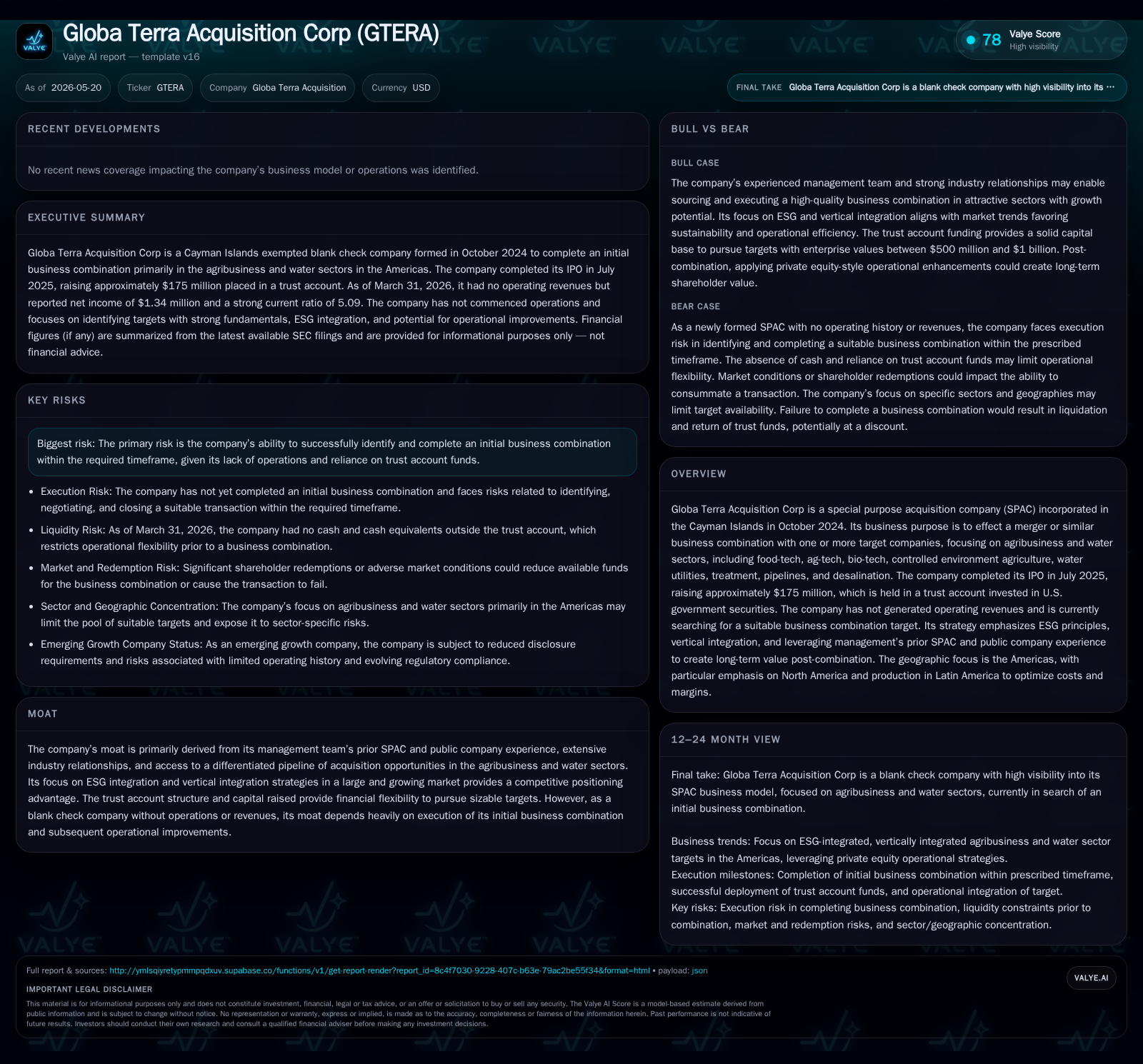
Globa Terra Acquisition Corp, a Cayman Islands incorporated SPAC launched in late 2024, completed its IPO in July 2025 raising approximately $175 million held in trust for acquisition purposes. The latest quarterly filing confirms its status as a pure blank-check vehicle with no operating revenues, cash reserves depleted, but sufficient current assets and minimal liabilities maintaining liquidity for ongoing operations. The company targets agritech and water-related businesses emphasizing ESG principles, vertical integration, and leveraging management expertise to unlock long-term value post-combination. Execution risks center on completing a qualifying business combination within stipulated timeframes amid competitive market pressures.
Latest Quarterly Update: Capital Position and Operating Status
Globa Terra Acquisition Corp’s most recent SEC filing dated May 14, 2026 (10-Q) reconfirms its identity as a special purpose acquisition company without ongoing operations or revenue generation [S2]. At quarter-end March 31, 2026, while cash and cash equivalents were recorded at zero [F1], the company maintained $537,074 in current assets against $105,509 of current liabilities, producing a robust current ratio of approximately 5.09 [F1]. This liquidity cushion underscores minimal working capital requirements given the blank-check model. This trust structure ensures capital security dedicated solely for future business combination activity.
Absent operational cashflows or product sales, maintaining governance controls over costs during the search phase is critical. Management has indicated reliance on interest income from trust funds to cover routine expenses until deployment or potential liquidation if no deal materializes [S1]. Preserving this financial runway supports continued diligence on target identification.
SPAC Business Model with Focus on Agribusiness and Water Solutions
Founded as a Cayman Islands exempted company on October 18, 2024 [S12], Globa Terra executed an IPO on July 10, 2025 that raised $174.9 million through issuance of over 17 million units priced at $10 each [S1], [S12], supplemented by private placements totaling roughly $3.15 million [S12]. Each unit comprises one Class A ordinary share with associated warrants and rights exercisable contingent upon consummation of an initial business combination. Under IPO terms, these net proceeds are placed into a trust account until released either via completion of the merger or redemption events [S1], [S28].
The company's strategic mandate is to acquire one or more businesses principally serving the agribusiness and water sectors across the Americas [S1], [S24]. Within agribusiness, focus areas include food technology developments like plant-based alternatives and lab-grown protein; ag-tech applications involving controlled environment agriculture; and bio-tech innovations improving sustainability. Water sector targets encompass utilities management, treatment solutions including desalination technologies, pipeline infrastructure, and novel approaches addressing escalating global water scarcity challenges. This sectoral delineation implies an intent to leverage emerging environmental technologies aligned with evolving consumer preferences centered on healthfulness and sustainability themes [S1].
Management leverages extensive prior SPAC sponsoring experience alongside public company operation insights enabling disciplined combative deal sourcing reflective of private equity style operational enhancements post-business combination [S1]. This approach suggests targeting entities where active governance engagement can drive strategic growth rather than passive financial ownership.
Competitive Environment and Industry Positioning in Agritech SPACs
The competitive milieu for agritech-related SPACs is increasingly discerning. Valuations for promising agribusiness targets often reflect bullish near-term growth expectations fueled by rising ESG investor activism coupled with regulatory incentives focusing on sustainable agriculture practices. However, this creates an acute supply-demand imbalance where quality candidates are scarce vis-à-vis multiple suitors vying for footholds. Consequently, bidding wars can inflate purchase prices forcing acquirers to make tradeoffs between valuation discipline versus strategic imperatives such as vertical integration or geographic scale advantages.
Globa Terra’s emphasis on vertical integration—merging primary production capabilities with value-added processing activities—and commitment to rigorous ESG standards constitute meaningful differentiators within this congested landscape [S24]. Their managerial network presents access to proprietary deal flow unavailable to more generic vehicles lacking sector specialization. Yet inherent information asymmetries typical of early-stage agritech ventures combined with nascent regulatory frameworks can impose elevated transaction execution complexity, requiring exceptional due diligence capacity.
Strategic Growth Drivers Anchored on ESG and Vertical Integration
Growth prospects rest largely on macroeconomic tailwinds favoring sustainable food production modalities and resilient water infrastructure solutions addressing climate change-induced stresses [S1]. The increasing consumer preference for plant-based protein substitutes catalyzes innovation and adoption within targeted portfolio companies' product pipelines entailing improved margins relative to legacy agriculture models
Technological adoption encompassing advanced controlled environment agriculture systems powered by AI-driven analytics enhances yield stability and reduces input waste—key levers amplified post-business combination through operational excellence initiatives [S1]. Meanwhile, blockchain-enabled supply chain transparency adds downstream trust credentials favored by eco-conscious buyers.
ESG principles underpinning investment decisions have become central criteria—not solely ethical mandates—driving premium multiples and favorable financing terms post-merger. Vertical integration across the value chain presents synergies reducing cost structures while enhancing responsiveness to shifting market conditions in volatile commodity pricing environments [S24]. Therefore, success hinges on executing combinations with alignment between target management teams’ vision shared by Globa Terra sponsors enabling scalable expansion strategies beyond initial acquisition footprints.
Risks Centered on Execution of Initial Business Combination
Primary risks derive from Globa Terra’s blank-check nature requiring that it consummate its initial business combination within prescribed temporal windows—15 months from IPO closing extendable up to 21 months contingent upon shareholder approvals [S1], [S17]. Failure would trigger mandatory liquidation of trust funds plus accrued interest back to public shareholders minus permitted expenses resulting in shareholder loss of optionality into projected post-combination upside.
Market conditions influencing deal valuations may deteriorate abruptly posing challenges both validating target assessments legally defensible under aggressive valuation policies adopted by the board [S19] and securing any requisite third-party funding outside trust account resources given no explicit financing commitments currently exist [S19]. Further complicating factors include increased directors’ & officers’ liability insurance premiums potentially restricting managerial agility during transaction negotiation phases or impairing post-investment governance effectiveness owing to cost constraints impacting recruitment/retention of qualified executives.[S23]
Moreover, corporate governance constructs allow Globa Terra discretion not to conduct shareholder votes approving initial business combinations absent legal obligations—a mechanism placing minority investor protections at heightened risk should conflicts arise regarding transaction fairness or alignment with shareholder interests. Redemption rights complexity add another dimension where large-scale redemptions could materially affect available capital leading to renegotiation risk post-announcement.[S15],[S21]
Key Milestones to Monitor: Target Search and Capital Deployment
Attention should focus closely on announcements signaling definitive agreements or exclusivity arrangements relating to potential acquisition targets as these represent primary near-term catalysts transitioning Globa Terra from search mode into transactional execution phase. Timelines remain constrained reflecting typical SPAC lifecycle deadlines given IPO consummated July 2025 signals external pressure toward closing deals by late Q3/Q4 2026 absent extension approvals.
Metrics worth tracking include amount of public shareholder redemptions submitted in voting processes which influence net proceeds available; continuous disclosures via Form 8-K filings detailing negotiations progress; updates related to any proposed financing facilities supplementing trust account capital; changes in cash balances once funds move from trust accounts into operating accounts post-deal closure; management commentary during earnings calls or proxy statements addressing strategic rationale confirming consistency with stated ESG vertical integration objectives.
Given proprietary access claims associated with sponsor networks coupled with increasing agritech-water sector valuations globally, indications that Globa Terra moves swiftly toward announcing a transaction would reflect well-anchored positioning leveraged by experienced sponsors potentially yielding compelling portfolio creation opportunities.
This analysis reflects publicly disclosed facts drawn directly from Globa Terra Acquisition Corp's SEC filings through May 14, 2026. It does not constitute investment advice but aims to provide an informed industry perspective on corporate structure dynamics, strategy execution risks, competitive environment nuances, and growth potential drivers relevant for valuation considerations post-business combination.
Disclaimer: This is research-only, informational analysis and not investment advice. It may include AI-generated interpretation and general industry context. Always verify important details using primary sources.

Comments