
Gray Media's Revenue Compression Reflects Election Cycle and Advertising Shifts
Gray Media’s extensive broadcast footprint contends with pronounced revenue declines shaped by political ad cycles and evolving capital structure refinements in 2025.
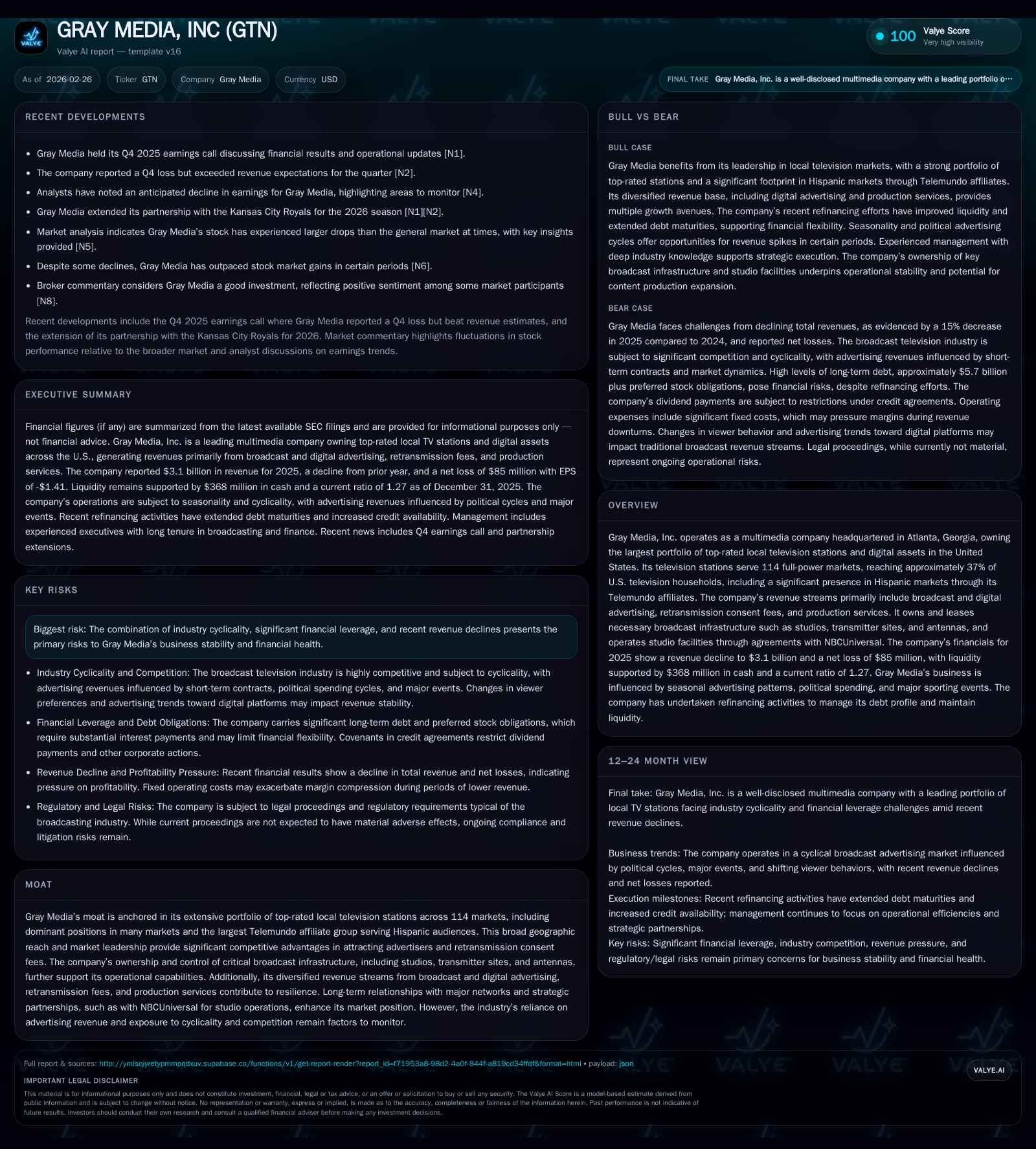
Gray Media, Inc. reported a notable 15% revenue decline in 2025 to $3.1 billion, heavily influenced by a 92% drop in political advertising due to the off-year election cycle and shifts in core advertising linked to major sporting events. Despite operational cost containment reducing broadcasting expenses by 3%, operating income dropped over 50%, culminating in a net loss of $85 million for the year [F1][S1]. The company undertook significant refinancing efforts including issuing new senior secured notes and amending its revolving credit facility to manage leverage and enhance liquidity [S4][S5]. With cash flow from operations decreasing sharply yet still positive after capex, Gray Media maintains a current ratio of 1.27 supported by $368 million in cash [F1]. Looking forward, political advertising recovery and digital revenue expansion remain key growth drivers, while leverage and sector cyclicality pose risks [N1][S26].
2025 Revenue Decline: Advertising Cycles and Market Mix Impact
Historical performance (annual)
| FY | Net ($mm) | CFO ($mm) | OpInc ($mm) | Capex ($mm) | Net YoY |
|---|---|---|---|---|---|
| 2025 | -85 | 289 | 392 | 108 | -122.7% |
| 2024 | 375 | 751 | 851 | 143 | +593.4% |
| 2023 | -76 | 648 | 383 | 348 | -116.7% |
| 2022 | 455 | 829 | 990 | 436 |
Source: SEC companyfacts cache [F1].
Capital returns and efficiency (annual)
| FY | Buybacks ($mm) | FCF ($mm) | ROE% |
|---|---|---|---|
| 2025 | 181 | -3.9 | |
| 2024 | 0 | 608 | 16.4 |
| 2023 | 0 | 300 | -3.9 |
| 2022 | 50 | 393 | 21.5 |
Source: SEC companyfacts cache [F1].
Gray Media experienced a significant revenue contraction in fiscal 2025, reporting total revenues of approximately $3.1 billion—a decline of nearly 15% compared to $3.64 billion in 2024 [F1][S1]. This shrinkage was sharply influenced by the nature of the U.S. election cycle: political advertising revenue plummeted by an estimated 92%, falling from $497 million in the prior year to just $42 million due to the off-year political calendar where fewer federal campaigns generate less media spending [S1].
Core advertising revenues themselves decreased marginally by about $38 million year-over-year, reflecting softness primarily in the first half of the year amid broader macroeconomic headwinds impacting advertiser spending. Notably, event-driven advertising demonstrated variability—the Super Bowl broadcast on Gray’s FOX-affiliated stations generated roughly $9 million in ad revenues compared with substantially higher figures tied to the Olympic Games aired across NBC stations in the prior year ($16 million). Additionally, a leap day reduction resulted in about a $4 million estimated decrement due to one fewer selling day for advertisers on local TV [S1].
Retransmission consent fees—a critical component stemming from agreements with multichannel video program distributors—declined moderately by about 4% or $53 million due principally to subscriber erosion aligned partially with losing one station’s network affiliation mid-year, tempered somewhat by rate increases under existing contracts [S1]. Production company revenues posted slight gains.
The revenue patterns underscore Gray Media's sensitivity to cyclical political spending and core local ad market dynamics shaped heavily by major live sports events and related viewer engagement.
Operating Income Volatility Amid Broad Industry Trends
Operating income showcased marked volatility as it diminished roughly 54% year-over-year from approximately $851 million down to around $392 million for FY2025 [F1][S1]. Despite broadcasting expenses declining by about $78 million (a reduction of roughly 3%) due largely to lower incentive compensation aligned with revenue pressures, reduced headcount, and stock compensation expense moderation, these savings failed to fully counterbalance top-line weakness.
The steep operating income contraction reflects challenges facing local broadcasters—including shifting advertiser allocations toward digital platforms and lingering macroeconomic softness—which pressure margins even when operational efficiencies are pursued aggressively.
Net income swung into negative territory posting an $85 million loss compared with a strong positive net result of roughly $375 million in 2024 [F1], further confirming earnings susceptibility tied closely to ad market cyclicality.
Evolving Capital Structure: Refinancing to Manage Leverage
In response to industry cyclical pressures compounded by its substantial debt load, Gray Media executed strategic refinancing maneuvers throughout 2025 aimed at extending maturity profiles and shoring liquidity buffers.
Key transactions included issuance of:
- Approximately $900 million plus an additional $250 million (totaling $1.15 billion) in senior secured second lien notes at a coupon rate of 9.625%, maturing in mid-2032;
- A senior secured first lien note offering totaling about $775 million at a lower coupon of 7.25%, maturing August 2033;
- Amendments increasing the Revolving Credit Facility borrowing capacity from original levels up to $750 million with extended commitments through December 2028.
Proceeds from these financings were deployed towards redeeming near-term maturities including entirely retiring all outstanding senior notes due in mid-2027 at par, repaying a material portion of term loans due between 2028 and 2029, redemption premiums on certain higher-coupon debt tranches, transaction costs, plus supporting general corporate purposes [S4][S5][S6].
These actions reduced immediate refinancing risk but maintained high leverage metrics with substantial annual interest expense obligations estimated near $450 million per annum.
Liquidity and Cash Flow: Balancing Operational Cash Generation and Capital Expenditures
Cash flow from operations declined steeply—by approximately 62%—from about $751 million in FY2024 down to roughly $289 million FY2025 as earnings weakened significantly [F1]. Still, this operational cash generation remained sufficient relative to capital expenditure outlays which decreased moderately from about $143 million down to around $108 million reflecting tighter investment discipline amidst uncertainty.
Resultantly, free cash flow approximated a modest positive figure near $181 million—enabling coverage of dividend distributions (common stock dividends historically modest or absent), interest payments, working capital needs, and debt service [F1][S5].
Balance sheet liquidity remains stable; cash balances increased materially during the period reaching nearly $368 million at year-end alongside current assets comfortably exceeding current liabilities yielding a current ratio near 1.27—both signaling adequate short-term financial flexibility despite external headwinds [F1].
Strategic Asset Base: Studio Operations and Broadcast Infrastructure
Gray Media's competitive positioning benefits significantly from its ownership or leasehold interests covering critical broadcast infrastructure across all markets it operates—offices, studios, transmitter sites, antennas—to ensure seamless transmission capabilities aligned with FCC regulations governing broadcast coverage [S1].
In particular, its ownership stakes include Third Rail Studios and Assembly Atlanta—a sprawling real estate complex encompassing over 135 acres dedicated to studio operations situated near Atlanta’s industrial hubs. Strategic partnership arrangements place management responsibility for these state-of-the-art production facilities under NBCUniversal Media via operating agreements ensuring professional stewardship while enabling internal content creation capabilities that bolster local programming differentiation [S1].
Such infrastructure depth represents substantial entry barriers against competitors relying solely on leased or third-party facilities particularly within large Hispanic demographic markets owing to Gray’s leadership through its Telemundo affiliates.
Future Growth Outlook: Political Cycle Influence and Digital Advances
Looking ahead into the next election cycle starting late CY2026/early CY2027 political advertising revenue is expected to rebound markedly restoring one of Gray’s highest-yielding revenue segments historically contributing over a tenth of total sales during peak years [N1][N3]. However, evolving consumer media consumption habits continue pressuring traditional local TV advertising share as digital platforms accelerate monetization traction requiring strategic emphasis on digital capabilities.
Gray has signaled plans targeting incremental growth through augmented digital ad offerings integrated alongside retransmission fee renewals—which have historically provided steady subscription-aligned revenue streams even during ad market contractions—as well as production service expansions that exploit owned studio assets leveraging long-term network affiliations especially with NBCUniversal partnerships [N6][S1].
Nevertheless macroeconomic factors constrain upside potential until sustained advertiser demand stabilizes beyond isolated political inflections.
Risks from Financial Leverage and Industry Cyclicality
Key structural vulnerabilities for Gray Media stem from significant financial leverage coupled with cyclical demand risk inherent in television broadcast advertising markets exacerbated by increasing alternative media competition [S11][S26]. Long-term debt stands near approximately $5.7 billion excluding preferred stock instruments—with high coupon burdens limiting nimbleness amid tightening operating cash flows—and covenant frameworks requiring close compliance monitoring given episodic earnings volatility against fluctuating macroeconomic backdrops.
Interest costs alone accounted for nearly one-third of operating cash flows pre-capital expenditures last fiscal year challenging sustainable capital return policies including dividends or buybacks absent robust top-line growth restoration or refinancing advantages achievable at more favorable rates over time [F1][S5].
Further regulatory shifts impacting retransmission consent arrangements or network affiliation structures could introduce additional downside risks although currently no material legal contingencies threaten core operations beyond routinely-managed claims disclosed annually [S26].
What Investors Should Monitor Ahead
Stakeholders should focus scrutiny on upcoming quarterly earnings trends aligned closely with increasing political ad inflows fueling core broadcast ads recovery cycles post off-year doldrums observed throughout early-to-mid-2025 periods [N9][N3]. Tracking contract renewals for retransmission consent fees will illuminate subscription base stability while any escalations could compensate partially for lingering ad softness.
Progress against digital initiatives such as increased programmatic sales integration into local station platforms should also be evaluated for incremental contributions supporting margin stabilization amid austerity regimes affecting legacy line items.
Finally, refinancing opportunities extending maturities beyond current longest-dated instruments issued mid-2030s without elevating overall cost basis will remain critical for long-term solvency assurances under prevailing interest rate environments.[N9]
Disclaimer: This analysis is intended solely for informational purposes based on publicly available data as of February 26, 2026. It does not constitute investment advice or recommendations.
Disclaimer: This is research-only, informational analysis and not investment advice. It may include AI-generated interpretation and general industry context. Always verify important details using primary sources.

Comments