
Greenwave Technology: Expansion Ambitions Meet Sector Cyclicality and Tight Liquidity
Greenwave Technology Solutions continues its pivot to scrap metal recycling, expanding its facility footprint and raising revenue outlooks. Yet, persistent net losses, low liquidity, and sector volatility highlight the company’s dependence on successful execution of operational and strategic initiatives.
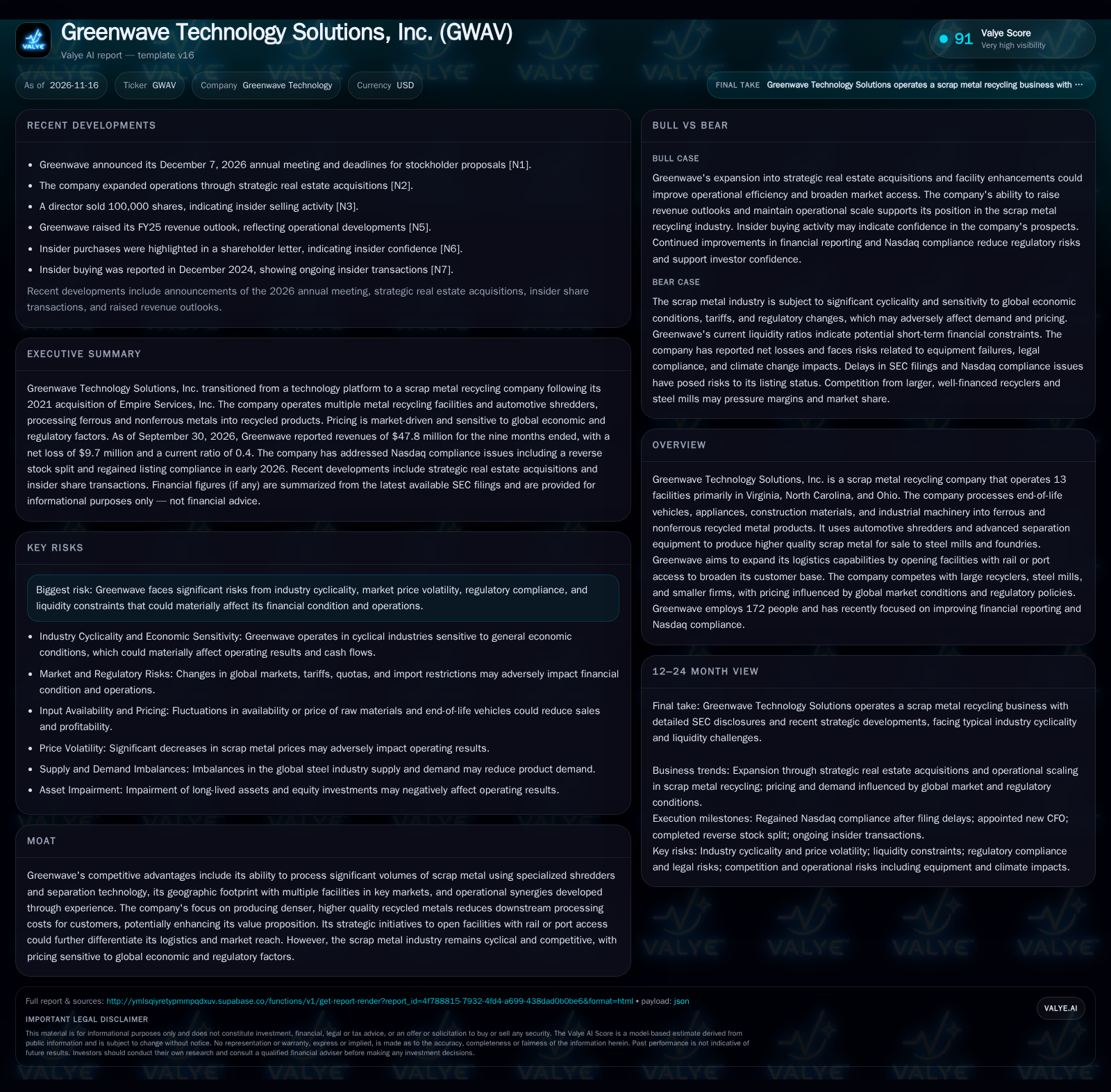
Greenwave Technology Solutions operates 13 metal recycling facilities and is expanding through real estate acquisitions. The company reported $47.8 million in revenue but a net loss of $9.7 million for the first nine months of 2026, and reported liquidity-ratio trends of 0.4.Insider transaction activity was reported in the cited source; this activity does not by itself establish insider confidence. The viability of recent expansion and logistics initiatives will be crucial to improving profitability and resilience. [S2] [N2] [N5] [N6] [N7]
Greenwave Technology Solutions, once a tech platform, now operates as a regional scrap metal recycler with an expanding facility base across Virginia, North Carolina, and Ohio. The company’s recent push for strategic real estate acquisitions and a raised revenue outlook reflect ambitions to scale and capture operational efficiencies. However, continuing net losses, a reported current ratio, and exposure to metal price swings underscore a precarious balance between growth initiatives and the realities of a cyclical, capital-intensive industry. The company’s next phase will hinge on its ability to translate facility investments and logistics upgrades into sustainable profitability and improved financial footing.
Recent Facility Expansion and Financial Strains Shape the Near-Term Outlook
Greenwave Technology Solutions currently operates 13 metal recycling facilities, having expanded its operations through strategic real estate acquisitions designed to improve logistics and broaden its market reach. This expansion aligns with management’s stated goal of opening facilities with rail or deep-water port access, potentially enabling access to new customers and more efficient transportation routes. [S2] [N2]
For the first nine months of 2026, Greenwave reported revenue of approximately $47.83 million with a gross profit of $18.34 million, but a net loss of $9.72 million. As of September 30, 2026, the company’s current assets stood at $7.88 million against $19.81 million in current liabilities, yielding a current ratio of 0.4 and a cash ratio of 0. [S2]
Greenwave has also raised its FY25 revenue outlook and highlighted insider share purchases, suggesting management’s optimism about future performance. However, the company’s persistent net losses and tight liquidity ratios indicate ongoing operational and financial pressures. [N5] [N6] [N7]
How Facility Scale, Product Mix, and Logistics Drive Profitability in Scrap Metal Recycling
Greenwave’s business model centers on sourcing end-of-life vehicles, appliances, and industrial equipment, processing these through shredders and separation technology, and selling the resulting ferrous and nonferrous metals to steel mills and foundries. The company’s economics are highly sensitive to scrap input costs, the yield and quality of recycled output, and prevailing commodity prices for metals like steel, copper, and aluminum.
Revenue is volume-driven but subject to market pricing cycles. Margins can be enhanced by processing denser, higher-quality scrap (e.g., zorba, zurik, shredded insulated wire), which commands better prices and reduces downstream costs for buyers. However, achieving consistent margin improvement requires scale, operational efficiency, and continuous investment in equipment and logistics.
Fixed costs include facility maintenance, depreciation on shredders, payroll for 172 employees, and regulatory compliance. Variable costs are dominated by input acquisition, hauling, and energy. Operating leverage is possible if incremental volumes can be processed without proportional increases in fixed costs—especially if new facilities with better transport access reduce per-unit logistics costs.
Capital needs remain significant. The company reported a current ratio of 0.4 for the period. The sector’s working capital needs can spike if metal prices fall or input availability tightens, amplifying financial risk in downturns. [S2]
Competing on Scale, Quality, and Logistics in a Fragmented Yet Concentrated Market
Greenwave competes with large, vertically integrated recyclers, steel mills with in-house processing, and numerous smaller regional scrap yards. Larger peers typically benefit from greater bargaining power in sourcing and sales, more advanced technology, and broader geographic reach, which can compress margins for mid-size operators like Greenwave.
The company’s competitive levers include its regional density (13 facilities), ability to process significant volumes, and focus on producing higher-quality, denser recycled metals. These characteristics may enhance its standing with steel mills seeking consistent, high-grade feedstock and could reduce transportation costs if facility locations are optimized.
However, barriers to entry in metal recycling are moderate—capital intensity and local regulatory compliance matter, but scrap sourcing is competitive and price-driven. The threat of substitutes is limited, as recycled metals are generally cost-competitive and environmentally preferred versus virgin mining, but demand is cyclical and exposed to end-market volatility (e.g., construction, automotive, manufacturing).
Expansion into facilities with rail or deep-water port access could be a differentiator if it leads to lower logistics costs or access to export markets, but execution risk is high and larger rivals may follow suit.
If Real Estate Expansion Enables Operational Leverage and Margin Gains
A favorable outcome emerges if Greenwave successfully opens new facilities with superior transportation access, increasing throughput and serving higher-value customers. Enhanced logistics would allow the company to source scrap more efficiently, reduce per-ton hauling costs, and potentially access export markets or distant domestic buyers willing to pay premiums for quality and reliability.
If the company can sustain or grow processing volumes while holding fixed costs relatively steady, operating leverage could drive gross margin expansion. Upgrades in shredding and separation technology may yield higher-purity products, commanding better pricing from mills. A sustained recovery in scrap metal prices or a shift in demand (e.g., infrastructure spending, steel demand) would further amplify revenue and margin gains.
Evidence supporting this scenario would include improved gross margins, higher facility utilization rates, increased share of sales to premium customers, and positive free cash flow. Confirmation would require disclosure of logistics cost savings, export sales growth, or a significant reduction in per-ton processing costs.
Modest Revenue Growth Balanced by Ongoing Margin and Liquidity Headwinds
The most plausible trajectory is one in which Greenwave achieves incremental revenue growth through facility expansion but continues to face thin margins due to input cost pressures, industry cyclicality, and competitive pricing. Facility upgrades and real estate acquisitions may yield operational improvements, but these gains could be offset by persistent fixed costs, working capital needs, and limited pricing power.
The company may remain exposed to fluctuations in scrap supply and commodity prices, with gross profit variability and continued net losses. Liquidity constraints could limit flexibility to invest in further expansion or technology upgrades, and any downturn in metal prices would quickly pressure cash flows.
Liquidity Crunch and Adverse Market Cycles Could Force Retrenchment
A negative outcome could unfold if metal prices decline sharply, scrap supply tightens, or operating costs rise faster than revenues. In such a scenario, working capital shortages might force asset sales, facility closures, or dilutive financings.
Operational disruptions—such as equipment failures, regulatory penalties, or climate-related facility impacts—would compound financial strains. Larger competitors could use downturns to consolidate share or undercut regional pricing, further squeezing margins.
Warning signs for this scenario would include a spike in accounts payable, missed debt or lease payments, delays in payroll or capex, or disclosures of asset impairments and forced divestitures.
Signals That Will Clarify Greenwave’s Expansion Payoff and Financial Durability
Gross margin trends by facility and overall—if disclosed—would reveal whether operational improvements are translating into better unit economics.
Changes in the mix of ferrous versus nonferrous product sales, and the proportion of premium (high-purity) output, would help assess pricing power and customer value.
Facility utilization rates and throughput volumes, particularly at newly acquired or upgraded sites, would indicate the effectiveness of expansion investments.
Disclosure of logistics costs per ton and customer delivery distances would clarify whether real estate acquisitions are yielding the intended transportation efficiencies.
Quarterly working capital trends, including inventory turns and accounts payable, would provide early warning of liquidity stress or improvement.
Any new export contracts, rail or port facility launches, or expansion into new geographic markets would test the thesis that logistics upgrades can drive growth.
Recurring net losses or dilutive capital raises—if they persist—would signal that the company is not achieving sustainable operating leverage.
Disclaimer: This is research-only, informational analysis and not investment advice. It may include AI-generated interpretation and general industry context. Always verify important details using primary sources.

Comments