
Haemonetics Gains Traction with New Tech in Plasma and Hospital Segments
Latest quarterly results highlight operational momentum fueled by innovations in plasma collection and hospital technologies, underpinning Haemonetics' strategic growth focus.
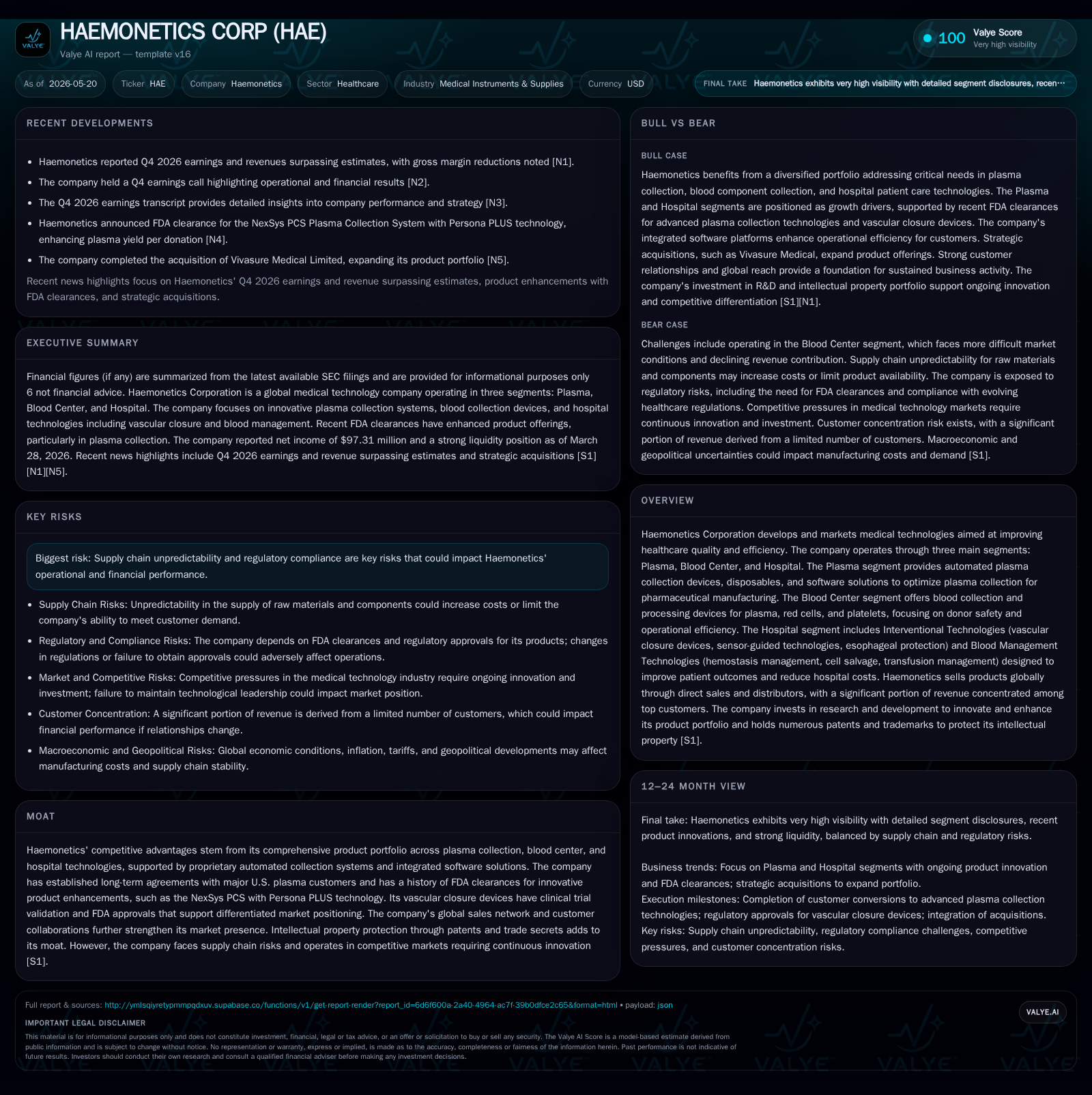
Haemonetics Corporation reported strong fiscal fourth quarter and year-end results, driven primarily by their Plasma and Hospital segments. The company advanced next-generation technology approvals—including the NexSys PCS with Persona PLUS in plasma collection and expanded FDA labeling for vascular closure devices—strengthening its competitive positioning. While supply chain challenges and regulatory complexities persist as risks, ongoing product innovation and software integration continue to support operational efficiency and market share gains. Financially, Haemonetics maintains a solid liquidity buffer despite considerable debt, enabling sustained investment in R&D and strategic initiatives.
Latest Quarterly Operating Update: What Changed?
Haemonetics’ fiscal Q4 ended March 28, 2026, revealed solid execution across core business lines as disclosed in the February 5, 2026 filing [S2] and supplemented by the May 7 event release [S3]. The company reported revenues surpassing consensus estimates primarily driven by strength in the Plasma and Hospital segments. These results underpin management’s narrative focusing future capital allocation and R&D towards these higher-growth areas.
Notable operational developments include FDA clearance of the NexSys PCS Plasma Collection System equipped with Persona PLUS technology. This next-gen system further customizes plasma volume collected per donor, delivering a mid-single-digit percentage increase on top of prior gains—with the potential to enhance yield significantly on a per-donation basis [S1][S27]. Such innovation directly supports plasma center throughput optimization amid pricing pressures.
The Hospital segment also posted gains supported by expanded clinical indications for vascular closure devices. Specifically, FDA approval extended the labeling for VASCADE MVP XL allowing use with larger procedural sheaths (up to 17F outer diameter), which is critical for emerging therapies like pulsed field ablation (PFA) and left atrial appendage closure (LAAC) that require large-bore access [S13]. This regulatory progress highlights Haemonetics’ commitment to advancing interventional technologies aligned to evolving cardiology practices.
Despite positive momentum, supply chain volatility remains a constraint flagged in filings. Raw material shortages and increased costs due to inflationary macro factors create operational headwinds that may pressure margins if unmitigated [S13][S15].
Business Model and Product Portfolio Breakdown
Haemonetics operates three primary segments—Plasma, Blood Center, and Hospital—each serving distinct parts of the blood collection and medical device ecosystem [S1][S14].
Plasma concentrates on source plasma collection systems, disposables, donor management software, and operational analytics designed specifically for dedicated pharmaceutical fractionation centers. The flagship NexSys PCS series incorporates patented Persona technology that personalizes donation volumes based on donor physiology to improve efficiency.
Blood Center targets comprehensive blood component collection—from plasma, platelets to red cells—primarily serving traditional blood banks using manual or automated apheresis methods. This segment faces more mature demand curves due to procedural trends favoring minimally invasive surgery and improved blood management but retains niche opportunities particularly in platelet collection technologies.
Hospital includes Interventional Technologies (vascular closure devices, sensor-guided guidewires, esophageal protection systems) aimed at cardiology workflows; plus Blood Management Technologies offering hemostasis diagnostics (TEG 6s platform), cell salvage systems (Cell Saver Elite+), and transfusion management software suites (SafeTrace Tx®, BloodTrack®). These integrated solutions seek to improve patient outcomes while reducing hospital resource utilization.
Overall, Haemonetics’ value proposition rests on its vertically integrated ecosystem combining hardware innovation with proprietary software suites enabling operational intelligence across collection centers and hospital floors alike. FDA clearances and design wins cement switching costs.
Competitive Landscape and Industry Structure
The medical instruments market delineated by highly regulated device approvals is intensely competitive yet characterized by significant barriers such as patent protections, regulatory clearances, and long-term customer relationships. Haemonetics leverages a portfolio approach spanning collection systems to advanced clinical devices supported by extensive IP rights including patents covering its Persona technology enhancements [S1][S15].
Competitors vary by segment; for example, plasma collection is also contested by Grifols' Biomat line while hospital vascular closure devices face competitors like Abbott’s Angio-Seal or Terumo's ClosureFast. Haemonetics mitigates these pressures through continuous innovation cycles paired with integrated software platforms—a differentiation not easily replicated given the technical complexity involved.
However, supply chain disruptions have industry-wide ramifications impacting component sourcing for clean-room manufactured disposables—a risk Haemonetics explicitly disclosed as affecting production cost structure [S13]. Pricing pressure tied to payer reimbursement dynamics in hospitals also curtails rapid margin expansion.
Growth Drivers Anchored in Segment Momentum
Growth prospects center largely around the Plasma segment and certain franchises within Hospital:
The Plasma business benefits from secular increases in demand for immunoglobulin therapies derived from source plasma amid aging populations globally. Adoption rates of upgraded automated collectors like NexSys PCS persona-enabled platforms remain high especially among large U.S. biopharma customers who have adopted next-gen units across their networks fully by FY26-end [S27][N2]. Enhancements reducing procedure time via Express Plus technology further improve center capacity economics.
In Hospital, Interventional Technologies such as vascular closure devices are capitalizing on expanding minimally invasive cardiovascular procedure volumes enabled by growing acceptance of cutting-edge modalities like pulsed field ablation that require specialized large bore access closure systems like PerQseal Elite—which recently secured CE Mark with FDA PMA submission pending in U.S. markets [S26][N2].
Sensor-guided guidewires providing diagnostic metrics improve accuracy while reducing procedural times aiding clinician adoption.
Blood Management Systems such as TEG 6s diagnostic platforms advance personalized patient care approaches limiting transfusion-related complications; timely additions of global indication approvals steadily enlarge this addressable market [S20].
These drivers align with KPIs including number of units installed globally, rate of software license renewals/updates across customer base, clinical trial validations supporting new use cases, as well as backlog growth indicating healthy demand pipelines.
Risks Factors Tailored to Supply Chain & ESG Challenges
Haemonetics flags several risks pertinent to its operational outlook:
Supply Chain Instability: Increased unpredictability around raw materials sourced from Asia-Pacific component manufacturers elevates risk of production delays or cost escalations—with limited near-term visibility into resolution timelines [S13][S15]
Regulatory Compliance: Ongoing need for extensive FDA clearances shapes product launch timelines [S26]. Delays or refusals could impact anticipated revenue streams especially in Hospital device innovations such as PerQseal Elite large bore vascular closure system pending PMA approval
Share Repurchase Effects: Although the company maintains an active share repurchase program approved through April 2028 with $325 million remaining authorization as of March 28, 2026, buybacks can introduce stock price volatility increasing perceived investment risk [S5][S18]
ESG Considerations: Customer preferences increasingly weigh environmental impact profiles alongside efficacy; failures or perceived shortfalls against sustainability goals could impair market share retention or employee recruitment/retention efforts [S5]
Legal & IP Litigation Exposure: Active patent enforcement litigation incurs potential costs or injunction risks that might constrain commercialization activities or require costly workarounds hampering brand reputation [S15].
What to Monitor Next: Catalysts and Execution Milestones
Investors should focus on several near-term indicators:
Progress on FDA PMA approval for PerQseal Elite large bore vascular closure system which would open critical market segments tied to TAVR/EVAR procedures [N2][S26]
Commercial rollout velocity for recent Plasma device upgrades including installation counts of Persona PLUS enabled NexSys PCS units particularly within major U.S. plasma centers underpinning recurring consumable sales [N2][N3][S27]
Updates from clinical trials validating new indications or performance benefits across Sensor-Guided Technologies will influence hospital adoption pacing.
Efficacy of supply chain mitigation plans reflected in production lead times and margin stability during Q1 FY27 disclosures.
Management guidance updates post FY26 results release clarifying outlook range for organic revenue growth segmented by Plasma/Hospital/Blood Center businesses enhancing visibility into capital allocation priorities [N1][S3]
Financial Snapshot: Supporting the Operating Story
As of March 28, 2026 data from companyfacts cache reveals Haemonetics holds approximately $245 million in cash and equivalents against total debt nearing $1.22 billion yielding net debt around $980 million—the sizeable leverage reflects investment intensity supporting R&D-driven expansion alongside ongoing share repurchases commitment underwritten by a current ratio approximating 2.95 evidencing solid near-term liquidity cushions [F1]
Disclaimer: This analysis is provided for informational purposes only without any investment research view or advice. Readers should conduct their own due diligence before making financial decisions.
Disclaimer: This is research-only, informational analysis and not investment advice. It may include AI-generated interpretation and general industry context. Always verify important details using primary sources.

Comments