
Healthier Choices Management Corp.: Patent Monetization Strategy Confronts Competitive and Financial Headwinds
After spinning off its grocery segment, HCMC is now a focused intellectual property company in the vaping technology sector.
HCMC is now a pure-play vaping IP company, relying on licensing, joint ventures, and litigation to monetize its Q-Cup and related patents. Its ability to generate material licensing revenue and defend its IP against major industry players, while managing regulatory and supply chain risks, will determine future viability. [S1] [S2]
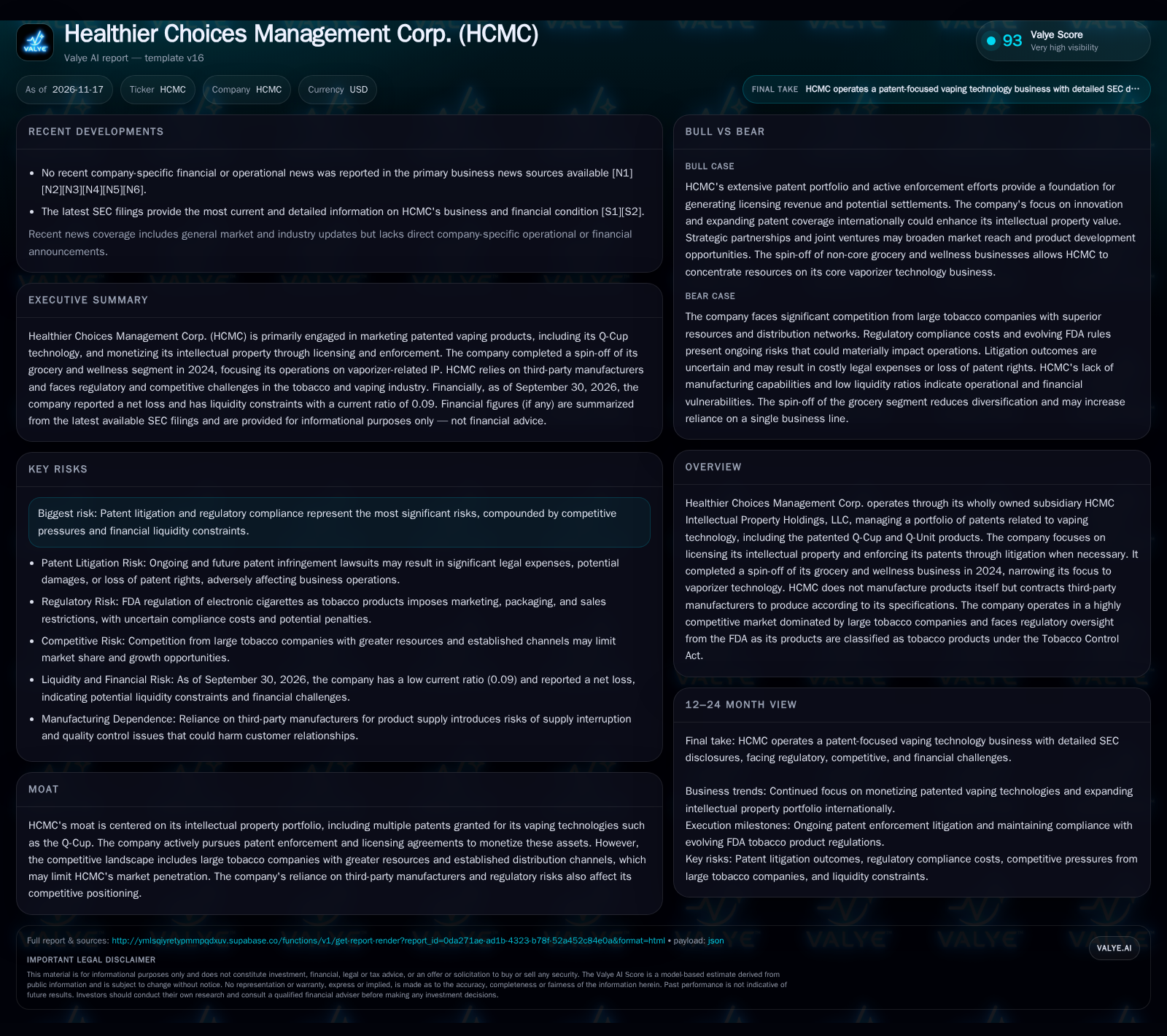
Healthier Choices Management Corp. (HCMC) has repositioned itself as a specialized intellectual property company following its 2024 spin-off of grocery and wellness operations. Now focused on licensing and enforcing its portfolio of vaping-related patents—including the proprietary Q-Cup—HCMC aims to extract value through royalties, partnerships, and litigation. The outcome of high-stakes patent disputes and the company’s capacity to secure meaningful licensing deals will likely dictate its future trajectory. [S1] [S2]
Acute Liquidity Stress and a Focused IP Portfolio Define HCMC’s Present State
HCMC’s latest SEC filings show the company recorded a net loss of $315,418 for the quarter ended September 30, 2026. Cash and equivalents stood at just $82,151, and current liabilities far exceeded current assets, yielding a current ratio of 0.09. This signals severe liquidity pressure and leaves little margin for operational error or unforeseen expenses. [S2]
Following the September 2024 spin-off of its grocery and wellness business (now traded as HCWC), HCMC is now a narrowly focused entity centered on its vaporizer technology IP, notably the Q-Cup product line and related patents. [S1]
The company continues to pursue enforcement of its patents, including lawsuits filed against major tobacco companies such as Philip Morris USA and R. J. Reynolds Vapor Company; some litigation has been dismissed, but enforcement and appeals are ongoing. [S1]
HCMC remains a non-manufacturing entity, relying on third-party manufacturers to produce its products to specification—introducing supply chain and quality control risks if relationships falter. [S1]
Monetizing Patents: Royalty Streams, Litigation, and the Challenge of Scale
HCMC’s business model is predicated on generating revenue through licensing its patented vaporizer technologies, extracting royalties from manufacturers or distributors who use its IP, and seeking settlements or awards via patent enforcement litigation. This model is highly leveraged to the value and defensibility of its patent portfolio. [S1]
The economics of IP monetization can be attractive if patents are both defensible and widely adopted by industry players. However, revenue visibility is inherently lumpy and unpredictable: licensing deals and legal settlements are episodic, not recurring, and are subject to counterparty negotiation and legal outcomes.
HCMC’s lack of in-house manufacturing means it does not capture manufacturing or distribution margins; it instead contracts production on a purchase-order basis, holding inventory for distribution. This limits fixed cost exposure but also means the company cannot directly drive volume growth or benefit from manufacturing scale economies. [S1]
The company’s financials reflect a cost base that includes ongoing legal expenses, regulatory compliance, and fixed overhead, with no evidence of material recurring revenue. [S2]
Patent Portfolio as Moat: Strengths and Structural Weaknesses in the Vaping Value Chain
HCMC’s principal competitive asset is its suite of patented vaping technologies, most notably the Q-Cup—a quartz-cup-based system for vaporizing cannabis or CBD concentrates. The company’s strategy relies on the uniqueness and enforceability of these patents to secure licensing deals or legal settlements from larger industry players. [S1]
However, the vaping and e-liquid market is dominated by large tobacco companies with deep resources, established distribution, and broad product portfolios. These incumbents can afford protracted legal battles and may be able to design around contested patents, reducing HCMC’s leverage in negotiations.
Regulatory risk is another critical factor: HCMC’s products are classified as tobacco products by the FDA, subjecting them to evolving marketing, packaging, and sales restrictions. Compliance costs and the risk of adverse regulatory changes can erode any narrow IP advantage.
The company’s lack of manufacturing or direct distribution infrastructure also means it must rely on partners or licensees to realize the commercial potential of its IP. This weakens its position relative to vertically integrated peers and increases vulnerability to supply chain disruptions or unfavorable contract terms.
If Licensing Accelerates: Successful Enforcement Could Unlock Material Revenue
A favorable scenario for HCMC would involve securing one or more substantial licensing or settlement agreements with major industry players, validating the strength of its Q-Cup patents and generating significant, potentially recurring royalty streams. This could occur if court rulings uphold HCMC’s patents against infringement challenges and counterparties opt to settle rather than risk ongoing litigation. [S1]
Strategic partnerships or joint ventures that leverage HCMC’s IP, particularly if they involve global players or new product categories (such as cannabis vaporization), could further broaden revenue sources and enhance the company’s negotiating position.
Confirmation of this scenario would require disclosure of new, material licensing agreements, favorable legal judgments, or a marked increase in royalty revenue in future filings. Evidence of expanded international patent protection or new partnerships would also support the upside case.
Falsification would occur if litigation outcomes consistently favor defendants, if patent claims are invalidated, or if HCMC fails to announce meaningful licensing deals despite ongoing enforcement efforts.
Sustained Legal and Financial Strain Amid Episodic Licensing Activity
The most plausible near-term scenario is that HCMC continues to pursue licensing and enforcement opportunities but faces ongoing legal expenses, regulatory hurdles, and operational constraints. Licensing revenue may be sporadic and insufficient to cover costs, leading to continued net losses and persistent liquidity pressure. [S2]
HCMC’s ability to maintain operations will likely depend on its capacity to secure bridge financing or renegotiate supplier and creditor terms, absent a major legal or licensing breakthrough.
This scenario would be confirmed by continued net losses, minimal or negative cash flow, and the absence of material new licensing disclosures in subsequent quarters. Conversely, evidence of stabilized or improving liquidity, new revenue sources, or a reduction in legal expense intensity would challenge the base case.
Acute Liquidity Event or Adverse Litigation Outcome Forces Restructuring
The most adverse scenario involves a combination of continued net losses, inability to secure additional funding, and/or negative legal outcomes (such as patent invalidation or costly settlements). [S2]
A string of unfavorable court rulings or regulatory actions could also undermine the perceived value of the company’s IP portfolio, eroding negotiating leverage and making it harder to attract partners or investors.
Confirmation of this scenario would include missed payments to creditors, public disclosure of going concern warnings, or the announcement of asset sales, creditor negotiations, or bankruptcy filings. A sharp increase in legal liabilities or loss of key patent protections would further reinforce the downside risk.
Milestones That Will Clarify HCMC’s IP Monetization Prospects and Financial Survival
Disclosure of any new, material licensing or royalty agreements—especially with large industry incumbents—would provide concrete evidence of IP monetization progress.
Updates on the status and outcomes of ongoing patent litigation, including appeals and inter-partes reviews, are critical to assessing the future value of the Q-Cup patent family.
A useful metric would be detailed reporting of quarterly royalty and licensing revenue, which would clarify the sustainability and scale of the company’s business model.
Any announcement of new strategic partnerships or joint ventures, particularly those involving international expansion or cannabis-related applications, could alter the company’s revenue trajectory.
Evidence of supply chain disruptions or changes in third-party manufacturing relationships would signal operational vulnerability.
Regulatory developments affecting the FDA’s oversight of vaping products, or changes to the Tobacco Control Act’s scope, could materially alter the compliance cost structure or product viability.
Disclaimer: This is research-only, informational analysis and not investment advice. It may include AI-generated interpretation and general industry context. Always verify important details using primary sources.

Comments