
HCW Biologics Reports Q1 Profit as Autoimmune and Oncology Pipeline Advances
The company posts an unusual quarterly net income amid ongoing clinical developments and licensing progress in fusion protein and T-cell engager therapies.
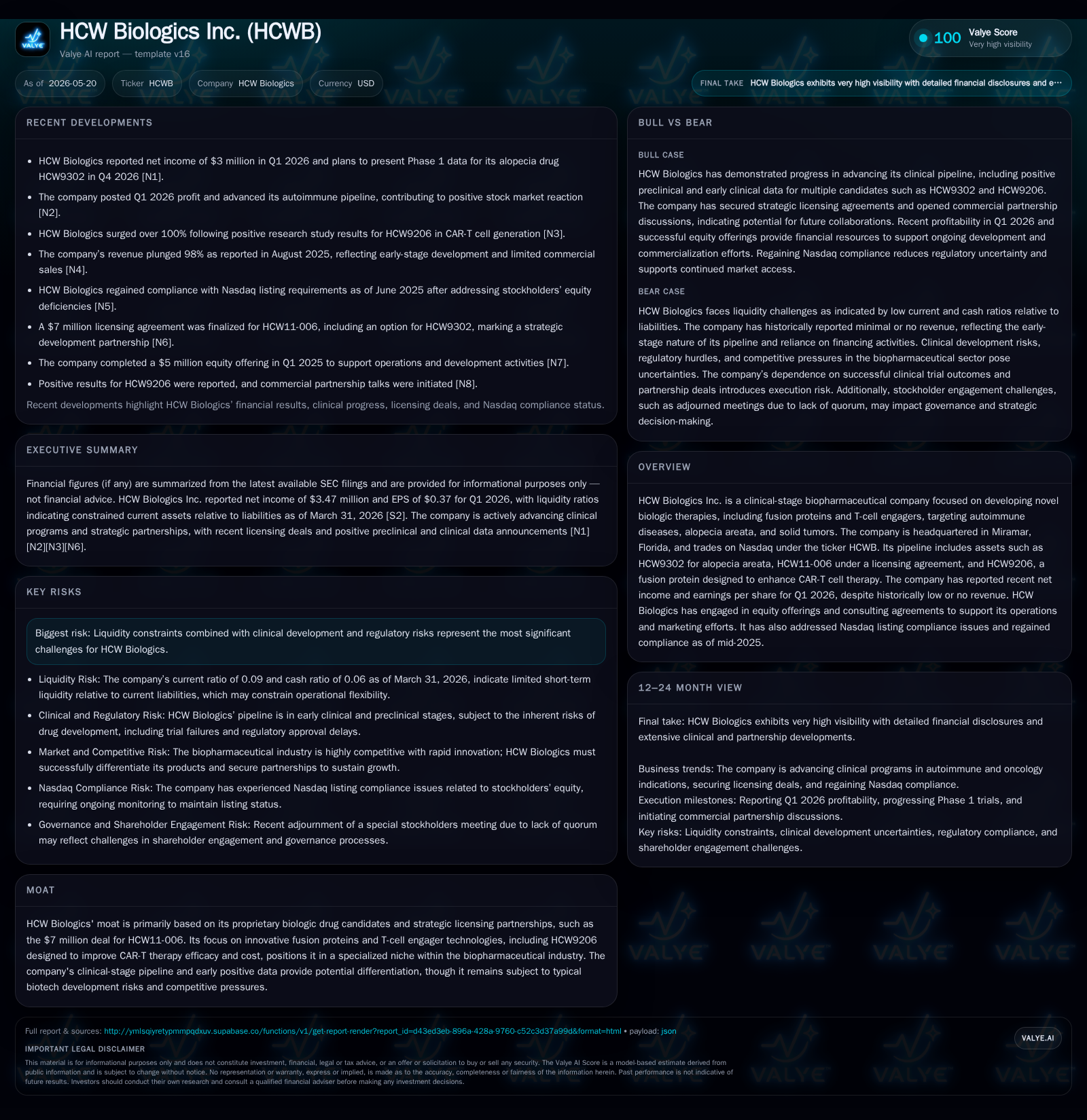
HCW Biologics reported a net income of approximately $3 million in Q1 2026 despite being a clinical-stage company without commercial products, reflecting improved financial management alongside pipeline progress. Key near-term catalysts include anticipated Phase 1 data for autoimmune-focused HCW9302 by Q4 2026 and recent licensing deals that bolster capital and validate its biologics platform. The company’s focus on innovative fusion proteins targeting alopecia areata and solid tumors positions it within a specialized biotech niche, though liquidity constraints and regulatory risks remain significant challenges.
Q1 2026 Operating Update: Profitability and Pipeline Momentum
HCW Biologics reported a notable net income of approximately $3 million for the quarter ended March 31, 2026, a rare event for clinical-stage biotechs typically operating at losses due to heavy R&D expenditures before product commercialization [S2][N1]. This financial milestone accompanies advancing operational momentum driven by the company’s evolving pipeline.
A critical upcoming catalyst is the Phase 1 clinical data readout expected in late 2026 for HCW9302, a fusion protein candidate targeting alopecia areata [N1]. Positive results could materially validate the company's platform within autoimmune disorders and bolster investor confidence regarding its commercial potential
Simultaneously, HCW Biologics presented encouraging preclinical data on HCW11-018b addressing solid tumors, broadening their therapeutic reach into oncology beyond autoimmune indications [N3]. Additionally, the company secured an exclusive worldwide licensing agreement for HCW11-006 along with options to license Greater China rights for HCW9302's in vivo applications. These arrangements exemplify strategic monetization of intellectual property through structured collaborations producing upfront payments and potential milestone revenues [S12][S19].
Business Model: Fusion Proteins and T-cell Engagers Focused on Licensing Revenue
As a clinical-stage developer specializing in biologics such as fusion proteins and T-cell engagers, HCW Biologics generates revenue primarily through milestone payments and upfront license fees rather than product sales given its lack of approved commercial products [S1]. The licensing deal involving HCW11-006 notably included an upfront payment received by March 2026, demonstrating active capital generation from intellectual property assets [S12][S19].
The company's proprietary candidates—HCW9302 for autoimmune diseases like alopecia areata and HCW9206 aimed at enhancing CAR-T cell therapy efficacy—reflect focused innovation intended to address immunotherapy limitations. Contract research agreements underpinning antibody sequences and data ownership further secure key components of the biologics pipeline [S1].
This model typifies early-stage biopharma companies where substantial R&D investments precede commercialization milestones. Licensing revenues provide non-dilutive capital supporting ongoing development while internal efforts target regulatory progress to enhance valuation.
Competitive Environment: Resource Challenges Amid Rapid Innovation
HCW Biologics operates within highly competitive therapeutic areas characterized by rapid technological advances. Large pharmaceutical companies benefit from extensive resources across drug development stages including clinical trials, manufacturing scale-up, regulatory approvals, and marketing — advantages that smaller firms like HCWB must strategically navigate [S1].
Patient recruitment for novel immunotherapies poses additional challenges due to competition among trials in autoimmune and oncology domains where standard treatments exist or emerging therapies compete. Nonetheless, HCWB’s focus on distinct fusion protein modalities offers potential differentiation if supported by compelling clinical data.
The settlement of previous legal disputes has reduced management uncertainty but contingent obligations related to these settlements remain potential operational risks [S1]. Sustaining competitive positioning will depend on translating early-stage science into validated clinical outcomes amid evolving regulatory frameworks domestically and internationally.
Growth Drivers: Clinical Milestones, Licensing Expansion, and Pipeline Diversification
Near-term growth hinges on the Phase 1 data readout from HCW9302 anticipated by Q4 2026 [N1][S2]. Demonstrating safety and efficacy at this stage is essential for progression into later trials paving regulatory approval paths
Licensing partnerships continue unlocking capital while expanding geographic reach. The exclusive global license granted to WY Biotech covers development and commercialization rights for HCW11-006 with upfront payment realized fully by March 2026; options to extend Greater China rights for HCW9302 further enhance commercial prospects in a key market [S12][S19]
Advancing oncology assets like HCW11-018b diversifies risk exposure while aligning with immuno-oncology growth trends supported by companion biologics designed to optimize CAR-T therapy efficacy [N3]. This portfolio breadth increases optionality but depends heavily on future clinical validation.
Risks: Liquidity Constraints, Regulatory Complexity, and Development Uncertainty
Despite recent profitability signals, liquidity remains strained [F1]. As of March 31, 2026, current assets were approximately $1.7 million against current liabilities near $20 million, yielding a precarious current ratio around 0.09 that underscores urgent working capital pressures requiring frequent financing or milestone-triggered inflows
Regulatory risks span multiple jurisdictions covering clinical trial requirements, reimbursement policies post-approval, pricing controls especially outside the U.S., plus compliance costs related to manufacturing quality standards—common challenges confronting novel biologic developers with global ambitions [S1]
Legal settlement-related contingent promissory notes expose potential episodic cash outflows tied to future milestone achievements that could impact liquidity if triggered unexpectedly [S1]
R&D productivity risks persist as failure in any late-phase trial could delay or halt commercialization timelines significantly impacting valuation consistent with biotech sector norms.
Outlook: Key Catalysts to Monitor
Investors should watch the following near-term milestones:
- Release of Phase 1 data from the alopecia candidate HCW9302 by Q4 2026 providing essential validation or directional insight into therapeutic viability [N1]
- Additional licensing agreements potentially extending regional presence or funding capacity especially in Asia-Pacific markets as demonstrated by WY Biotech collaboration [S12]
- Patient enrollment rates during ongoing trials serving as indicators of operational execution efficiency affecting development timelines
- Management’s ability to maintain Nasdaq listing standards through equity or deleveraging actions post prior compliance challenges [S25]
- Progression updates on CAR-T enhancement molecule HCW9206 alongside shifts from preclinical to clinical phases in oncology assets offering synergistic growth opportunities
Financial Summary Snapshot
While historically operating at losses typical of R&D-intensive biopharma (operating loss was approximately -$13.16 million year-end December 2025), the Q1 net income near $3 million likely reflects timing of license fee recognition or cost controls [S2][F1]. Cash & equivalents stood around $1.23 million at quarter-end; total debt last reported near $2 million as of early 2024 with no update since but working capital pressures remain acute given the substantial gap between current liabilities and assets highlighting ongoing funding dependency [F1].
In sum, sustaining operations through upcoming developmental milestones will require continued capital raises or partnership-driven revenue generation balanced against dilution concerns.
This analysis integrates the latest SEC filings through May 14, 2026 ([S2], [S3], [F1]) alongside recent press releases ([N1], [N3]) without speculative forecasts. It aims to contextualize HCW Biologics Inc.’s operating developments within sector-specific dynamics shaping its progression.
Disclaimer: This is research-only, informational analysis and not investment advice. It may include AI-generated interpretation and general industry context. Always verify important details using primary sources.

Comments