
HCW Biologics: Innovation Pipeline Collides with Acute Liquidity Risk and the High Bar of Clinical Proof
With a differentiated approach to immunotherapeutics and CAR-T cell therapy, HCW Biologics is progressing on early clinical data and strategic licensing, but faces immediate liquidity crises and going-concern warnings. The company’s future now hinges on clinical inflection points, partnership monetization, and urgent capital access.
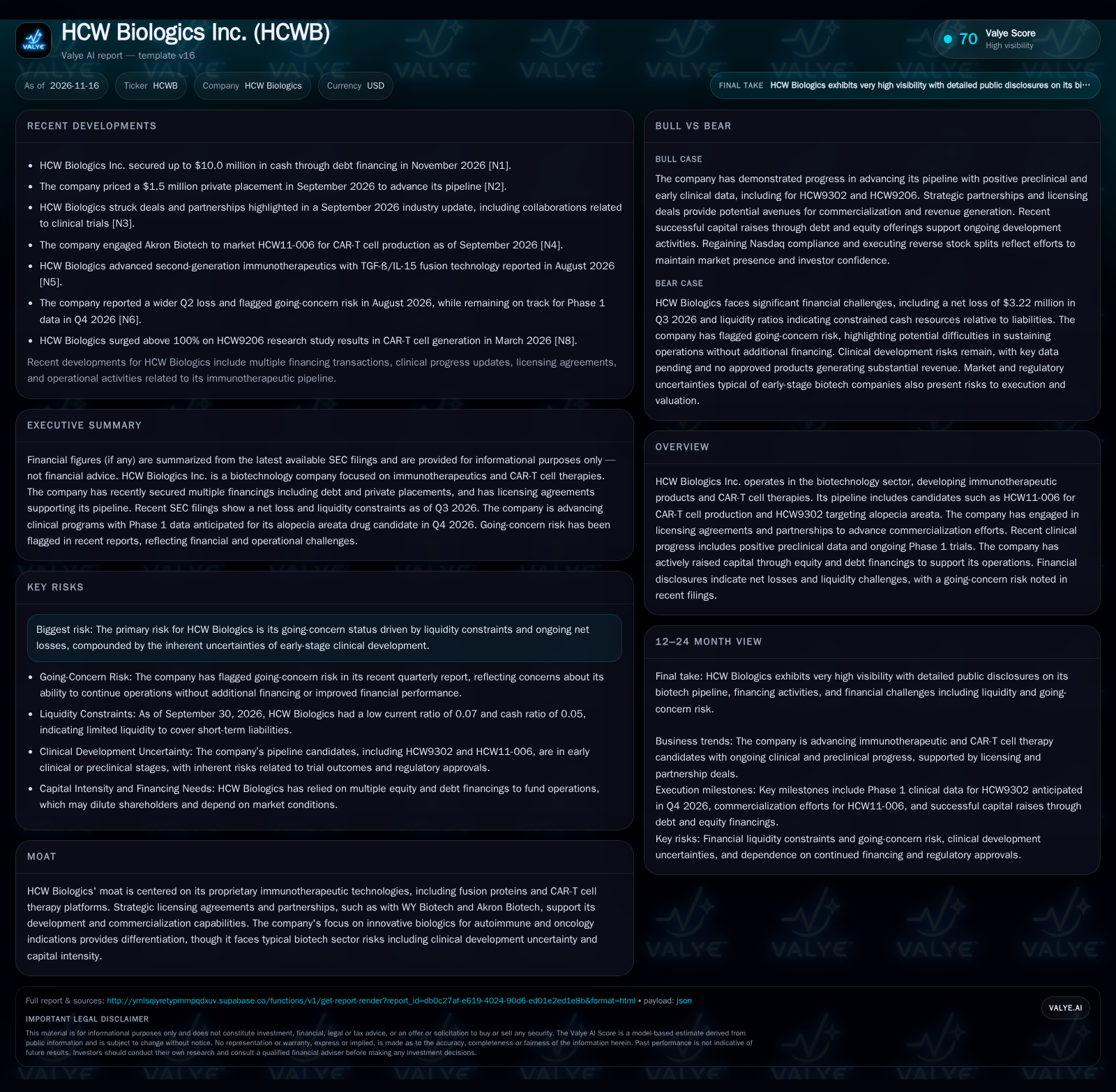
HCW Biologics is advancing proprietary immunotherapeutics and CAR-T cell candidates, including ongoing Phase 1 trials and licensing activity. Recent financings and partnerships offer some runway, but near-term survival and long-term value depend on successful clinical data, monetization of deals, and continued external funding [S2] [N1] [N2] [N6].
HCW Biologics sits at a precarious crossroads: its proprietary fusion protein and CAR-T platforms have attracted licensing deals and partnership interest, but the company’s balance sheet is under acute strain. While recent debt and equity financings provide some short-term breathing room, the company’s ultimate fate depends on delivering positive clinical milestones, extracting value from its partnerships, and securing additional capital in a volatile early-stage biotech environment. The coming quarters will test both the scientific promise and financial survivability of the HCW Biologics model.
Acute Liquidity Shortfall and Critical Clinical Milestones Define the Current Moment
The company reported a current ratio of 0.07 for the period. [S2] [N6] This has triggered a formal going-concern warning, meaning management and auditors question the company’s ability to continue operations without new funding or a dramatic change in financial performance.
Despite these headwinds, HCW Biologics is not standing still. It has secured a $10 million debt financing in November 2026 and closed a $1.5 million private placement two months prior, providing some runway to support operations and critical clinical activity [N1] [N2]. On the pipeline front, the company is targeting a major near-term milestone: Phase 1 clinical data for its alopecia areata candidate, HCW9302, is anticipated in Q4 2026—a data readout that could prove pivotal for both scientific validation and future funding [N6].
Commercially, the company has signed a $7 million license deal with WY Biotech for HCW11-006 (with an option on HCW9302) and has engaged Akron Biotech to market HCW11-006 for CAR-T cell production [S2] [N4]. These partnerships signal external validation and potential non-dilutive capital, but the company remains in a clear high-risk, high-reward zone.
How HCW Biologics’ Model Relies on Platform Monetization, High Fixed Costs, and Capital Access
The business model of HCW Biologics is typical of early-stage biotech: it is capital-intensive, with negative operating leverage until a product either reaches market or secures substantial out-licensing or partnership revenue. The company’s most immediate revenue drivers are licensing fees and milestone payments, such as the $7 million deal with WY Biotech for HCW11-006. Unlike mature pharma, there is no recurring product revenue; instead, the economics hinge on successful clinical advancement and the ability to convert scientific progress into licensing, partnership, or eventual commercialization cash flows.
Fixed costs are high—chiefly R&D, clinical trial expenses, and G&A—while variable costs are relatively low until commercial manufacturing or sales scale up. This structure means that each incremental dollar of revenue (from licensing, milestone, or partnership fees) can disproportionately improve the bottom line, but the company must first cross a high break-even threshold.
Given the $3.22 million net loss in Q3 2026 and ongoing negative EPS, HCW Biologics is structurally dependent on frequent external capital raises—either equity, debt, or non-dilutive partnership payments [S2]. The recent $10 million debt financing and $1.5 million private placement are critical, but absent a commercial-stage product or regular milestone payments, the company’s economics remain highly vulnerable to market sentiment and the timing of clinical successes.
Differentiation Through Fusion Protein Technology Amid Intense Sector Competition
HCW Biologics’ competitive edge is rooted in its proprietary immunotherapeutic platforms, particularly TGF-ß/IL-15 fusion proteins designed to modulate immune responses in cancer and autoimmune disease. The company’s HCW11-006 and HCW9302 candidates offer novel mechanisms that, if proven, could carve out a unique niche within the crowded CAR-T and immunomodulation landscape.
However, the competitive environment for CAR-T and next-generation immunotherapies is intense and includes both established pharma and numerous biotech peers. Differentiation typically comes from demonstrating superior efficacy, safety, manufacturing simplicity, or cost advantages in clinical trials. While preclinical and early clinical data have been positive, much larger competitors often have deeper pipelines, greater capital resources, and established commercial infrastructure.
Strategic partnerships—such as the licensing deal with WY Biotech and the marketing collaboration with Akron Biotech—are critical for leveraging limited resources and gaining commercial traction. Still, until clinical proof-of-concept is established and commercial terms are realized, the company’s position remains aspirational rather than defensible.
Successful Clinical Data and Partnership Monetization Could Unlock Transformative Value
The bullish scenario for HCW Biologics is predicated on two interlocking catalysts: first, the company delivers positive Phase 1 clinical data for HCW9302 in Q4 2026, and second, this data (along with ongoing progress in CAR-T programs) triggers either further licensing deals, milestone payments, or strategic investments.
If the company can translate early clinical wins into substantial non-dilutive capital—either from WY Biotech exercising its option for HCW9302, or from Akron Biotech driving commercial adoption of HCW11-006—then the cash runway could extend materially, reducing dependence on dilutive equity or costly debt. Successful data could also attract larger biotech or pharma partners, potentially leading to buyouts or co-development deals.
Confirmation of this scenario would include: clear, positive Phase 1 data for HCW9302; public disclosure of milestone payments or expanded licensing deals; and evidence of commercial uptake or customer interest in HCW11-006 via Akron Biotech. Falsification would occur if clinical data is inconclusive, if partnerships stall, or if no additional non-dilutive funding materializes.
Survival by Serial Financing and Incremental Progress While Awaiting Inflection
The most plausible near-term trajectory for HCW Biologics is a continued race between capital consumption and incremental pipeline progress. In this scenario, the company manages to secure sufficient intermittent funding—through a mix of debt, private placements, and modest partnership payments—to sustain operations while it advances its lead candidates through early clinical stages.
Clinical data for HCW9302 in Q4 2026 may be promising but not transformative, supporting continued development but not triggering major external investment or commercial deals. Partnership activity, such as with Akron Biotech, yields some revenue or non-dilutive capital but not enough to fully offset burn. The company remains reliant on capital markets access, with periodic going-concern warnings and dilution risk persisting.
This scenario is confirmed by ongoing small-scale financings, incremental clinical progress, and no major commercial breakthroughs. It would be falsified if either a major clinical failure or an unexpected commercial windfall dramatically alters the company’s trajectory.
Liquidity Exhaustion or Clinical Setbacks Force Restructuring or Asset Sale
The adverse scenario for HCW Biologics is driven by the combination of persistent net losses, inability to secure additional funding, and/or disappointing clinical results. If the company is unable to raise further capital—either due to unfavorable market conditions, dilution limits, or lack of investor confidence—its reported cash balance could be exhausted within a single quarter, triggering layoffs, restructuring, or forced asset sales.
A negative or inconclusive Phase 1 readout for HCW9302 would likely close off near-term partnership or licensing opportunities, further tightening the capital vise. In extreme cases, the company could be delisted or enter bankruptcy if no strategic alternatives emerge.
This scenario is confirmed by failed or delayed financing attempts, formal restructuring announcements, or regulatory filings indicating asset sales or bankruptcy proceedings. It would be falsified if the company secures a major capital infusion or delivers unexpectedly strong clinical data that unlocks new partnership value.
Milestones That Will Determine Whether HCW Biologics Crosses the Survival Threshold
Phase 1 clinical data for HCW9302 in alopecia areata (expected Q4 2026)—the outcome and quality of this data will be pivotal for future funding and partnership interest.
Disclosure of milestone payments or option exercise by WY Biotech related to HCW11-006 or HCW9302—would indicate commercial traction and non-dilutive capital inflow.
Evidence of commercial adoption or revenue from Akron Biotech’s marketing of HCW11-006—a useful metric would be customer numbers, order volumes, or partnership revenue, if disclosed.
Updates to going-concern warnings or auditor statements—removal or escalation of these warnings would signal changing financial risk.
Progress on other pipeline candidates, especially in oncology indications—new clinical or preclinical data could diversify risk and attract additional partners.
Nasdaq listing status—continued compliance or new reverse stock splits may signal market perception and capital access health.
Disclaimer: This is research-only, informational analysis and not investment advice. It may include AI-generated interpretation and general industry context. Always verify important details using primary sources.

Comments