
Hamilton Insurance Group Advances Specialty Book with Data-Driven Underwriting and Capital Discipline
Hamilton leverages diversified specialty platforms, tech-enabled underwriting, and disciplined capital management for durable growth.
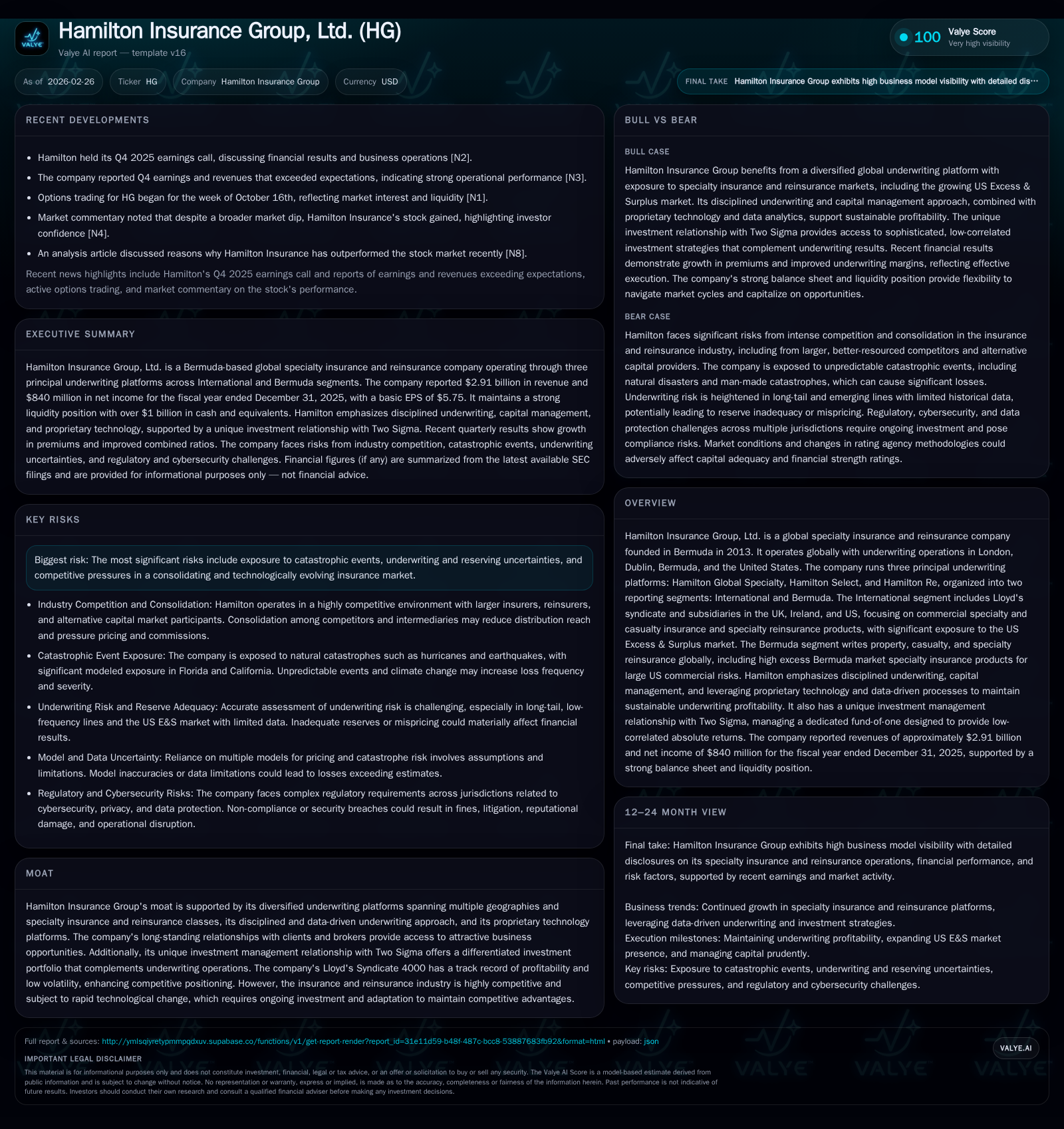
Hamilton Insurance Group, Ltd. has exhibited robust revenue and net income growth through its diverse underwriting platforms spanning global specialty insurance and reinsurance segments. Its strategic expansion in the US Excess & Surplus market paired with data-driven underwriting analytics underpins its competitive moat. Capital allocation remains prudent, with a focus on sustaining underwriting profitability while maintaining strong returns on equity supported by a unique investment partnership with Two Sigma. Going forward, careful navigation of catastrophic risk and technological evolution will shape sustainable value creation.
Performance Momentum Fueled by Diversified Specialty Platforms
Hamilton Insurance Group has experienced substantial growth over the last three fiscal years, underpinned by its multi-platform underwriting approach that includes the International segment (Hamilton Global Specialty and Hamilton Select) and the Bermuda segment (Hamilton Re).
From fiscal year (FY) 2023 through FY2025, consolidated revenues climbed from approximately $1.57 billion to $2.91 billion, reflecting a compound annual growth rate exceeding 24%, according to company filings [F1]. This increase aligns with expanded premium generation from Lloyd’s Syndicate 4000 within the International segment and growth in Bermuda-based reinsurance operations.
Net income exhibited even stronger momentum, expanding from roughly $280 million in FY2023 to $840 million by FY2025, a near tripling over this period and a remarkable 37% increase year-over-year in 2025 [F1]. This profitability surge derives from disciplined underwriting that balances risk exposures across casualty insurance and specialty reinsurance classes while capitalizing on higher-margin niche products.
Operating cash flow has demonstrated steady improvement commensurate with earnings gains: from $283 million in FY2023 to $842 million in FY2025, a 10.9% increase year-over-year [F1]. This robust cash generation bolsters Hamilton’s ability to maintain underwriting agility and support strategic capital deployment.
Segment performance further clarifies these results: Lloyd’s Syndicate 4000 contributes significant premiums predominantly sourced from the U.S. Excess & Surplus market, noted for its consistent underwriting profitability and historical low volatility compared to peers at Lloyd’s [S1]. Meanwhile, Bermuda-based Hamilton Re focuses on high-excess specialty insurance for large U.S. commercial risks as well as broad property and casualty reinsurance worldwide [S1].
Historical performance (annual)
| FY | Rev ($bn) | Net ($mm) | CFO ($mm) | Rev YoY | Net YoY |
|---|---|---|---|---|---|
| 2025 | 2.9 | 840 | 842 | +24.7% | +37.0% |
| 2024 | 2.3 | 613 | 759 | +48.3% | +118.8% |
| 2023 | 1.6 | 280 | 283 |
Source: SEC companyfacts cache [F1].
Capital returns and efficiency (annual)
| FY | Buybacks ($mm) | ROE% |
|---|---|---|
| 2025 | 113 | 29.8 |
| 2024 | 150 | 26.3 |
| 2023 | 2 | 13.7 |
Source: SEC companyfacts cache [F1].
Financials sourced from Hamilton Insurance Group consolidated filings [F1]. Buybacks represent common share repurchases.
Strategic Expansion in the U.S. Excess & Surplus Market
Hamilton Select represents a focused thrust into the U.S.'s hard-to-place casualty niche within the Excess & Surplus (E&S) market segment targeting small-to-mid-sized commercial accounts [S1]. The company highlights meaningful near- to medium-term profitable growth potential here based on increased submissions following market shifts away from admitted carriers toward non-admitted ones post-hard market cycles [N1], [S2].
The platform leverages specialized underwriting expertise combined with data-driven risk segmentation to offer tailored casualty lines that many traditional carriers avoid due to complexity or volatility concerns [N1]. Growth constraints may arise from competitive pressures as other specialty insurers vie for similar accounts; however, Hamilton's established broker relationships and proprietary pricing models provide differentiation [S1]. Segment revenue contribution shows upward trajectory but is less explicitly detailed — hence monitoring quarterly filings for disclosure on volume trends remains important.
Data and Technology as Competitive Keys in Underwriting
At the core of Hamilton’s underwriting discipline lies a proprietary technology suite that supports sophisticated risk assessment processes encompassing actuarial model enhancements and AI-driven analytics [S1], [N2]. This infrastructure enables dynamic risk-adjusted pricing strategies that improve loss ratio visibility and reserve adequacy management across long-tail and specialty lines.
The company deploys real-time data ingestion capabilities along with machine learning algorithms to refine exposure profiling continuously—an approach increasingly essential given heightened regulatory scrutiny over reserve assumptions and model validation standards within specialty insurance sectors [S1]. This technology edge not only aids profitability but also facilitates nimble portfolio repositioning in response to emerging claim patterns or catastrophe scenarios.
Capital Management: Balancing Growth and Return on Equity
Hamilton maintains prudent capital strategies designed to sustain robust underwriting margins while optimizing shareholder returns [S4], [S16], [S27]. At year-end FY2025, shareholders' equity stood at approximately $2.82 billion — up over $490 million from prior year levels — primarily driven by retained earnings alongside moderate share repurchases totaling around $113 million versus $150 million in the previous year [F1], [S16].
The company executed buybacks selectively rather than aggressively given the opportunity cost of reinvesting capital in organic growth areas; this restraint aligns with maintaining adequate liquidity buffers amid cyclical risks inherent in property-casualty cycles [S15],[S16]. Debt is limited, centered on a $150 million term loan facility maturing mid-2028 with customary covenants ensuring financial strength ratings remain intact [S5], [S6].
Return on equity for FY2025 calculates near an impressive ~29.8%, underscoring efficient use of equity capital generated through sustained profitability and effective risk controls [F1]. Liquidity profiles are strengthened via access to letter of credit facilities exceeding $1 billion that support collateral requirements chiefly at Lloyd’s syndicate operations, enabling flexible capital deployment across geographies without overleveraging.
Investment Partnership with Two Sigma: An Unconventional Asset Perspective
A distinct element underpinning Hamilton's balance sheet robustness is its unique investment management relationship with algorithmic-focused Two Sigma Investments [S1]. This collaboration injects quantitative rigor into asset allocation decisions governing the company’s surplus portfolio.
Unlike typical specialty insurers whose portfolios skew heavily toward conventional fixed income or equities managed via traditional asset managers, Hamilton benefits from Two Sigma's systematic investment strategies aimed at reducing volatility while capturing alpha opportunities through advanced data science techniques.
This asset-liability matching synergy complements underwriting discipline by smoothing investment returns across market cycles—a competitive advantage particularly valuable given frequently volatile insurance loss patterns within casualty and reinsurance classes.
Navigating Risks: Catastrophes, Reserving, and Technological Change
As detailed extensively in regulatory disclosures [S23], Hamilton faces several inherent risks characteristic of global specialty insurers:
- Exposure to natural catastrophes remains primary despite geographic diversification; loss severity spikes can pressure claims reserves unexpectedly.
- Reserving uncertainties prevail especially within long-tail liability lines where loss development patterns may evolve over extended periods necessitating conservative reserve adequacy testing using stochastic modeling enhancements.
- Industry consolidation intensifies competition alongside alternative capital inflows applying downward pressure on rates.
- Rapidly evolving technology landscapes require continuous investments both to update proprietary underwriting platforms while safeguarding intellectual property amidst cybersecurity threats.
- Compliance complexities related to sanctions regimes across multiple jurisdictions add operational risk layers demanding rigorous internal controls.
Management acknowledges these risks but emphasizes its strategic focus on disciplined underwriting coupled with forward-looking reserve analytics and technology safeguards designed to mitigate impact while sustaining growth trajectories.
Outlook: Growth Opportunities Amid Evolving Market Dynamics
While explicit forward guidance remains limited in public disclosures ([N1], [N2]), areas warranting close observation include premium rate trends within US E&S casualty segments served by Hamilton Select along with ongoing performance metrics of Lloyd's Syndicate 4000 given its outsized contribution to International segment profitability.
Continued rate adequacy improvements post recent hard markets will be critical for preserving underwriting margins especially as business shifts between admitted versus non-admitted channels stabilize or unfold anew depending on macroeconomic cycles and catastrophe frequency.
Moreover, success scaling proprietary technology applications throughout broader platforms could unlock additional profitable niches previously underserved or inaccessible due to lack of granular risk insight or pricing sophistication.
In summary, Hamilton's trajectory blends steady organic expansion across diversified desks leveraging enhanced data infrastructure balanced against vigilant capital stewardship—a prudent formula delivering sustained profitability amidst an evolving specialty insurance environment.
This report synthesizes currently available company filings and recent public disclosures as of February 26, 2026; it does not provide investment advice or projections beyond stated corporate commentary or factual reporting.
Disclaimer: This is research-only, informational analysis and not investment advice. It may include AI-generated interpretation and general industry context. Always verify important details using primary sources.

Comments