
Global Gas Corp Advances Modular Hydrogen Solutions amid Liquidity Constraints
Global Gas Corporation focuses on modular, multi-output hydrogen and carbon recovery projects while contending with substantial liquidity risks and no current paying customers.
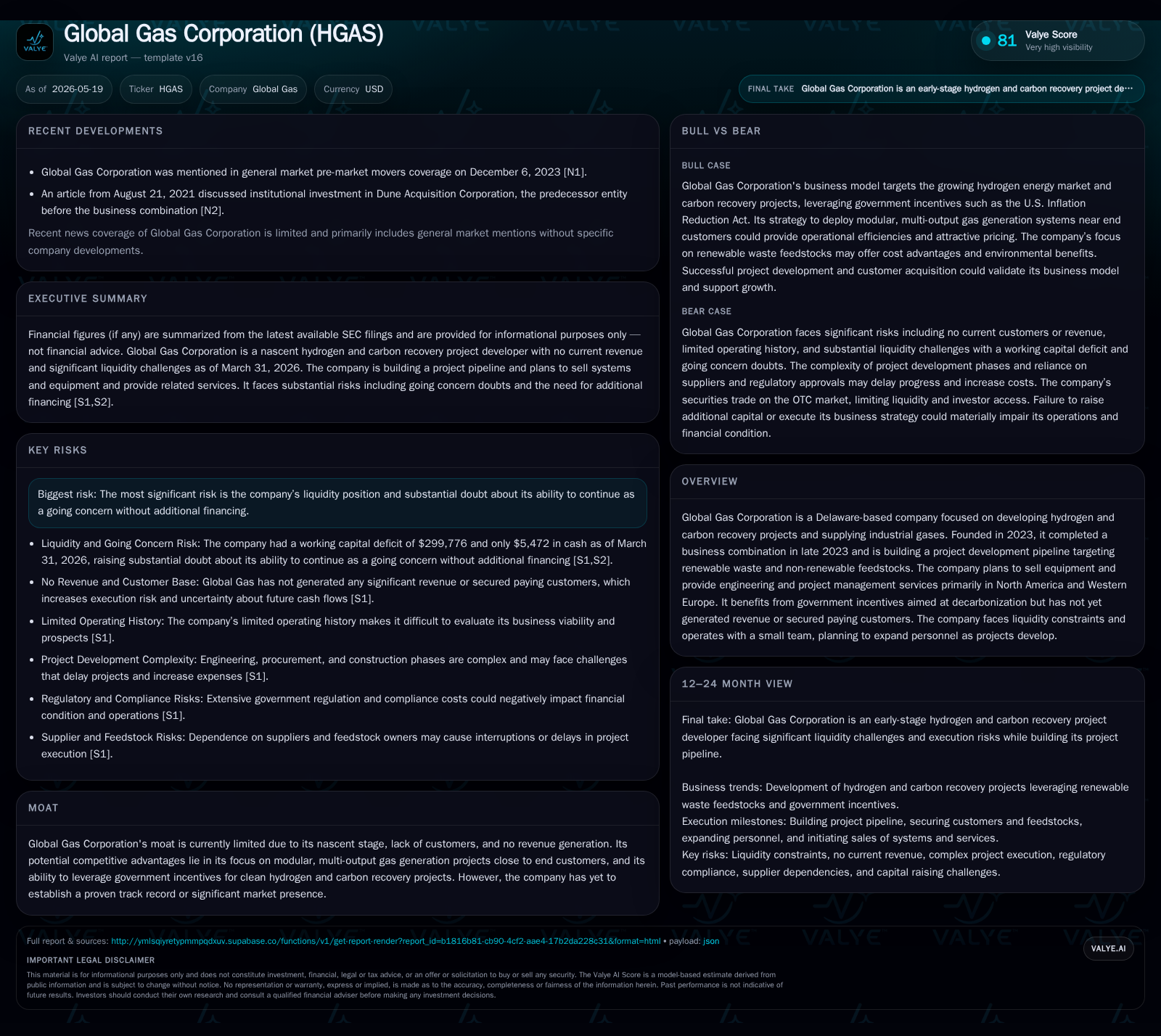
In its latest quarter ending March 31, 2026, Global Gas Corporation reiterated its strategy to develop modular hydrogen generation and carbon recovery projects located near end users, targeting cost-efficient production typically associated with larger plants. Operating without revenue-generating customers and facing a significant working capital deficit and liquidity constraints, the company depends heavily on external financing to sustain operations. Positioned in the nascent green hydrogen sector, Global Gas aims to capitalize on government incentives under frameworks like the U.S. Inflation Reduction Act by offering multiple gas products from single feedstocks; however, execution risk and funding remain critical challenges.
Recent Operating Update
Global Gas Corporation's latest quarterly filing for the period ended March 31, 2026 [S2] highlights its continued status as an early-stage project developer without any current paying customers or recurring revenue streams. The company manages a modest cash balance of approximately $5,472 alongside a working capital deficit approaching $300,000 as of quarter-end; this ratio underscores acute liquidity pressures [S2], [F1]. Despite these constraints, management emphasizes the strategic intent to install modular hydrogen generation and carbon recovery assets close to end-user locations — often onsite — enabling production efficiencies normally reserved for large-scale plants. The firm intends that these modular systems can produce multiple output gases from single feedstocks at competitive cost points to win market share in North America and Western Europe.
Management actively monitors operating expenses — which include general administrative and sales/marketing costs — within financial planning forums led by the Chief Operating Decision Maker (CODM) to preserve cash runway [S2]. While operational activity remains focused on early-stage pipeline development rather than commercial execution, these spending controls are vital given constrained capital resources.
Business Model
Global Gas is structured primarily as a project developer and equipment supplier for hydrogen and carbon recovery solutions. Revenue generation is expected largely from sales of equipment such as electrolyzers, steam methane reformers, compressors, pumps, storage tanks, heat exchangers, dispensing systems, and analyzers tailored to clean gas application needs [S15]. Beyond hardware sales, the company offers engineering services including project feasibility analysis, design sizing, management solutions, and financing structures tied to each deployment.
The business model banks heavily on winning contracts with industrial gas consumers who seek localized clean energy sources especially for fuel-cell vehicles and low-carbon industrial uses. Proximity of installations to customers aims to reduce logistical costs associated with distribution of gaseous products. This 'modular multi-gas output' approach potentially confers pricing flexibility as each project generates hydrogen plus secondary outputs like pure CO2 or oxygen from waste or renewable feedstocks.
Importantly, Global Gas currently lacks secured purchase agreements or long-term offtake contracts—a significant weakness reflective of its startup phase without realized commercial scale [S15]. Customer acquisition hinges on convincing sizable industrial clients of economic benefits amid rising climate regulation pressures.
Industry Structure and Competitive Position
The clean hydrogen sector remains embryonic but rapidly evolving due to global decarbonization mandates. Competitors range from multinational industrial gas incumbents diversifying into renewables (e.g., Air Liquide, Linde) to specialized modular system providers focusing on scalability and feedstock versatility.
Global Gas positions itself distinctively by targeting high-value niche projects using modular designs that can provide onsite generation advantages. This contrasts with traditional centralized large-plant models requiring extensive pipeline infrastructure. The company also leverages anticipated subsidies stemming from policies such as the U.S. Inflation Reduction Act's hydrogen production tax credits—vital tailwinds reducing effective production costs [S16]
Nonetheless, Global Gas has yet to establish proven operational capabilities or deep market penetration that would meaningfully differentiate it beyond structural technological promises. Its limited organizational scale—currently a small team with plans for expansion only as projects mature—compounds competitive vulnerability against better-funded peers [S1].
Growth Drivers
Growth prospects rest on four interlinked pillars:
- Project Development Pipeline Expansion: Adding vetted potential projects after detailed customer interaction fosters a prospective backlog critical for scaling revenue [S16].
- Successful Equipment Sales: Transitioning from pipeline development into monetized sales of modular equipment is essential; near-term focus in 2026 is targeted here [S15].
- Government Incentives: Capitalizing on federal and regional subsidies that lower capital expenditures improves investment appeal by reducing pricing risks.
- Market Adoption of Hydrogen Energy: Rising demand driven by decarbonization in transportation fuels (fuel cells), industrial processing, and grid balancing catalyzes long-term volume growth.
Tracking KPIs such as finalized customer contracts, completed feasibility studies progressing into construction phases, the number of modular units sold/installations commissioned will be key milestones signaling growth trajectory health.
Risks / Watchpoints / Growth Constraints
Foremost risk emerges from Global Gas’ precarious liquidity position: cash barely covers minimal immediate obligations; the working capital deficit signals dependency on fresh equity or debt infusions for survival [S2], [S3], [F1]. The company recognizes ‘‘substantial doubt’’ about continuing as a going concern absent new financing commitments [S3].
Additional operational risks include:
- Delayed Project Execution: Regulatory hurdles around environmental permitting or local approvals could extend timelines beyond management’s optimistic forecasts [S14].
- Customer Acquisition Challenges: Intensive competition for industrial off-takers and uncertain pricing dynamics may limit contract closures.
- Technological Execution: Modular concepts must prove scalable while maintaining cost-efficiency; unanticipated technical issues may impair margins.
- Policy Dependence: Shifts in government incentives or climate policies could materially alter economic feasibility of projects.
Effective cost control against fixed overheads remains crucial given the absence of stable revenues.
What to Watch Next
Key developments that will offer insight into Global Gas' progress include:
- Public announcements of binding commercial contracts or memorandum of understanding (MOU) wins translating pipeline projects into booked sales.
- Evidence of fundraising success through equity issuances or alternative financing mechanisms that address going-concern doubts.
- Regulatory milestones like securing land permits or commencing civil works at initial project sites.
- Updates on technology partnerships or vendor agreements expanding equipment supply capabilities.
- Management commentary on scaling personnel resources aligned with operational expansion plans.
Progression in these areas will be critical indicators differentiating potential sustainable growth versus prolonged gestation phase.
Financial Profile Summary
As of March 31, 2026, Global Gas holds nominal cash reserves totaling approximately $5,472 but faces current liabilities exceeding current assets substantially—a current ratio of roughly 0.03 highlights extreme short-term funding challenges [F1], [S2]. Total debt stands near $181 million at quarter-end against net debt around $133 million after accounting for cash balances [F1]. The company’s cumulative operating deficit extends past $440 thousand since inception reflecting pre-revenue startup phase dynamics [S2], [F1].
Operating expenses are carefully managed but no positive operating income exists at this stage. Revenue recorded was minimal ($33K recognized net basis in prior quarters) confirming absence of sustainable commercial traction [F1]. Interest expense relates mainly to convertible notes issued during earlier financings but declined slightly compared to prior periods reflecting managed cost reduction efforts [S5].
Unless substantial new funding is secured imminently to support ongoing operations—including project development investments—liquidity constraints will continue imposing existential challenges [S3]. Nonetheless, planned targeted sales activities in 2026 aim to begin climbing revenue recognition from equipment shipments which may progressively improve financial health metrics if successful.
This analysis is based exclusively on publicly available SEC filings through May 2026 combined with sector-context insights; it is not investment advice nor a market research view.

Comments