
Hilton Grand Vacations’ 2025 Growth and Capital Strategy Bolstered by Integrated Timeshare Model
Strong brand and securitized financing underpin Hilton Grand Vacations’ steady growth despite margin pressures and liquidity risks.
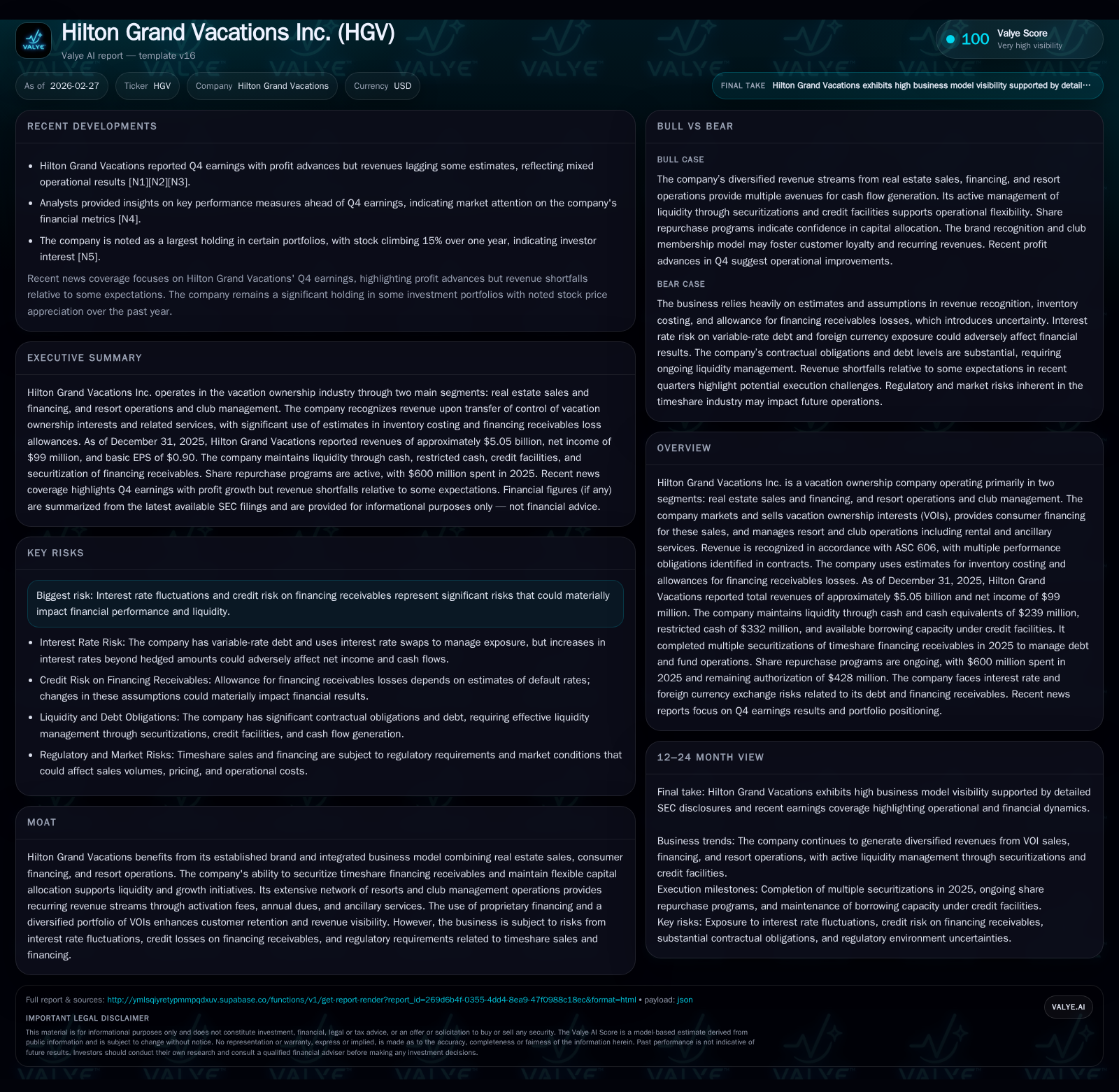
Hilton Grand Vacations Inc. (HGV) posted modest revenue growth of 1.3% in 2025, continuing a recovery from pandemic disruptions driven by real estate sales and financing. The company’s integrated business model combines vacation ownership sales, proprietary consumer financing, and resort management to generate diverse revenue streams. Capital allocation has emphasized share repurchases and strategic debt management supported by multiple securitizations of timeshare receivables. While liquidity appears sufficient through revolving credit facilities and restricted cash, the company faces ongoing challenges from interest rate volatility and credit risk on its financing portfolio.
Company Overview
Hilton Grand Vacations Inc. (HGV) operates primarily in two main segments: real estate sales and financing of vacation ownership interests (VOIs), alongside resort operations and club management activities primarily under the Hilton brand [S1][N1]. The company’s business model integrates marketing, selling VOIs, providing tailored consumer financing solutions, managing resort operations including rentals, annual dues, and ancillary services — creating diversified revenue streams.
As of December 31, 2025, Hilton Grand Vacations achieved total revenues of approximately $5.05 billion with net income tallying $81 million [F1], evidencing modest growth during a gradual recovery phase post-pandemic. The firm’s ability to securitize timeshare financing receivables supports both liquidity management and capital flexibility critical for its growth plans.
Historical Performance Drivers
From FY2022 through FY2025, HGV sustained broadly positive top-line momentum:
Historical performance (annual)
| FY | Rev ($bn) | Net ($mm) | CFO ($mm) | Capex ($mm) | Rev YoY | Net YoY |
|---|---|---|---|---|---|---|
| 2025 | 5.0 | 81 | 300 | 70 | +1.3% | +72.3% |
| 2024 | 5.0 | 47 | 309 | 42 | +25.2% | -85.0% |
| 2023 | 4.0 | 313 | 312 | 31 | +3.7% | -11.1% |
| 2022 | 3.8 | 352 | 747 | 58 |
Source: SEC companyfacts cache [F1].
Capital returns and efficiency (annual)
| FY | Buybacks ($mm) | FCF ($mm) | ROE% |
|---|---|---|---|
| 2025 | 600 | 230 | 6.3 |
| 2024 | 432 | 267 | 2.7 |
| 2023 | 368 | 281 | 14.8 |
| 2022 | 272 | 689 | 16.4 |
Source: SEC companyfacts cache [F1].
Source: [F1]
Key factors behind this trajectory include resumed consumer demand for VOI purchases complemented by the ramp-up in resort operations revenue as travel normalized. However, the large decline in net income from pre-pandemic levels signals challenges such as elevated operating costs and one-time charges related to acquisitions.
Operating cash flow remained stable despite a more than doubling in capital expenditures in 2025 relative to prior years to support property upgrades and technology investments [S26].
Business Model Nuances
Hilton Grand Vacations employs ASC 606 accounting standards recognizing revenue as performance obligations such as sale delivery or club services are satisfied [S9]. The use of proprietary consumer financing enhances customer retention by enabling installment sales backed by collateralized loans secured by timeshare properties.
Their diversified portfolio includes originated timeshare financing receivables combined with acquired legacy portfolios from Diamond Resorts and Bluegreen Vacations, raising complexity but also scale advantages in credit risk management via static pool analysis models assessing expected credit losses [S21].
Capital recycling through structured securitizations enables liquidity injection while mitigating direct balance sheet exposure to credit risk, utilizing non-recourse debt instruments backed solely by pledged receivables collateral [S8][S15].
Capital Structure & Liquidity
At fiscal year-end 2025, total gross debt stood at approximately $4.6 billion with non-recourse debt layering another $2.75 billion secured against specific financing assets [S5][S13]. Average interest rates declined slightly due to recent refinancing activity that subdued spreads on term loans linked to SOFR benchmarks [S19].
Remaining borrowing capacity amounted to $809 million under revolving credit lines alongside a further $235 million available under the Timeshare Facility — supporting operational funding requirements plus development commitments totaling roughly $226 million over the next decade [S4][S12].
A significant feature of their capital strategy is aggressive share repurchases: during calendar year 2025 alone HGV repurchased $600 million worth of shares amid two successive authorized programs totaling over a billion dollars accessible for buybacks [F1][S11]. This accounts for a meaningful reduction in equity base from $2.15 billion in 2024 down to $1.29 billion in 2025.
The firm maintains robust cybersecurity governance led by experienced CTO and CISO executives with comprehensive board oversight — an increasingly critical dimension given sensitive customer data associated with financing activities [S1].
Risks & Challenges
Interest rate volatility presents a key risk vector given substantial floating-rate borrowings partially offset by interest rate swaps designed as cash flow hedges; shifts can significantly affect interest expense profiles going forward [S19][S21].
Credit losses on the financed portion of VOI sales constitute an inherent operational risk; although mitigated through static pool default modeling and loan portfolio stratifications by customer FICO scores and loan-to-value ratios, adverse economic conditions or regulatory changes could pressure allowances for financing receivables losses [S21][S22].
Complexities related to multi-jurisdictional tax regimes and regulatory compliance regarding timeshare sales also require ongoing capital expenditure allocations—reflected in elevated capex trends—with uncertain return implications.
Future Outlook & Monitoring Points (Analysis)
Absent explicit forward guidance disclosed this cycle ([N#]/[S#]), monitoring HGV’s upcoming quarterly earnings releases for sustainability in VOI sales volume growth should be prioritized, especially considering competitive leisure travel dynamics.
Capital deployment effectiveness will hinge on maintaining prudent leverage metrics while balancing growth investments against shareholder returns via buybacks or eventual dividends.
On the operational front, refining collections efficiency within the financing portfolios amidst potential macroeconomic headwinds will be crucial to preserving margin stability.
Lastly, integration progress post-acquisition of legacy portfolios including Bluegreen impacts should be assessed continuously given cumulative scale benefits versus integration costs.
Conclusion
Hilton Grand Vacations’ intrinsic competitive advantage stems from its integrated vacation ownership ecosystem that synergizes real estate marketing with captive consumer financing mechanisms supported by recurring resort management revenues. This multifaceted model affords some resilience amid cyclical travel industry variability.
The company's disciplined securitization program buttresses liquidity while share repurchase policies reflect confidence in long-term value creation despite profitability swings reflecting prior acquisition costs and market conditions.
Investors should weigh these structural positives against exposure risks notably stemming from interest rate movements and credit quality within its sizeable lending portfolio.
Disclaimer: This analysis is intended solely for informational purposes reflecting data available as of February 27, 2026. It does not constitute investment advice or recommendations regarding Hilton Grand Vacations or any other security.
Disclaimer: This is research-only, informational analysis and not investment advice. It may include AI-generated interpretation and general industry context. Always verify important details using primary sources.

Comments