
The Hartford Raises Investment Income Amid Rising Disability Claims and Tech Costs
Q1 2026 results show increased Employee Benefits losses partially offset by higher reinvestment yields and premium growth.
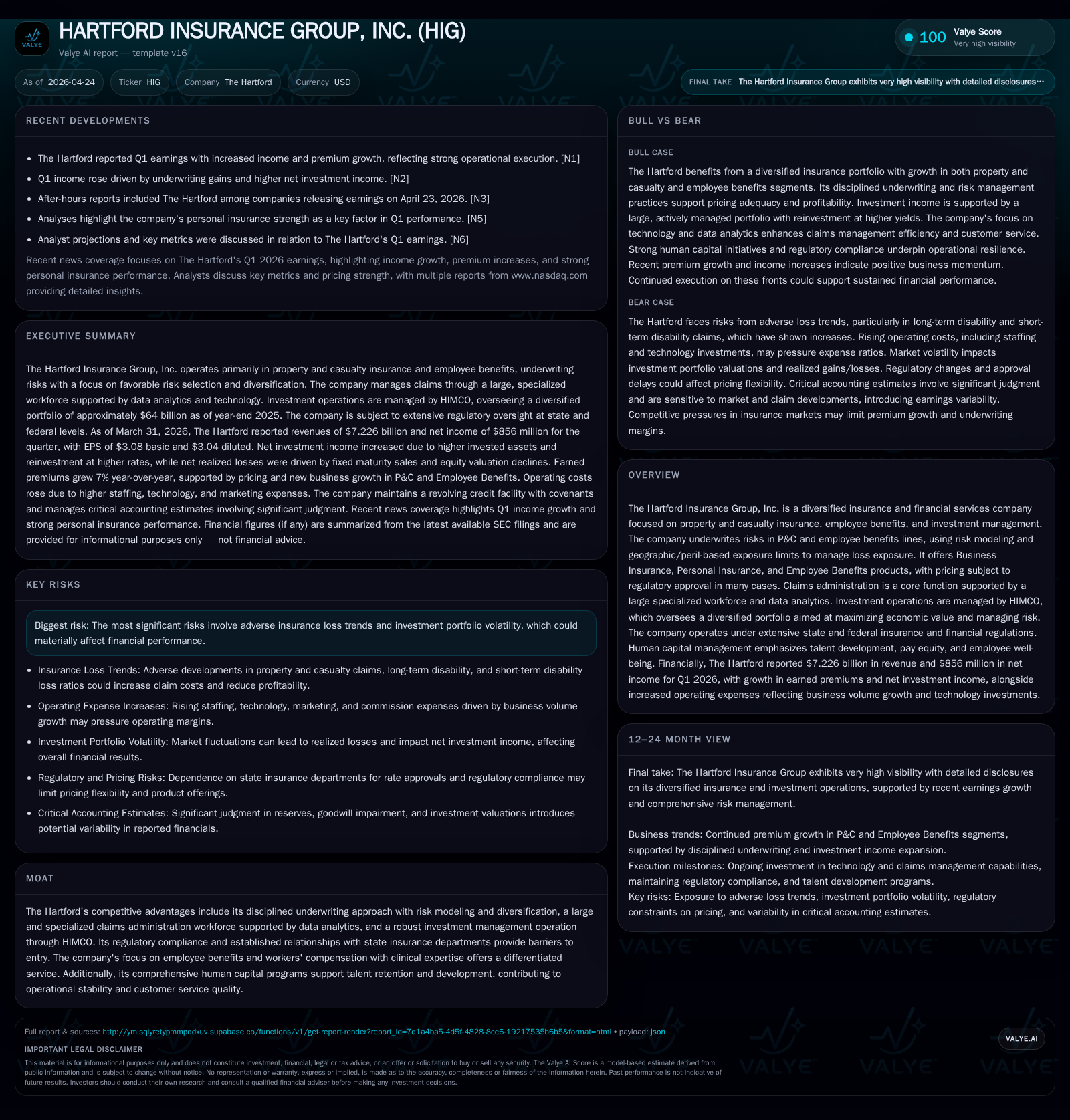
The Hartford Insurance Group's latest quarterly report reveals a nuanced operating environment: while earned premiums continue to grow across business lines, rising short- and long-term disability claims have pushed Employee Benefits losses higher. The company has responded with pricing actions in paid family and medical leave products. Investment income improved due to reinvesting at yields above maturing asset rates, though net realized losses increased slightly. Elevated staffing and technology expenses reflect investments to support growth. The firm maintains disciplined underwriting with a diversified product mix across P&C, personal insurance, and employee benefits supported by robust claims management.
Recent Operating Update: Q1 2026 Highlights
The Hartford's first-quarter 2026 filing [S2] details a performance environment characterized by both growth in earned premiums and pressure from Employee Benefits loss experience. Earned premiums rose across the board, notably supported by Business Insurance lines that benefitted from both pricing increases and new business gains. However, losses in the Employee Benefits segment increased by $39 million owing largely to elevated short- and long-term disability ratios. This was partially balanced by lower group life losses, reflecting improved mortality trends.
On the investment front, the company achieved an average reinvestment rate of 5.3% on fixed maturities and mortgage loans excluding U.S. Treasuries, surpassing the 4.9% yield of sales and maturities within the quarter. This improvement contributes to stronger net investment income despite prevalent market volatility impacting valuations primarily within fixed maturity securities [S2].
Insurance operating costs have risen, driven by higher headcount-related expenses aligning with increased business volumes, expanded benefits costs for employees, incremental variable expenses in Hartford Funds operations, and heightened technology spend reflecting ongoing digital transformation efforts.
Business Model: Revenue Generation Through Risk Underwriting and Investment
The Hartford generates revenue principally via premiums from Property & Casualty (P&C), Personal Insurance, and Employee Benefits products,[S1] underwriting risks using sophisticated modeling that incorporates geographic and peril-based exposure limits. Pricing decisions undergo regulatory scrutiny in many states but also allow flexibility in excess and surplus lines where regulation is less constraining.
The company aims to balance underwriting profitability with investment income derived mainly from a large portfolio managed through its Hartford Investment Management Company (HIMCO). Net investment income includes interest from fixed maturities, mortgage loans, limited partnerships, alternative investments, and equity securities.[S2] This diversified asset base supports the company's obligations to policyholders while enhancing economic value.
Claims administration constitutes a critical operational pillar featuring approximately 6,700 specialized staff including medical professionals to manage complex Employee Benefit claims.[S1] Such infrastructure underpins service quality and cost control.
Industry Structure and Competitive Position
The insurance sector's underlying structure subjects carriers like The Hartford to heavy regulatory oversight that governs capital adequacy, pricing approvals, underwriting practices, and investment constraints across multiple jurisdictions.[S1] These regulations often protect policyholder interests but can limit flexibility for insurers.
Within this framework, The Hartford's competitive advantages stem from its disciplined underwriting process emphasizing risk diversification; its size-enabled scale in claims handling coupled with data analytics enhancing loss adjustment efficiency; and its established investment management arm delivering tailored asset-liability management.
By targeting niche strength in Employee Benefits—particularly workers' compensation integrated with clinical expertise—the company differentiates itself amid intensifying competition. It leverages long-term relationships with regulators which present barriers to entry for smaller or less established competitors.
Growth Drivers and Constraints
Growth prospects rely on several intertwined factors:
- Pricing Power: Earned premium growth reported reflects successful rate adjustments primarily in Business Insurance lines alongside retention programs maintaining policy count despite some Personal Insurance policy attrition [S1].
- Claims Trend Management: Emerging adverse trends in disability claims require ongoing pricing revisions as evidenced by recent paid family and medical leave product adjustments [S2]. The ability to moderate loss ratios here is pivotal to profitability.
- Investment Income: Current reinvestment rates sustaining above-maturity yields provide incremental margin expansion potential but remain sensitive to macroeconomic shifts impacting interest rates and credit spreads [S2].
- Operational Efficiency: Increasing insurance operating costs related to staffing and technology investments must be managed carefully to avoid margin erosion while supporting volume growth [S2].
- Regulatory Environment: State-level insurance regulations constrain rapid pricing changes yet promote stability; however, evolving legislative priorities around issues such as climate risk disclosure or AI use pose unknown future impacts [S1].
Constraints similarly include exposure to catastrophe events as reflected by prior accident year reserve developments impacting results intermittently.
What to Watch Next
Key executional milestones include:
- Monitoring short- and long-term disability loss ratios for evidence of moderation or further deterioration post-pricing action,
- Tracking reinvestment yields versus market benchmarks amidst fluctuating interest rates,
- Managing expense growth particularly technology deployments intended to enhance underwriting precision or claims processing,
- Observing regulatory developments especially on pricing approval processes or new reporting mandates applicable internationally or domestically,
- Assessing progress in expanding fee-based income streams such as Hartford Funds amid volatile equity markets,
- Capital management updates including utilization of committed credit facilities or share repurchase programs disclosed in subsequent filings [S3],[S19].
Financial Profile Snapshot
Historical performance (annual)
| FY | Rev ($bn) | Net ($bn) | CFO ($bn) | Capex ($mm) | Rev YoY | Net YoY |
|---|---|---|---|---|---|---|
| 2025 | 28.4 | 3.8 | 5.9 | 169 | +6.9% | +23.3% |
| 2024 | 26.5 | 3.1 | 5.9 | 145 | +314.6% | +303.5% |
| 2023 | 6.4 | 0.8 | 4.2 | 215 | -71.4% | -57.5% |
| 2022 | 22.4 | 1.8 | 4.0 | 175 |
Source: SEC companyfacts cache [F1].
Capital returns and efficiency (annual)
| FY | Div ($mm) | Buybacks ($mm) | FCF ($bn) |
|---|---|---|---|
| 2025 | 592 | 1615 | 5.8 |
| 2024 | 556 | 1514 | 5.8 |
| 2023 | 528 | 1400 | 4.0 |
| 2022 | 506 | 1550 | 3.8 |
Source: SEC companyfacts cache [F1].
Anchored by annual results for FY 2025 [F1], The Hartford reported revenues of $28.4 billion representing near 7% year-over-year growth assisted by broad-based premium expansion. Net income surged approximately 23% year-over-year reaching $3.8 billion indicating solid bottom-line leverage despite cost pressures.
Operating cash flow remained robust near $5.9 billion translating into strong free cash flow ($5.75 billion after capex). Dividend payments totaled $592 million while the company returned significant capital via $1.6 billion in share repurchases illustrating balanced shareholder return priorities.
On the balance sheet front, although detailed current debt data was limited beyond historical book value of $500 million dating back to March 2018 [F1], recent filings confirm maintenance of a revolving credit facility up to $750 million with extension options through 2030 providing liquidity flexibility [S4],[S19].
Investment portfolio composition as of March 31, 2026 shows predominant allocation toward fixed maturities (72%), meaningful positions in mortgage loans (11%) plus growing allocations in limited partnerships/alternative investments (~9%) revealing tactical diversification supporting yield optimization strategies [S2],[S9].
Insurance loss reserves remain critical accounting estimates subject to management judgment uniquely sensitive to claims development volatility especially across asbestos/environmental legacy litigation segments as noted historically but currently controlled via reserve management practices [S14].
This analysis does not constitute investment advice or recommendations. It reflects a synthesis of publicly available regulatory filings supplemented by domain expertise aiming at elucidating operational dynamics behind The Hartford Insurance Group’s most recent performance disclosures.
Disclaimer: This is research-only, informational analysis and not investment advice. It may include AI-generated interpretation and general industry context. Always verify important details using primary sources.

Comments