
Horizon Kinetics Strengthens Institutional Position Following CEO Transition
Stable asset management performance and a tenured investment team underpin Horizon Kinetics’ resilience amid leadership change.
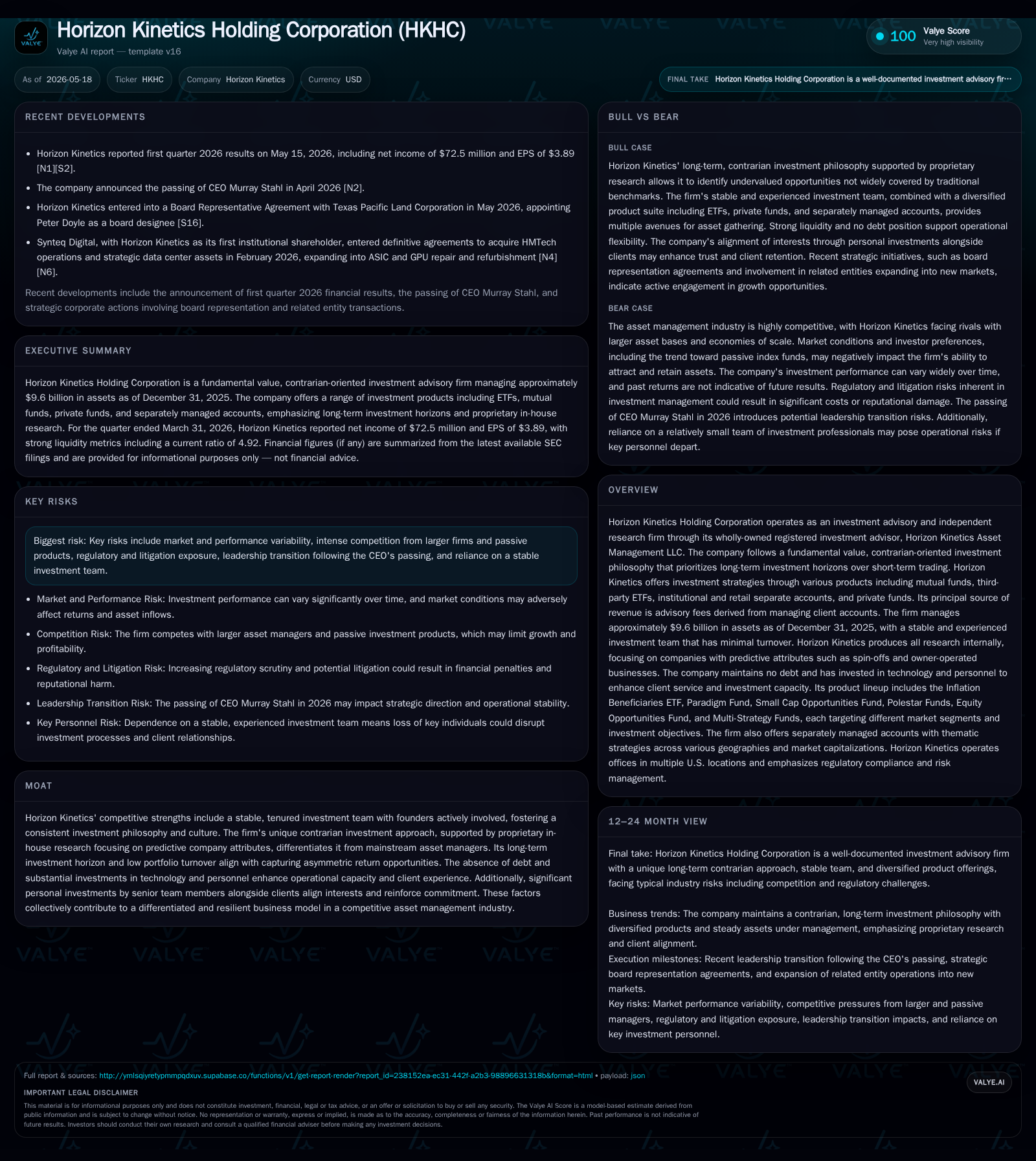
Horizon Kinetics Holding Corp reported steady AUM and operational stability in its latest quarter ended March 2026, despite the recent passing of CEO Murray Stahl in April 2026. The firm’s fundamental value, contrarian investment philosophy coupled with proprietary research and a long-tenured team supports its distinctive position in active asset management. Growth is driven by differentiated products such as inflation beneficiaries ETFs and aligned founder investments. Key risks include market volatility, the CEO succession process, and competitive pressures from passive products. Liquidity remains robust with no debt, providing flexibility to invest in technology and people.
Latest Quarterly Operating Update: Trends and Impact of Leadership Change
Horizon Kinetics reported during its May 15, 2026 SEC quarterly filing that assets under management (AUM) remained relatively stable at approximately $9.6 billion as of December 31, 2025, only marginally down from $9.8 billion at year-end 2024 [S2], [S1]. This reflects moderate resilience in an environment marked by market fluctuations impacting both client subscriptions/redemptions and asset valuations. Operationally, Horizon continued generating advisory revenues tied to these AUM levels with no material disruption noted in the filing.
However, the firm faced a critical near-term leadership event with the passing of CEO Murray Stahl announced in early April 2026 [S3], [N2]. This represents a significant operational inflection given Stahl’s integral role since the founding of Horizon Kinetics. Despite this loss, the company emphasized stability stemming from a senior investment team with exceptionally low turnover — many having worked together for over forty years — fostering continuity in investment philosophy and culture [S1]. The collaborative environment among senior managers anticipates easing transition risks while safeguarding execution consistency.
Business Model Overview: Contrarian, Fundamental Value Investment Discipline
Horizon Kinetics engages primarily as an investment advisory entity through its wholly owned registered advisor Horizon Kinetics Asset Management LLC. Its revenue mechanism chiefly hinges on advisory fee income derived from managing client portfolios via investment advisory and sub-advisory contracts spanning mutual funds, ETFs issued by third parties, private funds, and institutional/retail separate accounts [S1]. Fees are contingent on asset levels managed — influenced both by market value changes and net flows — as well as client-specific mandate size and servicing needs.
Fundamentally different from many peers dependent on short-term trading or indexing strategies, Horizon espouses a contrarian approach favoring fundamental value investing with long time horizons. This approach relies on capturing wider opportunity sets through extended holding periods rather than reacting to transient market moves or momentum signals. The absence of leverage (zero debt) combined with substantial investments in technology infrastructure bolsters operational scalability and client service quality, underscoring deliberate business model discipline aligned with sustainable growth [S1]
Quality of Offering: Proprietary Research and Product Differentiation
At its core, Horizon Kinetics places strong emphasis on internally generated proprietary research targeting distinctive securities characterized by "predictive attributes." These include corporate spin-offs, owner-operated companies, or entities possessing latent/dormant assets not well covered by conventional analysts or mainstream indexes [S1], [S27]. This proprietary insight pipeline facilitates investments in niches often overlooked or inefficiently priced by broader markets.
Such an intellectual capital base enhances product differentiation relative to traditional active managers reliant on external research or passive index replication strategies. The firm’s deliberately low portfolio turnover reflects commitment to crystallizing asymmetric return profiles over extended periods while minimizing frictional costs — an attribute closely tethered to their stability-focused culture.
Competitive Environment: Position Among Peers and Market Access Challenges
Operating within an intensely competitive asset management landscape dominated increasingly by large scale firms with economies of scale and the growing appeal of low-fee passive products poses significant headwinds for boutique active managers like Horizon Kinetics [S27], [S28]. While precise peer metrics are unavailable publicly, Horizon is positioned distinctly as a contrarian boutique offering alpha generation primarily through specialized research-intensive strategies rather than broad-market beta capture.
Fee compression trends across the industry further exacerbate margin pressures. Nonetheless, this niche focus enables Horizon to pursue opportunities less accessible to competitors reliant on conventional benchmarks or high-volume product universes.
Growth Drivers: Asset Gathering, Product Innovation, and Alignment of Interests
Key growth catalysts derive from successful delivery of superior risk-adjusted returns that attract incremental net inflows into existing product suites including mutual funds and emerging ETFs such as their inflation beneficiaries vehicle aimed at capitalizing on rising real asset prices [S9], [S24]. Expansion through differentiated investment themes addresses investor demand for diversification beyond traditional equity/fixed income mixes.
Crucially, founders and senior portfolio managers maintain substantial personal investments alongside clients reinforcing alignment of interest — a trust-building attribute that supports retention as well as measured asset growth through aligned incentives rather than aggressive marketing alone.
Operational capacity improvements via ongoing technology upgrades and talent acquisition provide scalable platforms necessary for sustainably managing growing AUM without proportionate expense escalation.
Risks and Constraints: Market Volatility, Succession Challenges, and Competition
The firm’s revenues remain tightly coupled to AUM levels that invariably fluctuate with market cycles; thus macroeconomic volatility constitutes a primary risk affecting fee income streams [S1], [S18]. The recent unexpected death of CEO Stahl introduces succession uncertainty requiring effective governance response to sustain cultural continuity vital for adherence to Horizon’s unique investment ethos amidst potential disruption [N2].
Competition intensifies as formidable asset managers leverage scale advantages while passive index funds continue siphoning retail/institutional dollars due to cost advantages — challenging active managers' ability to preserve market share amid fee compression dynamics.
Regulatory scrutiny continues growing worldwide elevating compliance costs and litigative exposures that could affect profitability or reputation although currently Horizon reports no pending litigation matters related to these risks [S18]. Ensuring staff retention amid competitive hiring markets is also critical given dependency on experienced portfolio managers maintaining strategy effectiveness.
Near-Term Outlook: Key Milestones and Execution Focus
Upcoming quarterly reporting milestones will be critical to observe whether AUM stabilization post-CEO transition sustains momentum or exhibits any signs of significant outflows linked to client apprehensions over leadership continuity. Progress pace of product enhancements or ETF launches targeting high-growth thematic areas will serve as barometers for innovation-driven expansion opportunities.
Further disclosures related to management structure adjustments in Q2/Q3 could provide important clarity around succession planning effectiveness alongside measures designed to maintain seamless client engagement standards across institutional accounts.
Financial Context: Liquidity and Capital Structure Snapshot
From a balance sheet perspective available data for the quarter ending March 31, 2026 shows approximately $36.7 million held in cash equivalents with no outstanding debt dating back several years confirming conservative leverage policy maintained consistently by the firm ([F1]). Current ratio levels near 4.9 indicate excess short-term liquidity supporting operational needs along with discretionary investments into technology infrastructure and personnel growth initiatives mentioned previously ([F1]). This strong liquidity profile provides financial flexibility enabling responses to near-term uncertainties without pressure on capital resources or borrowing requirements.
This analysis is based solely on publicly available regulatory filings and news sources cited herein without provision of any investment advice or research views.
Disclaimer: This is research-only, informational analysis and not investment advice. It may include AI-generated interpretation and general industry context. Always verify important details using primary sources.

Comments