
Hanover Bancorp's Financial Recovery and Strategic Positioning in New York Metro Banking
An examination of Hanover Bancorp’s recent financial trends, capital initiatives, and local market strategy amid intensifying competitive and regulatory forces.
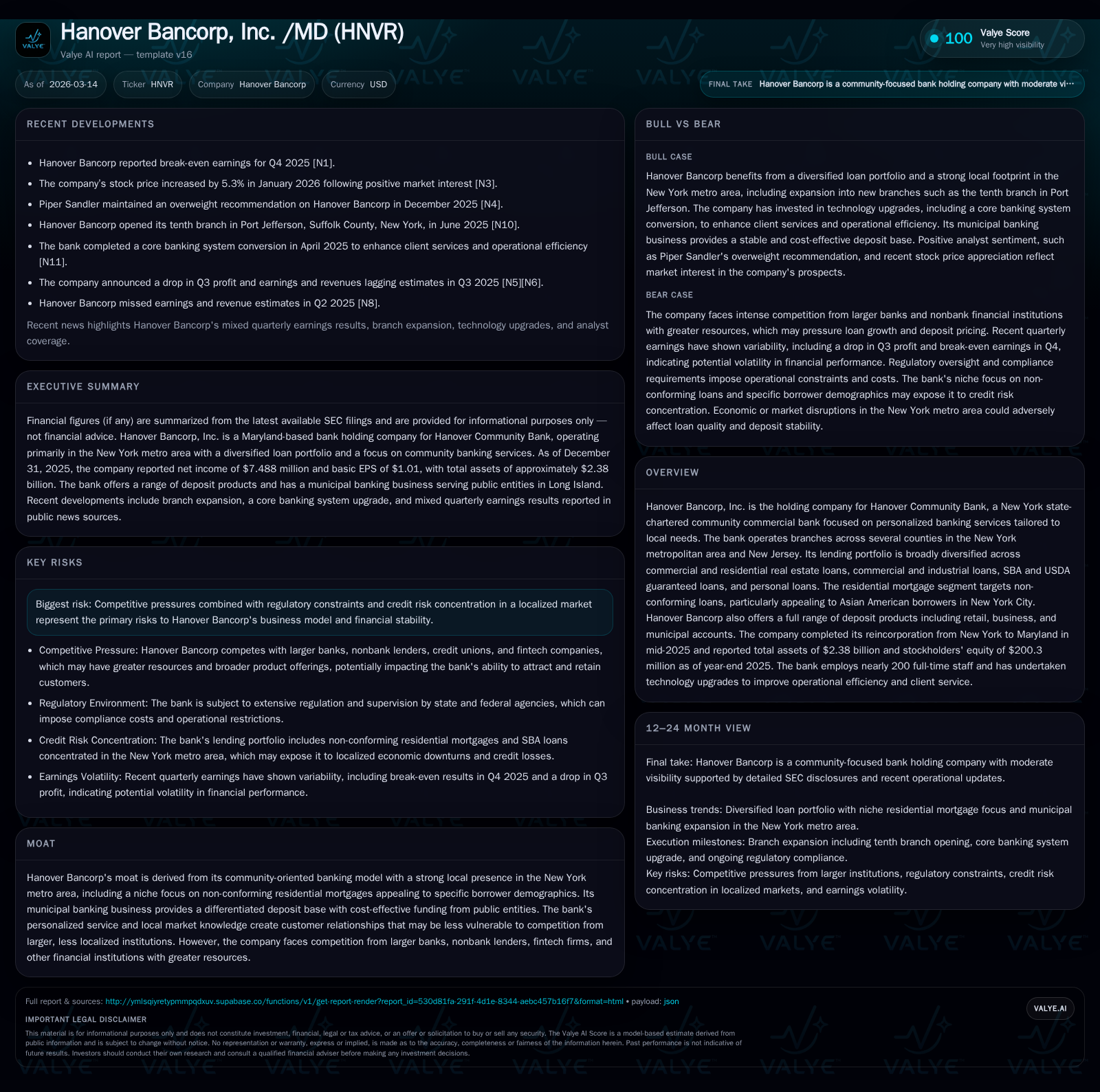
Hanover Bancorp, Inc. focuses on community banking within the New York metropolitan area, offering a diversified loan portfolio including specialized non-conforming residential mortgages tailored to Asian American borrowers. The firm has recently experienced a sharp contraction in net income but posted a strong increase in operating cash flow in 2025, reflecting operational transitions and credit risk mitigation efforts. Capital management moves, including a significant subordinated note issuance, bolster its Tier 2 capital, while the company balances growth opportunities in SBA lending and nascent cannabis industry banking against risks from concentrated credit exposures and competitive pressures. Essential forward-looking indicators will include credit quality metrics, loan origination volumes in new segments, and sustained earnings recovery.
Distinctive Community Banking Model and Niche Lending Focus
Hanover Bancorp serves as the holding company for Hanover Community Bank, a commercial bank chartered in New York but recently reincorporated in Maryland (mid-2025). Its branch footprint extends across multiple counties within the New York metropolitan area as well as New Jersey. The bank's strategy centers on highly personalized banking services tailored to meet local community needs [N1][F1].
A core strength derives from its diverse lending portfolio: encompassing commercial real estate loans (both owner-occupied and non-owner occupied), multifamily housing secured loans primarily in NYC boroughs, commercial and industrial (C&I) loans to small-medium businesses across sectors like manufacturing and retail, SBA and USDA guaranteed loans targeting small businesses usually held for investment or selectively sold on the secondary market, plus personal loans [S1][S4]. Notably, the residential mortgage segment focuses on non-conforming or “non-qualified” one- to four-family residential mortgages through direct broker referrals or internal branches. This segment has traction with Asian American borrowers concentrated in NYC boroughs [S5]. Products like the Residential Investor Program (RIP) cater specifically to two- to four-family units often used by residential investors.
On the deposit side, Hanover leverages traditional retail checking/savings alongside business accounts while maintaining a municipal banking niche — providing account services for public municipalities such as cities and school districts located mainly on Long Island. Such municipal relationships create a low-cost stable deposit base not easily replicated by regional competitors [S4][F1]. This mix differentiates Hanover amid fierce competition.
Historical Financial Performance and Key Drivers
The last several years witnessed volatile financial results with clear operational inflections. Net income peaked at $23.56 million at fiscal year-ending September 2022 but contracted sharply thereafter — notably declining by approximately 39.3% year-over-year to around $7.49 million for full-year 2025 [F1]. This steep drop contrasts with operating cash flows (CFO) that more than doubled (+121.2%) to $13.05 million in FY25 from prior year levels [F1].
Capex spent eased down from $1.29 million in FY24 to about $869 thousand in FY25 reflecting managed expenditures during tight earnings conditions. Equity grew steadily from $172.58 million in late FY22 to $200.27 million at FY25 indicating continued capital base strengthening despite profitability headwinds [F1]. Dividend payments increased moderately even amid waning profits — reaching nearly $3.01 million payout in FY25 [F1].
Historical performance (annual)
| FY | Net ($mm) | CFO ($mm) | Capex ($) | Net YoY |
|---|---|---|---|---|
| 2025 | 7 | 13 | 869000 | -39.3% |
| 2024 | 12 | 6 | 1292000 | +228.1% |
| 2023 | 4 | 4 | 356000 | -84.0% |
| 2022 | 24 | 25 | 1122000 |
Source: SEC companyfacts cache [F1].
Capital returns and efficiency (annual)
| FY | Div ($mm) | FCF ($mm) | ROE% |
|---|---|---|---|
| 2025 | 3 | 12 | 3.7 |
| 2024 | 3 | 5 | 6.3 |
| 2023 | 1 | 4 | 2.0 |
| 2022 | 24 | 13.6 |
Source: SEC companyfacts cache [F1].
Table: Hanover Bancorp historical financial key metrics as of fiscal year-end [F1]
This divergence suggests that while income statement pressures mounted—likely related to margin compression and elevated provisions—the company successfully generated operating liquidity through cash collections or balance sheet management tactics.
Emerging Challenges Impacting Profitability
Q4 of calendar year 2025 marked break-even earnings highlighting mounting operational challenges [N1]. Margin compression stems partly from rising funding costs amid economic tightening affecting spreads between loan yields and deposit costs.
Credit risk concentration remains a concern given the localized exposure chiefly within the New York metro real estate markets including multifamily rental properties with rent regulation complexities [S12][S21]. Increased regulatory scrutiny from FDIC and New York State Department of Financial Services mandates comprehensive compliance efforts raising operating expenses [S15][S16]. Competitive headwinds are intensifying not only from larger regional banks armed with scale advantages but also nimble fintech lenders who target similar borrower segments online providing faster turnaround or alternative underwriting models [N1][S15].
These challenges require prudent risk management balancing growth ambitions while preserving asset quality.
Growth Prospects from Diversified Loan Products and Markets
Hanover identifies several growth pathways anchored largely in its diversified loan product suite:
- Residential mortgages: The return to flow origination focused on selling individual loans due to diminished appetite among broader secondary purchasers because of higher interest rate environments since late-2023 provides incremental revenue streams [S12].
- SBA/USDA guaranteed lending: These programs targeting small businesses serve sectors such as manufacturing, wholesale trade, hospitality with the opportunity to enhance loan sale activity of guaranteed portions supporting fee income growth [S4][S5].
- Cannabis industry banking: Launched late Q4 2023 targeting licensed businesses within New York allowing Hanover to tap a rising yet cautiously expanding niche market recognized for stringent regulatory oversight but promising financing needs uniquely addressed by community banks willing to specialize [N1][S5].
- Commercial real estate: Multifamily portfolios representing stable cash flow collateral remain core; LTV ratios average conservatively around mid-50s percent reflecting cautious underwriting approach amidst fluctuating NYC real estate valuations [S12][S26].
Such product diversification combined with geographic footprint strengthens repositioning prospects though execution risks persist given market uncertainty.
Capital Management: Equity, Debt Issuance, and Shareholder Returns
Capital strategy shows balancing acts between fortifying Tier I equity bases while seizing tactical debt issuance opportunities for Tier II capital augmentation:
- Recent March 12, 2026 issuance of $35 million subordinated fixed-to-floating rate notes due 2036 at a coupon of 7.25% boosts regulatory capital buffers enabling future loan growth capacity under Basel III guidelines despite being below thresholds mandating LCR/NSFR requirements due to asset size below $3 billion [S3][S4].
- Common equity increased steadily across FY22-FY25 underpinning capital adequacy [F1], though modest profitability led to an approximate return on equity near 3.7% for FY25 signaling room for improvement relative to peer benchmarks.
- Dividend policy remained relatively consistent if conservative amid earnings volatility distributing around $3 million annually supporting shareholder income without compromising balance sheet strength [F1].
This measured approach aligns with prudent capital stewardship practice expected from community bank holding companies navigating uncertain credit cycles.
Evaluating Liquidity, Asset Quality, and Regulatory Considerations
Liquidity stands strong heading into early 2026 with cash & equivalents near $209 million providing ample coverage against near-term fund outflows while institutional deposit base heavily weighted toward core retail plus stable municipal deposits reduces reliance on volatile brokered funding lines [F1][S4][S11].
Loan delinquency data signal moderate asset quality trends: the bank carefully monitors special mention credits predominantly underwrite to conservative collateral Loan-to-Value (LTV) ratios especially within CRE segments capped near typical regulatory comfort bands below threshold concentrations [S21][S28]. Construction loan exposure remains minimal ($11 million) mitigating development cycle risks common elsewhere [S26].
Though Hanover is not subject to full Basel III prudential standards due to asset size sub-$3B it adheres closely to relevant NY DFS regulations ensuring timely reporting cycles plus compliance with interagency guidance regarding concentration limits emphasizing intensified management oversight on CRE lending concentrations at or above prescribed multiples of risk-based capital [S21][S28].
Deposit insurance assessments have seen minor upticks following FDIC policy revisions beginning January 2023 but remain manageable given overall institution stability [S25].
Market Position Amid Competitive and Demographic Trends
Hanover’s commitment to servicing Asian American communities via craftily designed mortgage products fosters lasting customer loyalty contrasting sharply against larger institutions where scale limits personalized service capabilities [N1][S5]. This demographic focus cements a moat harder for national banks or fintech disrupters lacking localized network penetration or community cultural alignment.
Municipal banking relationships provide further differentiation offering cost-effective funding sources largely insulated from transactional churn prevalent among general consumer depositors sustaining long duration deposits underpinning asset-liability matching advantages uncommon for midsize peers [S4].
Nevertheless competitors ranging from regional giants with technological firepower alongside emerging nonbank lenders continue pressuring margins forcing continual innovation in underwriting processes alongside digital channel enhancements revealing ongoing adaptability challenges inherent for community banks with smaller scales.
Key Milestones and Metrics to Monitor Going Forward
Investor focus should stay trained on subtle signals indicating traction or deterioration within pivotal operational areas:
- Quarterly earnings progression post-break-even result observed Q4 2025 serving as barometer for re-established profitability momentum or emerging losses amid tougher macro outlooks [N1].
- Credit quality indices including delinquencies over standard time buckets especially within high-value CRE/multifamily loan pools providing advance warning of portfolio stress ahead.
- Adoption rate curves tied to new product launches such as SBA guaranteed loan sales programs ramp-up along with penetration into licensed cannabis banking demonstrating diversification payoff.
- Capitalization ratios following subordinated note infusion examining retention under varying stress scenarios impacting dividend sustainability or share repurchase optionality absent currently documented buybacks.
- Deposit growth mix shifts tracking municipal versus retail balances informing funding cost trajectory forecasting crucial for margin projections.
While speculative forecasts are avoided here due to absent direct guidance inputs monitoring these quantifiable benchmarks forms prudent analytic foundation evaluating Hanover Bancorp’s forward trajectory effectively.
Disclaimer: This report is intended solely for informational purposes without making any investment recommendation regarding Hanover Bancorp or related securities. All data cited conform strictly with available factual disclosures without conjecture or forecasting beyond established filings.
Disclaimer: This is research-only, informational analysis and not investment advice. It may include AI-generated interpretation and general industry context. Always verify important details using primary sources.

Comments