
Honeywell's Aerospace Spin-Off and Portfolio Streamlining Herald Strategic Shift Amid Macro Pressures
Honeywell International reported Q1 2026 results highlighting portfolio realignment and operational resilience despite macroeconomic headwinds.
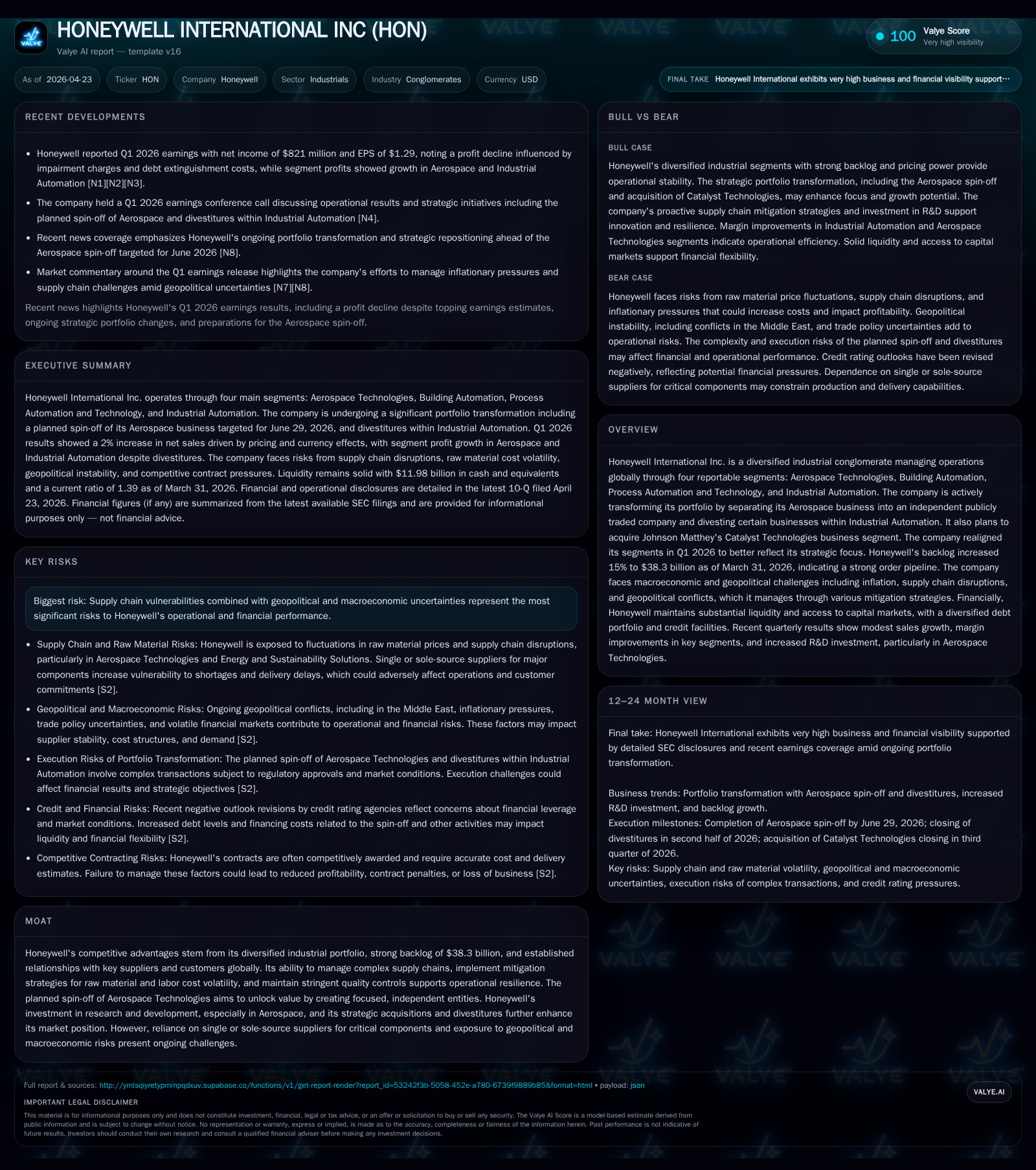
In Q1 2026, Honeywell International progressed with its strategic transformation by advancing the spin-off of its Aerospace Technologies segment, while actively divesting select Industrial Automation businesses. The company navigated inflationary pressures, supply chain constraints, and geopolitical volatility through pricing actions and supply chain mitigation strategies, reflected in an increased backlog of $38.3 billion. Organic sales growth was modest but supported by pricing and acquisitions, offsetting volume declines linked to divestitures. Honeywell’s diversified industrial footprint and backlog underpin resilience, although dependency on sole-source suppliers and macro uncertainties remain key risks. Management’s focus on portfolio simplification aims to sharpen business focus and unlock shareholder value ahead of the separation.
Recent Operating Update
Honeywell's first quarter 10-Q filing for period ended March 31, 2026 [S2] reveals pivotal near-term shifts anchored in ongoing portfolio transformation aligned with evolving market realities. The company’s backlog expanded by 15% year-over-year to $38.3 billion — a strong indicator of sustained order intake despite macroeconomic headwinds including inflationary pressures and global geopolitical disruptions.
Importantly, Honeywell is progressing toward a significant corporate restructuring with the planned separation of its Aerospace Technologies segment into an independent public company slated for June 29, 2026. This action is intended as a tax-free spin-off for shareholders subject to customary regulatory approvals [S2]. Concurrently, it has reached agreements during April to divest the Productivity Solutions and Services plus Warehouse and Workflow Solutions businesses within its Industrial Automation segment; these transactions are expected to close in the second half of the year [S2], [S4].
The Q1 results featured increased operating costs from higher raw material prices and labor expenses balanced by price increases aimed at mitigating inflation impacts. Net cash used for operating activities rose by over $1 billion largely due to litigation payments and interest expenses connected to debt refinancing undertaken in anticipation of the spin-off [S2]. Yet liquidity remains robust with cash reserves near $12 billion and manageable debt levels totaling approximately $36.7 billion, supported by diverse fixed-rate notes and revolving credit facilities [S4], [S8].
Business Model Overview
Honeywell International operates as a diversified industrial conglomerate distributed across four global segments — Aerospace Technologies, Building Automation, Process Automation and Technology, and Industrial Automation [S15]. Each division targets distinct markets but shares emphasis on high-technology products embedded with engineering complexity or software-enabled control systems.
- Aerospace Technologies: Manufactures avionics, engines components, aftermarket parts catering to commercial aviation plus defense customers. High R&D intensity reflects critical product innovation cycles.
- Building Automation: Provides integrated building controls encompassing HVAC systems, security solutions, fire safety products aligned with energy efficiency trends.
- Process Automation & Technology: Serves customers in refining, petrochemicals with flow control products such as valves (including Sundyne acquired assets), safety systems blending automation hardware/software.
- Industrial Automation: Delivers productivity solutions spanning warehouse management software (held-for-sale units) along with personal protective equipment (recently divested) and workflow optimization tools.
Revenue generation hinges on complex project bids often involving long lead times—particularly in aerospace where production cycles span years—with significant aftermarket recurring revenues providing steadier cash flows. The company's ability to leverage pricing power especially on inflation pass-throughs evidences embedded customer dependency due to quality standards and certification barriers that complicate supplier switching [S16].
Industry Structure & Competitive Position
As a conglomerate straddling diverse but interrelated industrial verticals, Honeywell's competitive moat emanates from technological depth combined with scale advantages over smaller niche players. It faces competition from other large multi-segment industrial giants like General Electric (in aerospace) and Siemens (in automation), yet distances itself through focused segment autonomy enhanced after recent realignments [S25].
The Aerospace Technologies division stands out as a distinct growth engine driven by aerospace OEM spending cycles and defense budgets coupled with increasing aftermarket service demand amid rising global fleet utilization. Dual sourcing initiatives attempted mitigate supply chain risk prevalent for sole-source precision components crucial in aerospace manufacturing [S18].
Building Automation rides secular tailwinds linked to environmental regulations pushing energy conservation technologies while Process Automation benefits from refinery upgrades adapting to low-carbon fuels. The divestiture path within Industrial Automation seeks to shed lower-margin or non-core units enabling tighter focus on scalable digital offerings supporting warehouse logistics efficiency.
Growth Drivers & Constraints
Growth Catalysts:
- Increasing backlog of $38.3 billion supports revenue sustainability over medium term even amid volume softness linked partly to portfolio pruning [S16], [S24].
- Pricing actions offset material inflation across all segments adding incremental margin cushion.
- Acquisition of Johnson Matthey’s Catalyst Technologies aimed at expanding footprint in emissions reduction aligns with growing regulatory emphasis on environmental sustainability [S25].
- Enhanced R&D investments especially in Aerospace signal continued push into next-generation avionics or propulsion components emphasizing differentiated technology offerings [S11], [S23].
- Global diversification reduces reliance on localized demand shocks although foreign currency tailwinds contributed positively this quarter.
Constraints & Risks:
- Supply chain fragility remains notable; single/sole-source dependence for some aerospace components poses disruption risk intensified by geopolitical tensions including Middle East conflicts [S2], [S18].
- Inflationary pressures in labor/material costs require ongoing price adjustments risking potential softening in contract bids amid competitive tendering environments [S16].
- Credit rating agencies have downgraded outlooks reflecting leverage raised for spin-off financing which could impact borrowing costs going forward albeit rating remains investment grade [S5].
- Execution risks surrounding the complex Aerospace carve-out including regulatory clearances add potential uncertainty around timing or structuring.
- Macro-economic uncertainties globally including trade policy volatility may adversely affect manufacturing investment cycles especially outside North America.
What To Watch Next
The upcoming quarters are critical milestones for Honeywell’s transformation trajectory:
- Completion of the Aerospace Technologies spin-off targeted by end June 2026 will redefine both entities operationally and financially; watch details on equity structure post-separation as well as standalone guidance issued by new Aerospace entity.[S1], [N1]
- Closure timelines for Industrial Automation divestitures expected in H2 2026 will impact revenue mix along with associated impairment or restructuring charges.[S2], [N2]
- Integration progress on Johnson Matthey Catalyst acquisition influencing Process Automation technology roadmap merits attention concerning contribution scale-up.[N1]
- Pricing environment evolution particularly if inflationary pressures moderate or intensify could affect margin trajectories across segments.
- Regulatory developments especially related to trade tariffs or export controls may influence supply chain reconfigurations.
Financial Profile Summary
Historical performance (annual)
| FY | Net ($bn) | CFO ($bn) | OpInc ($bn) | Capex ($mm) | Net YoY |
|---|---|---|---|---|---|
| 2025 | -0.1 | 6.4 | 8.1 | 986 | -102.0% |
| 2024 | 5.7 | 6.1 | 8.7 | 1164 | +0.8% |
| 2023 | 5.7 | 5.3 | 1039 | +13.9% | |
| 2022 | 5.0 | 5.3 | 766 |
Source: SEC companyfacts cache [F1].
Capital returns and efficiency (annual)
| FY | Div ($bn) | Buybacks ($bn) | FCF ($bn) |
|---|---|---|---|
| 2025 | 3.0 | 3.8 | 5.4 |
| 2024 | 2.9 | 1.7 | 4.9 |
| 2023 | 2.9 | 3.7 | 4.3 |
| 2022 | 2.7 | 4.2 | 4.5 |
Source: SEC companyfacts cache [F1].
In Q1 alone, net sales showed modest increase (+2%) driven primarily by price (+4%), foreign currency (+2%), and acquisitions (+1%), offsetting volume decline (-2%) largely attributable to portfolio changes including PPE divestiture impacts particularly visible within Industrial Automation [-11% reported sales] sold partially starting late last year [S10],[S16],[S24]. Segment profit margins improved notably across several divisions owing to disciplined cost management despite cost inflation headwinds.
Operating cash flow was pressured this quarter partly by settlement payments tied to Flexjet litigation ($375 million) alongside higher cash interest payments reflecting debt profile adjustments supporting anticipated spin-off financing structure [S2],[S12]. Capital expenditures remained moderate relative to revenue base though R&D spend increased significantly reflecting emphasis on innovation especially in Aerospace Technologies which can underpin long-term competitiveness post-spin.[S23]
Despite short-term earnings dilution effects from impairments on held-for-sale assets and debt extinguishment charges reducing net income per share this quarter [-0.35 EPS impact after tax], management reiterated confidence in the strategic repositioning unlocking value via enhanced market focus post spin-off along with portfolio simplifications aimed at sustainable margin expansion.[N1][N2]
Disclaimer
This analysis is based solely on information available as of April 23, 2026 from Honeywell International's SEC filings and related public disclosures without any speculative projections or investment recommendations.
Disclaimer: This is research-only, informational analysis and not investment advice. It may include AI-generated interpretation and general industry context. Always verify important details using primary sources.

Comments