
Horizon Space Acquisition I: Final Extension Window, Sponsor Reliance, and the SPAC Value Equation
With its trust capital eroding, a history of failed combinations, and delisting to OTC, Horizon Space Acquisition I Corp. now faces a narrowing window to secure a viable merger. The outcome will hinge on Sponsor funding, target quality, and market appetite for post-merger entities.
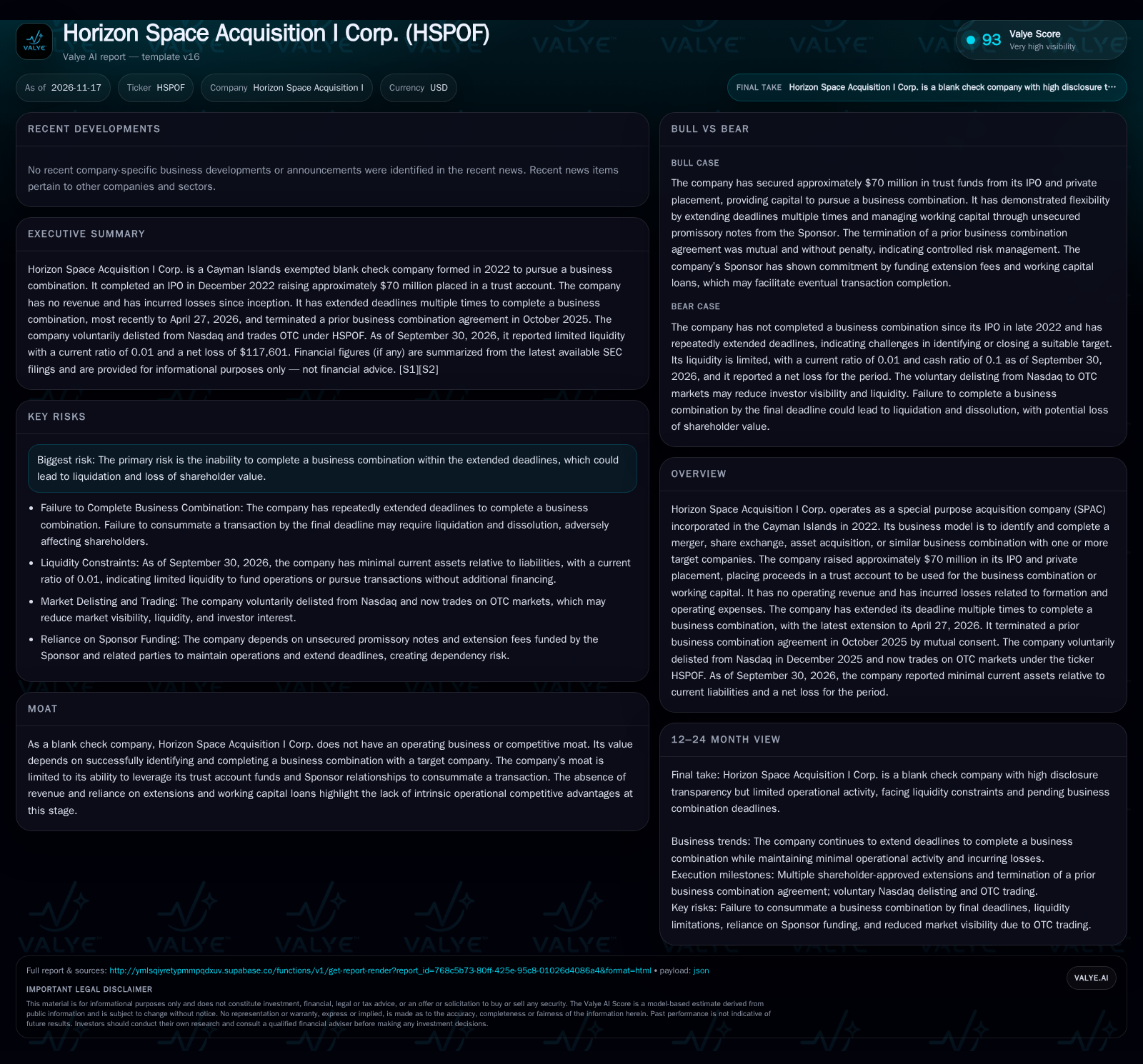
Horizon Space Acquisition I Corp. (HSPOF) is a SPAC on its final extension, with reported liquidity position, no revenue, and a terminated prior deal. Sponsor support has funded ongoing operations, but the company now trades OTC after delisting from Nasdaq. With a current ratio of 0.01 and a looming April 2026 deadline, the viability of any business combination—and ultimate shareholder value—depends on the company’s ability to source and close a credible transaction before time and resources run out. [S1] [S2]
After a high-profile delisting from Nasdaq and the collapse of its only announced deal, the company depends on Sponsor infusions and shareholder extensions to stay afloat. As the April 2026 deadline looms, the prospects for value creation are tightly linked to the company's ability to secure and close a credible target under increasingly strained conditions. The next six months will determine whether HSPOF delivers a business combination or heads for liquidation.
Why the Next Six Months Define Horizon Space Acquisition I’s Fate
Horizon Space Acquisition I Corp. faces a confluence of late-stage SPAC stress factors. The company reported cash and liquidity metrics for the period; these figures do not by themselves establish operating runway, investment capacity, financial flexibility, or financing capacity. [S2] The company has no revenue and continues to post net losses, recording a net loss of $117,601 for the most recent period [S2]. Its only announced merger, with Squirrel Enlivened Technology, was terminated in October 2025 without penalty, and the company has relied on unsecured Sponsor loans totaling $1.8 million and extension fee deposits to continue operations [S1]. Further, the voluntary delisting from Nasdaq in December 2025 has shifted its shares to OTC trading, potentially limiting investor reach and deal attractiveness [S1]. With the business combination deadline extended to April 27, 2026, the company’s future is now defined by its ability to secure and close a viable transaction before funds and extensions are exhausted.
Trust Account Math and the Economics of a Late-Stage SPAC
Horizon Space Acquisition I’s business model is structurally simple: raise capital via an IPO, park proceeds in a trust account, and seek to merge with a private company that wants public listing access and capital. The economics for public shareholders depend almost entirely on the value of the trust account net of redemptions, fees, and expenses, as there is no operating revenue or asset base outside the trust. Over time, repeated deadline extensions and redemptions can erode the trust’s size, reducing the potential per-share payout in either a successful merger or liquidation scenario.
The company’s persistent operating losses and the costs of repeated shareholder meetings, legal work, and regulatory compliance further eat into available capital. Sponsor loans and extension fee deposits have enabled the company to cover working capital needs, but these are typically subordinate to public shareholders in a liquidation. Unsecured promissory notes, if not repaid in a merger, may not be recoverable. This creates a capital stack where the public float, Sponsor, and insiders have diverging incentives as the deadline nears.
If a merger is consummated, value creation depends on the quality of the target and the market’s willingness to support the combined entity. If not, the trust is returned to public shareholders, less expenses, and the Sponsor’s investment is likely lost.
SPAC Market Crowding and Sponsor Leverage: Where Horizon Space Stands
Horizon Space Acquisition I operates in a highly competitive SPAC environment, where hundreds of blank check companies vie for a shrinking pool of attractive private targets. With no revenue or operating assets, its only competitive levers are the size and certainty of its trust account, the reputation and deal-sourcing ability of its Sponsor, and the terms it can offer a target.
Repeated deadline extensions, the collapse of the Squirrel Enlivened Technology deal, and the delisting from Nasdaq all weaken HSPOF’s pitch to prospective targets. OTC trading may further reduce the appeal, as many high-growth private companies prefer a Nasdaq or NYSE listing for liquidity and visibility. In this context, Sponsor relationships and willingness to fund further extensions are crucial, but may be insufficient if the trust size shrinks too far or if market sentiment toward post-merger SPACs remains tepid.
The competitive threat is not traditional peers but other SPACs with fresher capital, stronger Sponsor networks, and fewer red flags. Private companies may also opt for direct listings or traditional IPOs if market conditions permit.
A Credible Target Emerges and Trust Value Is Preserved
The most favorable outcome for HSPOF would be the identification and rapid closing of a business combination with a credible, growth-oriented private company. For this to create value, several conditions must align: the trust account must retain sufficient assets (limited further redemptions and expenses), the target must be willing to accept OTC listing or facilitate a relisting, and public shareholders must support the deal.
Evidence that would confirm this scenario includes: a new definitive merger agreement with a sector-relevant, scalable private company; limited or reversed redemptions following the announcement; and a plan to uplist post-merger. Early indications could be Sponsor announcements of further funding, positive market reaction to deal news, or regulatory filings detailing a new transaction structure.
Falsification would come from further delays, failure to announce a target before the final deadline, or a deal with a target that is perceived as low-quality, leading to mass redemptions.
Deadline Extensions, Eroding Trust, and the Probability of Liquidation
The most plausible scenario is continued deadline pressure, Sponsor-funded extensions, and ongoing search for a target, but with diminishing trust capital as redemptions and expenses mount. The company may announce one more potential transaction, but the risk is high that either the market or the target will balk at OTC status or the shrunken trust size.
A likely outcome is that, absent a compelling target and rapid execution, the company will be forced to liquidate after April 2026, returning remaining trust funds to public shareholders and leaving the Sponsor with a loss on its investment. Evidence confirming this scenario would include additional extension votes, continued operating losses, and lack of substantive merger progress by early 2026.
A reversal would be signaled by a high-quality target announcement, strong shareholder support, and a credible path to relisting or value-creating combination.
Trust Depletion and Sponsor Fatigue Lead to Wind-Down
In the adverse case, HSPOF fails to secure any credible business combination, Sponsor support wanes, and trust account assets are further depleted by ongoing expenses and redemptions. With no remaining time or resources, the company is forced into liquidation, and public shareholders receive less than their initial investment after expenses.
Downside indicators would include Sponsor refusal to fund further extensions, mounting unpaid liabilities, further declines in trust value, and regulatory risk associated with prolonged OTC trading. Shareholder returns could be further eroded by legal, accounting, and wind-down costs.
A partial falsification would be new Sponsor infusions or regulatory relief, but if the operating trend (losses, no target, shrinking trust) persists, liquidation is the endgame.
Milestones That Will Determine Whether HSPOF Delivers Value or Dissolves
Announcement of a new definitive business combination agreement with a credible private company, especially one with a plan to uplist or relist.
Size of the trust account and level of redemptions at each extension or transaction announcement—if disclosed, these figures would clarify potential shareholder returns.
Sponsor willingness to fund further extension fees and working capital loans, as indicated by new promissory notes or deposits.
Shareholder voting outcomes on further deadline extensions or on any proposed business combination, as these will determine the path forward.
Updates on regulatory filings related to proposed transactions, uplisting applications, or liquidation proceedings.
Any change in the company’s ability to meet current liabilities, as reflected in future reported current ratios or working capital positions.
Market reaction to deal announcements or Sponsor funding news, as measured by OTC trading volumes and price movements, if disclosed.
If disclosed, details of any expense reduction or Sponsor assumption of ongoing costs that could preserve trust value for public shareholders.
Disclaimer: This is research-only, informational analysis and not investment advice. It may include AI-generated interpretation and general industry context. Always verify important details using primary sources.

Comments