
HeartCore Enterprises: The Economics and Fragility of Japan-to-U.S. IPO Consulting After Strategic Refocus
Following its exit from software development, HeartCore Enterprises is now a pure-play consultant for Japanese firms seeking U.S. IPOs, leveraging an aligned compensation model but facing concentrated client risk and competitive pressure from larger advisory firms.
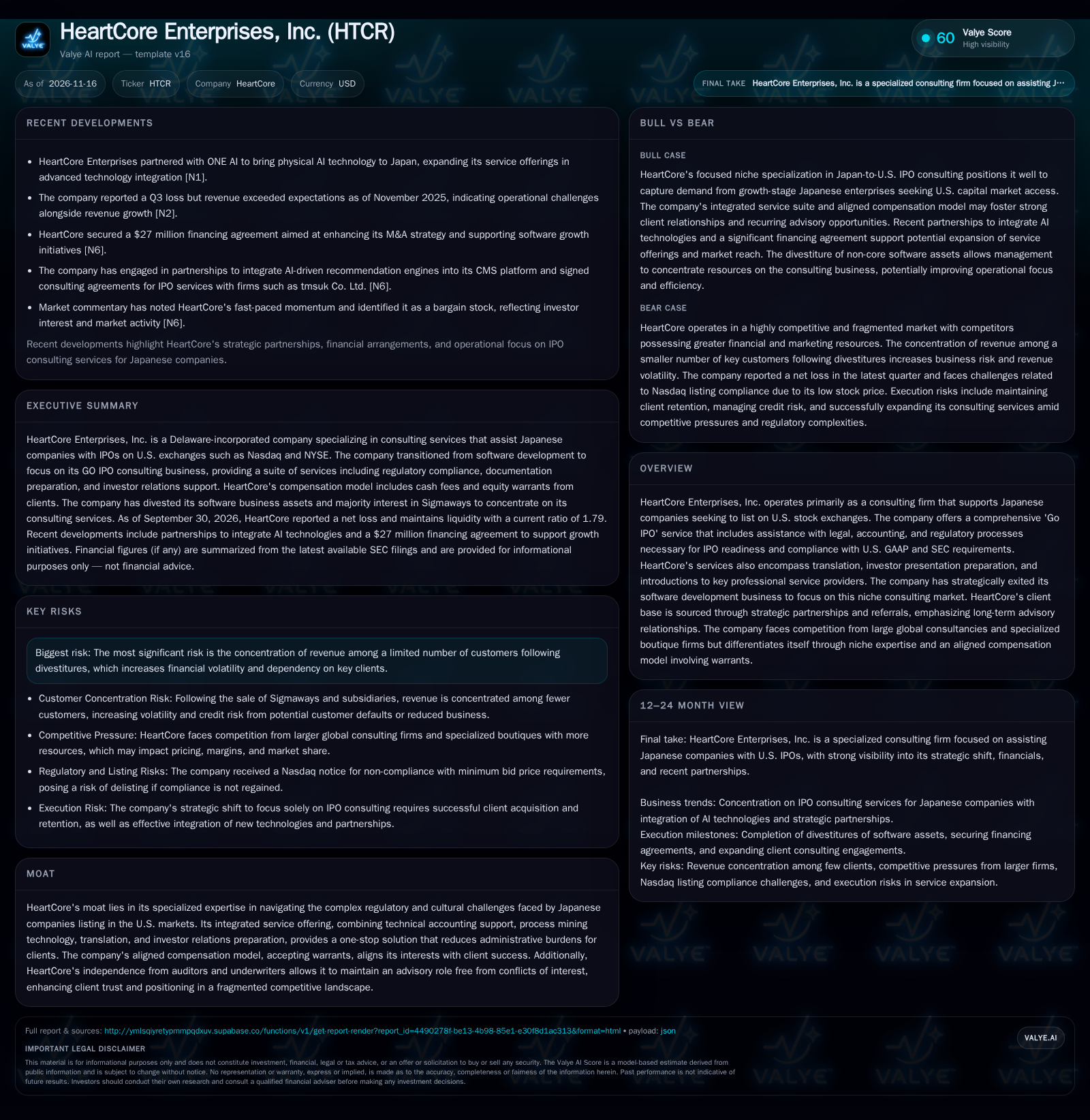
HeartCore Enterprises, Inc. has completed a strategic pivot, divesting its software business to focus exclusively on consulting Japanese companies through the U.S. IPO process. The company’s model combines fixed cash fees and equity warrants, aligning incentives but also exposing HeartCore to the volatility of client outcomes. While recent partnerships and technology integrations hint at service expansion, the business is now highly dependent on a small number of clients and must navigate fierce competition and Nasdaq listing compliance challenges. Execution on client pipeline and risk management will determine the durability of its new focus. [S2] [N1] [N2] [N6]
HeartCore Enterprises, Inc. has undergone a decisive transformation, shifting from a diversified software and consulting business to a focused provider of advisory services for Japanese companies seeking U.S. IPOs. This strategic reset is defined by the sale of its software operations and a compensation model that closely aligns its fate with the success of its clients, combining substantial cash fees with equity warrants. While this creates potential for upside if clients succeed, it also creates new fragilities: revenue is now concentrated among a small client base, and the company must contend with both competitive and regulatory headwinds. The next phase for HeartCore will be defined by its ability to sustain deal flow, expand its advisory moat, and manage the inherent volatility of its newly concentrated business.
Strategic Refocus and Its Immediate Consequences
HeartCore Enterprises has completed the sale of its Japanese software business and now operates primarily as a consulting firm focused on guiding Japanese companies through the process of listing on U.S. exchanges. This transition, finalized with the sale of HeartCore Japan on October 31, 2025, marks a decisive exit from software development and a pivot to a specialized, higher-touch service model. As of September 30, 2026, HeartCore reported a net loss for the quarter, and its revenue base is now concentrated among a smaller number of key clients due to the divestiture of non-core businesses. The company also faces ongoing compliance challenges with Nasdaq’s minimum bid price requirement, adding regulatory pressure to its operational risks. Meanwhile, HeartCore has announced partnerships to integrate AI technologies and expand its offering, though the commercial impact of these moves remains to be validated. [S2] [N1] [N2] [N6]
How HeartCore’s Consulting Model Drives Revenue and Risk
HeartCore’s economics are now defined almost exclusively by its Go IPO consulting services. The company charges clients a consulting fee ranging from $380,000 to $900,000 and also receives warrants or stock acquisition rights covering 1% to 4% of the client’s fully diluted share capital, exercisable at nominal prices. This approach directly aligns HeartCore’s upside with client success: if a client completes an IPO and performs well, the equity component could deliver significant returns. However, this also introduces volatility, as outcomes are binary—if a client fails to list or underperforms, the warrants may be worthless.
The business is characterized by high fixed costs relative to the number of simultaneous engagements, as each client requires bespoke support across legal, accounting, regulatory, and translation domains. This creates operating leverage if deal flow increases, but also magnifies downside risk if client volume falls. The exit from software development reduces capital intensity but increases dependence on advisory pipeline. Client acquisition, driven by referrals and partnerships, is critical, and the company’s long-term economics will depend on both the volume and success rate of engagements. Working capital needs are moderate, as cash fees are collected per engagement, but the equity component is illiquid and subject to market and execution risk. [S2]
Niche Positioning Versus Global and Boutique Rivals
HeartCore operates in a specialized niche—advising Japanese companies on U.S. IPOs—where its deep understanding of cross-border regulatory, accounting, and cultural complexities provides a differentiator. Its integrated service suite and independence from auditors and underwriters offer a one-stop, conflict-free solution, appealing to clients wary of large, multi-service firms. However, the market is fragmented and highly competitive, with large global consultancies and boutique advisory firms offering similar services, often with greater resources, brand recognition, or bundled offerings.
The use of equity warrants as partial compensation may attract growth-oriented clients but could also be replicated by competitors. Moreover, larger consultancies may offer more comprehensive global support, stronger investor networks, and greater capacity to absorb client failures. HeartCore’s moat is thus real but shallow—rooted in specialized expertise and alignment, but vulnerable to client concentration and the marketing might of larger rivals.
If HeartCore Converts Pipeline Into Repeatable Success
The most favorable scenario for HeartCore involves a steady pipeline of Japanese firms successfully listing on U.S. exchanges, with several engagements yielding both cash fees and material warrant gains. If recent technology partnerships (such as with ONE AI) translate into measurable differentiation and higher client win rates, HeartCore could build a reputation as the go-to advisor for Japan-to-U.S. listings. This would support both pricing power and the ability to attract higher-quality clients.
Confirmation would come from a growing roster of new client wins, increased average deal size, and evidence that warrants are being exercised or monetized at attractive valuations. Additional proof points would include repeat business or follow-on advisory engagements, as well as successful client IPOs that generate positive press and referrals. Falsification would occur if new client signings stall or if warrant-related income fails to materialize despite reported client IPOs. [N1] [N6]
Sustaining the Consulting Model Amid Volatility and Client Churn
The most plausible trajectory for HeartCore is one in which it maintains a modest but variable pipeline of IPO consulting mandates, with revenue and profit swings tied to the timing and outcome of client listings. The company likely remains exposed to periods of client concentration and lumpy earnings, with some quarters benefiting from successful client IPOs and others reflecting delays or failures.
HeartCore’s ability to sustain its business will hinge on replenishing its client pipeline and converting mandates into completed IPOs with positive warrant outcomes. Confirmation of this base scenario would come from a stable or gradually increasing number of engagements, ongoing partnerships, and periodic warrant income. Falsification would be signaled by a sharp drop in new client wins, persistent net losses without warrant monetization, or further regulatory setbacks regarding Nasdaq listing compliance.
What Happens if Client Concentration and Market Forces Turn Adverse
The primary risk for HeartCore is a scenario where one or more major clients fail to complete their IPOs or default on fee payments, causing a sharp decline in revenue. Given the current concentration of income among a few clients, even a single lost mandate could materially impact results. Competitive price pressure from larger consultancies or a slowdown in Japan-to-U.S. IPO activity would further compound the problem.
Worsening financial performance could trigger further Nasdaq compliance issues or delisting, damaging the company’s reputation and its ability to attract new clients. If the equity warrant model fails to produce meaningful upside—either due to client underperformance or illiquidity—HeartCore could find itself with the costs of a high-touch advisory business but without the upside to justify the risk. Confirmation of this scenario would be a persistent decline in client count, missed financial targets, or loss of listing status. [S2]
What Will Determine Whether HeartCore’s Pivot Pays Off
Number and quality of new consulting mandates signed each quarter—if disclosed—would indicate pipeline health and market demand.
Revenue mix between cash fees and warrant-based income; a useful metric would be the realized value of warrants from completed client IPOs.
Client concentration, specifically the percentage of revenue or engagement fees coming from the top one or two clients.
Progress on Nasdaq listing compliance, including bid price status updates and any remedial actions taken.
Demonstrated impact of AI and technology partnerships on client acquisition or service differentiation, particularly if new mandates cite these capabilities.
Gross margin trends, which would reveal whether operating leverage is improving as the consulting business scales.
Incidence of client defaults or cancellations, if disclosed, as a direct measure of credit and execution risk.
Announcements or evidence of repeat business, follow-on engagements, or long-term advisory relationships with past clients.
Disclaimer: This is research-only, informational analysis and not investment advice. It may include AI-generated interpretation and general industry context. Always verify important details using primary sources.

Comments