
International Battery Metals: Modular Lithium Extraction Ambitions Meet the Tests of Scale and Commercial Adoption
Armed with reported liquidity position and a proprietary modular direct lithium extraction technology, International Battery Metals seeks to capitalize on surging lithium demand. The company's next challenge: proving its modular model can achieve commercial traction, operational reliability, and cost-competitive economics in a volatile battery metals market.
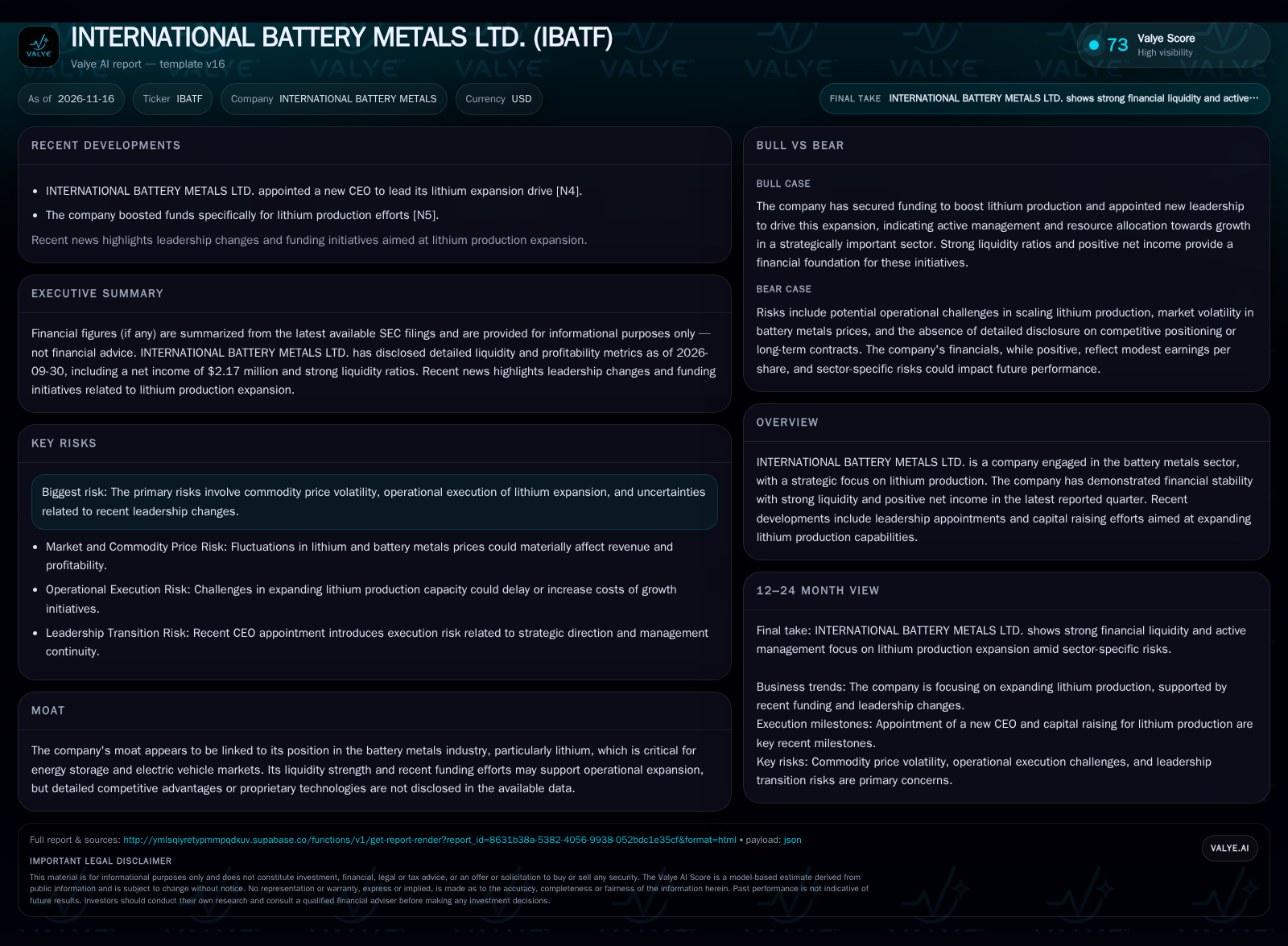
International Battery Metals (IBATF) enters late 2026 with a robust balance sheet, positive net income, and a new CEO focused on lithium production expansion. Its modular direct lithium extraction (MDLE) plant technology targets flexibility and environmental responsibility, but commercial adoption and sustained profitability depend on execution, cost discipline, and market demand for lithium amid commodity price volatility and sector competition [S2].
International Battery Metals (IBATF) is positioning itself at the crossroads of advanced lithium extraction technology and the accelerating global demand for battery-grade lithium. Backed by reported liquidity position and positive earnings, the company’s modular direct lithium extraction (MDLE) plant aims to deliver flexible, scalable solutions to a variety of brine resource owners. With a new CEO at the helm and fresh funding in place, IBATF’s near-term trajectory will be shaped by its ability to translate technical promise into commercial deployments, all while navigating the inherent volatility of the battery metals sector and the operational challenges of scaling a novel extraction platform.
Liquidity, Leadership, and Lithium Expansion: The Present State of Play
International Battery Metals entered the final quarter of 2026 with $7.4 million in cash and equivalents, current assets of $8.8 million, and current liabilities of just $0.94 million, resulting in a current ratio of 9.41 and a cash ratio of 7.85—metrics that underscore a reported liquidity position [S2]. For the quarter ending September 30, 2026, the company reported positive net income of $2.17 million and basic/diluted EPS of $0.01 [S2]. These results reflect stability and capacity to fund ongoing development.
Strategically, IBATF has appointed a new CEO tasked with accelerating lithium production expansion and has raised additional funds to support this agenda. Operationally, the company continues to focus on marketing and customizing its modular direct lithium extraction (MDLE) technology, with particular attention to U.S. brine resources—especially the Smackover formation in Arkansas and Texas—and international prospects [S2].
How a Modular Extraction Model Could Reshape Lithium Economics
IBATF’s economic proposition centers on its proprietary MDLE plant, which is modular and redeployable. This configuration is designed to minimize capital intensity per deployment, allowing the company—or its customers—to scale extraction capacity incrementally and relocate plants as brine sources are depleted. In theory, this flexibility could lower stranded-asset risk and improve capital efficiency compared to traditional, site-specific lithium operations.
The company’s business model appears aimed at enabling third-party brine owners to extract lithium chloride at commercial purity and concentration, potentially on a service, licensing, or plant-sale basis. However, the specific revenue mechanics—such as whether IBATF earns revenue through direct lithium sales, technology licensing, plant leasing, or turnkey project execution—are not explicitly disclosed. Each model carries different implications for margin structure, capital needs, and recurring revenue potential.
IBATF’s reported positive net income suggests that the current cost structure is manageable at this stage, though it is not clear whether this reflects commercial operations or primarily development and technology services. As the company transitions to larger-scale deployments, fixed costs are likely to rise with expanded staffing and field operations, as anticipated in its filings. The ability to maintain or expand margins will depend on proving out the MDLE plant’s cost advantages and reliability at commercial scale, especially as lithium prices remain volatile.
Proprietary Extraction in a Crowded, Rapidly Evolving Market
IBATF operates in a battery metals sector characterized by intense competition, technology innovation, and shifting customer priorities. Its key differentiator is its modular, redeployable direct lithium extraction technology, which promises both environmental responsibility and cost efficiency. This approach could appeal to brine resource owners seeking faster time-to-market and reduced upfront capital outlays compared to conventional evaporation or hard-rock mining.
However, the competitive landscape includes established lithium producers, emerging DLE technology firms, and vertically integrated battery material companies. Many are developing their own extraction technologies or scaling pilot plants. The moat for IBATF will hinge on proving superior extraction yields, lower operating costs, and reliable plant redeployment. Without multi-year contracts, exclusive technology partnerships, or demonstrated large-scale deployments, defensibility remains largely unproven.
Substitution risk also looms: if alternative lithium extraction methods or battery chemistries gain traction, or if major incumbents vertically integrate extraction, IBATF’s addressable market could shrink. Customer switching costs are likely low unless the company can lock in long-term technology or service agreements.
What Success Looks Like: Rapid Adoption and Margin Expansion from Modular DLE
The most favorable path for IBATF would see its MDLE plants gain traction with multiple brine resource owners—first in the U.S. Smackover region and then internationally. If the company can demonstrate reliable, low-cost extraction with flexible redeployment, it could rapidly scale via plant sales, recurring licensing, or revenue-sharing models. This scenario would be confirmed by signed commercial contracts, repeat orders, or long-term technology agreements with brine owners.
Margin expansion could follow as economies of scale are realized, technology costs are amortized, and the company leverages its early-mover advantage. Additional upside could come from environmental certifications or strategic partnerships with battery manufacturers or automotive OEMs seeking secure and green lithium supply. Evidence in support of this scenario would include publicized multi-plant deployments, disclosed contract values, and rising recurring revenues.
Scaling Hurdles and Incremental Progress: The Most Likely Course
The most plausible trajectory is a period of incremental progress, with IBATF spending the next 12-24 months customizing and deploying its MDLE plant for initial customers, likely in the U.S. brine market. Revenue growth may be uneven, reflecting project-based milestones and the lumpy nature of capital equipment or technology sales. Operating expenses will likely rise as staffing and field operations expand.
Successful transition to commercial operations will depend on the company’s ability to meet customer-specific requirements on time and within budget. Given the sector’s volatility and the early stage of modular DLE adoption, it is plausible that IBATF achieves modest contract wins but faces delays or cost overruns on initial deployments. Confirmation of this base case would include evidence of pilot or demonstration projects, initial plant customizations, and growing but still modest revenue contributions from commercial activity.
When Technology Promise Fails to Translate: Risks of Delayed Adoption and Margin Compression
The principal risk is that IBATF’s MDLE technology fails to achieve commercial adoption at scale. This could result from technical challenges in adapting the plant to diverse brine chemistries, underwhelming extraction yields, or reliability issues during redeployment. Operational missteps could erode customer confidence and drive up costs, leading to project delays or cancellations.
A downturn in lithium prices could further squeeze margins, making modular solutions less attractive to brine owners and reducing willingness to commit to new extraction projects. Leadership transition risk is also notable; if the new CEO’s strategy falters or execution is inconsistent, the company could lose momentum. Downside evidence would include a lack of disclosed commercial contracts, repeated technical setbacks, rising cash burn, or negative earnings as the company attempts to scale.
Milestones That Will Define IBATF’s Progress in Modular Lithium Extraction
Disclosure of signed commercial contracts or multi-plant deployment agreements with brine resource owners would clarify the pace of adoption.
Evidence of recurring revenue streams—such as technology licensing, service fees, or revenue-sharing arrangements—would help validate the model’s scalability.
Updates on the technical performance and reliability of the MDLE plant across different brine chemistries, especially in the U.S. Smackover region, would test technology risk.
Quarterly revenue and margin trends, if disclosed, will indicate whether the company is transitioning from development-phase activity to sustainable commercial operations.
Cash burn rate and liquidity metrics should be watched for signs of increased capital needs as the company expands field operations.
Management commentary on customer pipeline, backlog (if disclosed), and project timelines would signal commercial momentum or execution challenges.
Any announced strategic partnerships with battery manufacturers, automotive OEMs, or major resource holders would suggest validation of the company’s technology and market relevance.
Disclaimer: This is research-only, informational analysis and not investment advice. It may include AI-generated interpretation and general industry context. Always verify important details using primary sources.

Comments