
Invest Green Acquisition Corp: SPAC Strategy, Capital Constraints, and the Stakes of Target Selection in Clean Energy
As Invest Green Acquisition Corp enters the critical pre-deal phase, its ability to leverage sector expertise and navigate intense SPAC competition will shape the outcome—and long-term value—of its first business combination in the clean energy transition.
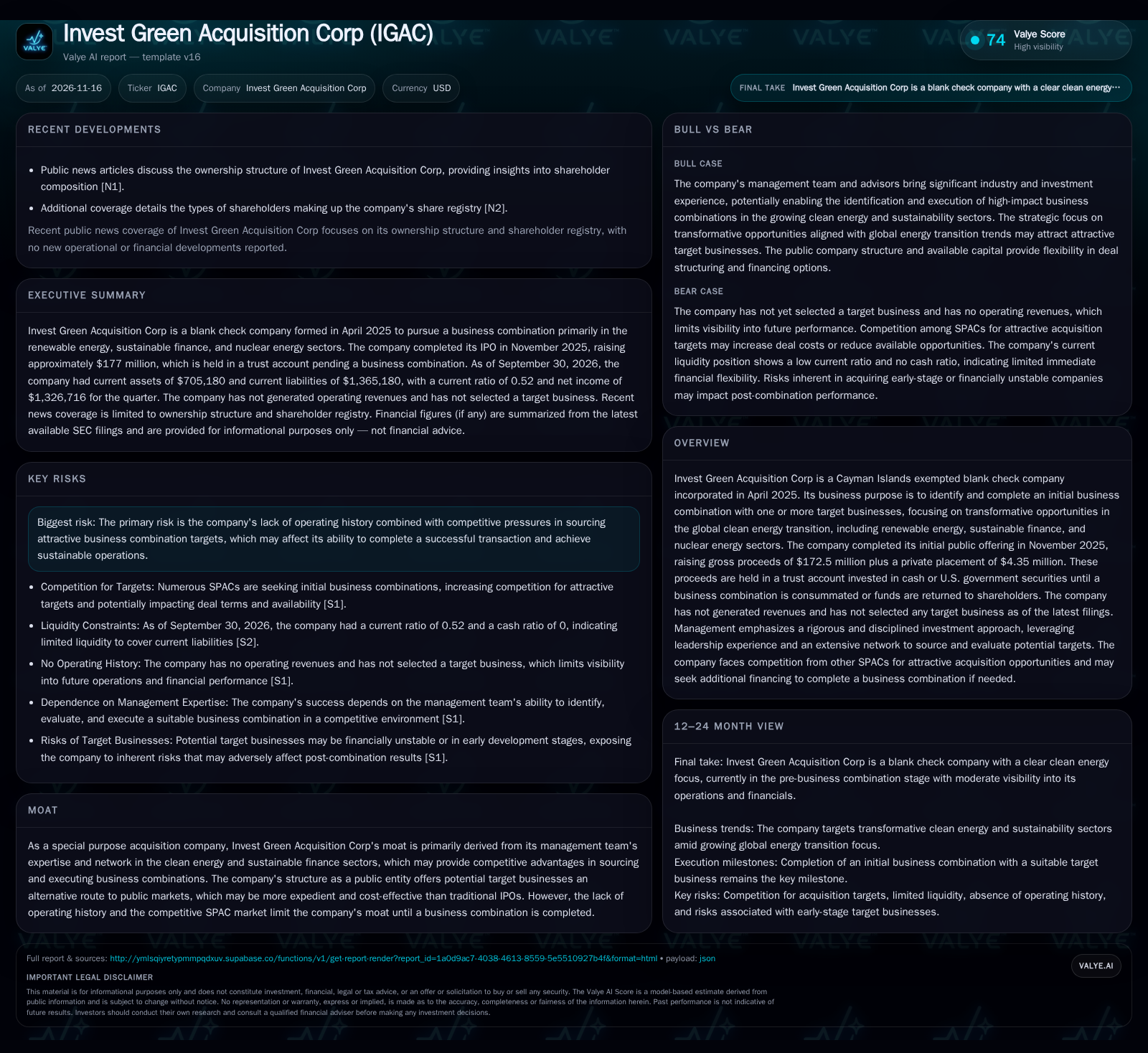
Invest Green Acquisition Corp remains in the pre-acquisition stage, with roughly $177 million in IPO and private placement proceeds in trust and no target selected as of late 2026. Success now hinges on sourcing a compelling clean energy or sustainability target and executing a value-accretive deal under tight time and capital pressure. [S1] [S2]
Invest Green Acquisition Corp (IGAC), a blank check company founded in 2025, stands at a pivotal juncture: flush with $177 million in trust proceeds earmarked for a business combination, but with no target business selected and reported liquidity position outside its trust account. The SPAC’s mission—sourcing a transformative acquisition in renewable energy, sustainable finance, or nuclear sectors—aligns with global investment trends, yet the competitive landscape for high-quality targets has rarely been more intense. With a seasoned management team but clear capital constraints, IGAC’s next moves will decide whether it can deliver on its promise to investors or risk becoming another SPAC unable to consummate a deal before deadlines loom.
Where Invest Green Acquisition Corp Stands: Pre-Deal, Trust Capital, and Liquidity Pinch
As of September 30, 2026, Invest Green Acquisition Corp had not yet selected or entered substantive discussions with any acquisition target, and had generated no operating revenues since inception. The company completed its IPO in November 2025, raising $172.5 million from public investors plus $4.35 million in a sponsor and underwriter private placement, with all proceeds held in trust. Current assets outside the trust account totaled $705,180, while current liabilities stood at $1,365,180, yielding a current ratio of 0.52 and a cash ratio of 0. This means IGAC faces limited operational liquidity for ongoing expenses, with trust proceeds strictly reserved for an eventual business combination or shareholder redemption. The company’s net income for the latest quarter was $1.33 million, driven by interest on trust investments rather than any business activities. [S1] [S2]
Management and advisory teams include veterans of Invest. Green, Fidelity, Microsoft, Robinhood Financial, and LONGi Green Energy Technology, providing depth in investment strategy and sector expertise. However, in the absence of a selected target, the company’s value proposition remains entirely prospective. [S1]
SPAC Economics: Deal Structure, Incentives, and Capital Dynamics
The economic model of a SPAC like IGAC is highly binary: value creation depends almost entirely on sourcing and executing a successful business combination. Until then, the company earns interest on trust assets but generates no operating revenue. The trust structure ensures that IPO proceeds are preserved for either an acquisition or returned to shareholders, with sponsors typically absorbing ongoing costs out-of-pocket or through modest working capital outside the trust. The company’s current liabilities exceeding its current assets suggest it may need to raise additional working capital or defer some expenses if a deal is delayed. [S2]
Deal economics are shaped by the terms of the eventual merger: IGAC can use cash, equity, debt, or combinations thereof to acquire a target. The opportunity is to take a promising clean energy or sustainability company public, providing capital, credibility, and potential liquidity for founders and early investors. However, dilution from sponsor shares, warrants, and possible PIPE (private investment in public equity) financing can erode value for public shareholders if the target is not attractively priced or if redemptions are high.
Operating leverage is minimal pre-deal; post-acquisition, the economics hinge on the acquired company’s business model, growth prospects, and capital intensity. If IGAC selects a capital-hungry target (e.g., project-based renewable energy), ongoing funding needs could be substantial. Conversely, a software- or asset-light sustainability platform could offer higher margins and quicker path to free-cash-flow generation. The absence of a selected target means the ultimate economic profile remains speculative.
Sourcing Edge or Commoditized SPAC? Competing for Targets in a Crowded Market
IGAC’s management and advisor roster brings credibility and relationships in clean energy, sustainable finance, and nuclear industries—sectors experiencing strong policy and capital tailwinds. This could confer an edge in identifying, evaluating, and winning high-quality targets. However, the current SPAC landscape is intensely competitive, with many blank check companies chasing a finite pool of attractive, scale-ready targets. This environment puts upward pressure on acquisition valuations and can force less selective SPACs into marginal deals.
SPACs offer targets a faster, sometimes more founder-friendly route to public markets than traditional IPOs, but this advantage has eroded as the SPAC boom has normalized. Competing buyers include other SPACs, private equity, infrastructure funds, and, increasingly, institutional investors seeking direct stakes in climate and transition assets. If IGAC’s management can leverage its network and sector knowledge to find proprietary or overlooked opportunities, it may sidestep the worst of the bidding wars. But if not, it risks either overpaying or failing to complete a deal within mandated timelines.
How IGAC Could Deliver: Proprietary Sourcing and a Convincing Clean Energy Platform
The most favorable outcome is that IGAC leverages its team’s connections to source a proprietary or underappreciated clean energy or sustainability business—ideally one with strong growth prospects, clear ESG credentials, and scalable economics. If the management team can identify such a target before SPAC deadlines, negotiate favorable terms, and execute a smooth transaction, the resulting public company could attract institutional support and trade at a premium to trust value.
Indicators confirming this upside would include a timely announcement of a business combination with a credible, high-growth target; low public shareholder redemptions; and evidence that the acquired business is positioned for revenue and margin expansion. Additional PIPE financing or strategic partners joining the deal would also signal market confidence.
This scenario requires that IGAC’s network delivers access to deals unavailable to less-connected SPACs, and that the team’s due diligence discipline prevents overpaying in a frothy market. If these conditions are not met—e.g., if the announced target draws skepticism, or if redemptions are high—the scenario is likely falsified.
Most Likely Trajectory: Protracted Target Search, Execution Risk, and Investor Caution
The most plausible trajectory is that IGAC spends the coming months searching for a suitable acquisition, amid ongoing sector competition and shareholder pressure to preserve trust value. The company may ultimately announce a business combination with a mid-tier or late-stage clean energy or sustainability company, but the deal may not be distinctive enough to command a significant premium to trust value.
Confirming evidence would include a deal announcement with a credible but not market-leading target, modest PIPE participation, and significant redemption rates from public shareholders seeking return of capital. The acquired company might be sound, but not sufficiently differentiated to generate outsized returns for SPAC sponsors or non-redeeming shareholders.
If IGAC cannot secure a target before deadlines or if market conditions worsen (e.g., negative sentiment toward SPACs or clean energy), the risk of deal failure or liquidation increases. Conversely, evidence of a unique, high-quality target or robust post-deal trading would challenge this base scenario.
When the Clock Runs Out: No Deal, High Redemptions, or Value-Destroying Acquisition
The principal downside is that IGAC fails to secure an attractive target before mandated deadlines, forcing liquidation and return of trust proceeds to public shareholders—leaving sponsors with sunk costs and investors with little or no upside. Alternatively, in a bid to avoid liquidation, the company could pursue a suboptimal or speculative target, resulting in high redemptions, post-deal share price declines, and reputational damage.
Red flags that would confirm this scenario include repeated deadline extensions, announcement of a low-quality or controversial target, little or no PIPE support, and overwhelming public shareholder redemptions. A deal that closes but is met with immediate post-merger share price weakness or operational disappointments would also validate the downside case.
Given the company’s reported liquidity position outside the trust, protracted delays or failed negotiations could strain working capital and force additional sponsor loans or dilutionary financings.
Milestones That Will Decide IGAC’s Value Creation in the Clean Energy SPAC Arena
Announcement of a letter of intent or definitive agreement with a target in the clean energy, sustainable finance, or nuclear sector.
Level of public shareholder redemptions at the time of business combination announcement and closing; high redemptions would signal limited investor confidence.
PIPE (private investment in public equity) participation, if any, to gauge institutional validation of the target and deal structure.
The profile, historical performance, and capital needs of the announced target—particularly whether it is capital-intensive or asset-light.
Evidence of proprietary sourcing or unique deal access via management’s network, as opposed to a widely shopped or competitive auction process.
Timeliness of deal announcement relative to SPAC deadlines and any requests for deadline extensions.
Additional working capital infusions, sponsor loans, or amendments to SPAC terms that could signal financial stress or shifting sponsor incentives.
Market reaction and post-deal trading of shares, if and when a business combination is consummated, as a litmus test of long-term value creation.
Disclaimer: This is research-only, informational analysis and not investment advice. It may include AI-generated interpretation and general industry context. Always verify important details using primary sources.

Comments