
IGI Advances Specialty Insurance Amid Rising Catastrophe Losses and Capital Optimizations
International General Insurance Holdings updates on recent board changes and dividend initiatives while managing elevated loss ratios in a competitive specialty insurance market.
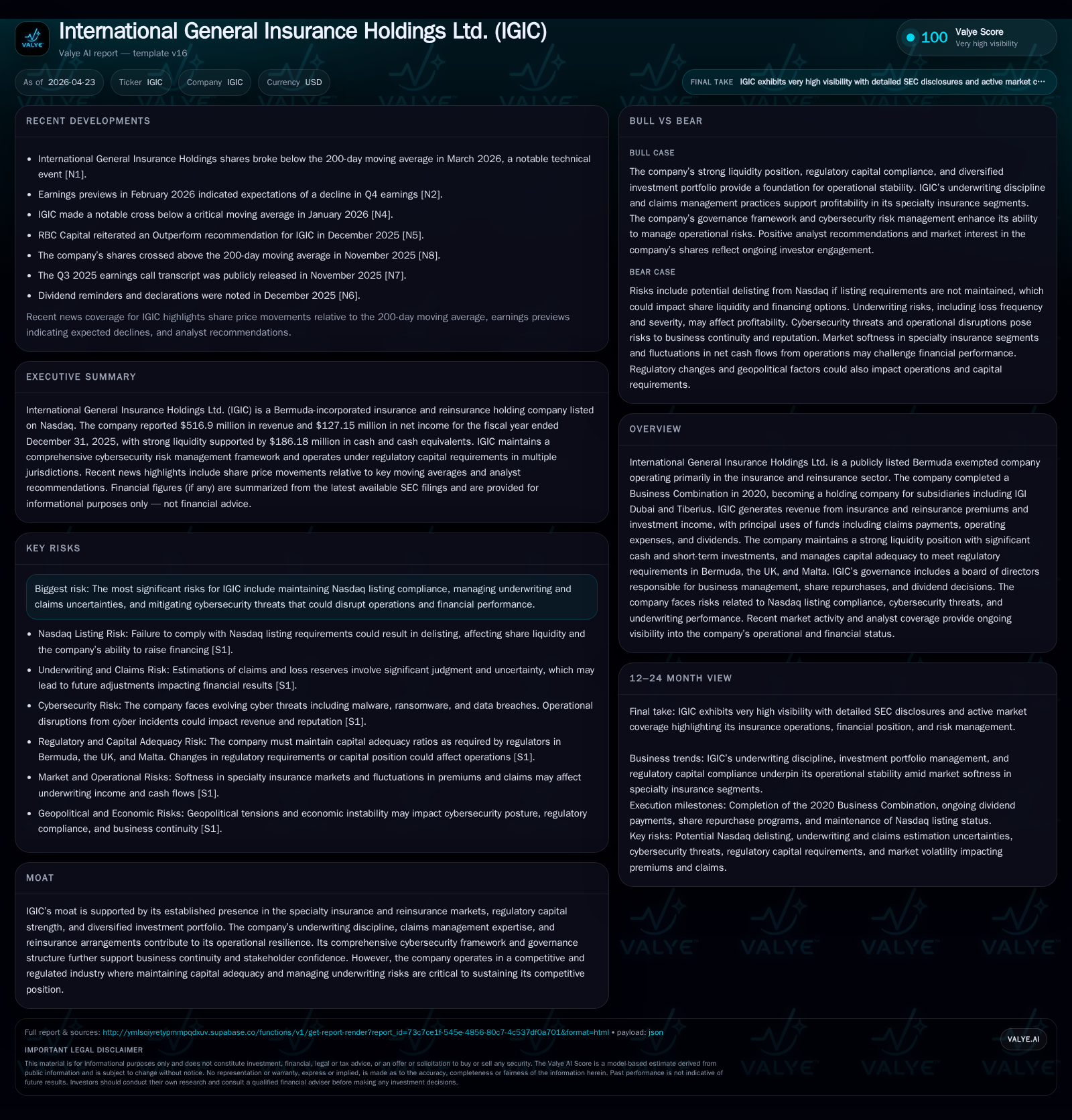
International General Insurance Holdings Ltd. (IGIC) reported operational updates in early 2026, including board replenishment and a sizable extraordinary cash dividend. The company faces near-term pressure from increasing catastrophe losses that have driven up loss ratios in 2025, alongside elevated expenses. IGI’s business model centers on specialty insurance and reinsurance with a diversified global footprint, leveraging underwriting discipline and robust capital adequacy to maintain competitiveness. Growth is tempered by regulatory capital constraints, claims inflation, and the cyclical nature of catastrophe events. Key monitoring points include underwriting performance trends, capital management decisions, and market conditions affecting reinsurance pricing and demand.
Recent Operating Update
International General Insurance Holdings Ltd. (IGIC) filed its latest quarterly interim disclosures via Form 6-K on March 18, 2026 [S2], accompanied by a February press release announcing an extraordinary cash dividend of $1.15 per common share declared earlier that month [S3]. The board was refreshed in March per disclosures attached to the latest filing, indicating ongoing corporate governance refinements [S2]. These developments underscore management's focus on shareholder returns while navigating evolving operating conditions.
While no specific numerical results were included in the March quarterly release itself beyond governance updates and dividend notices, the recently filed Annual Report on Form 20-F as of April 21, 2026 provides comprehensive financial details covering year-end December 31, 2025 [S1]. This annual disclosure anchors the current operating environment analysis.
Business Model
IGIC functions primarily as a Bermuda-based holding company engaged in specialty insurance and reinsurance segments through subsidiaries such as IGI Dubai and Tiberius [S1]. The core revenue streams arise from insurance premiums underwritten and reinsurances assumed globally across niche risk classes predominantly exposed to catastrophe events.
Premiums collected fund claims payments and operating expenses while investment income from a strategically managed portfolio supplements underwriting income. Investment assets are principally high-quality fixed income securities with strict duration matching aligned to reserve liabilities [S6][S23]. Liquidity is tightly maintained with cash plus short-term investments totaling approximately $217 million as of end-2025 [F1][S11].
The holding company structure enables centralized governance with considerable operational autonomy delegated to geographically diversified subsidiaries operating under Bermuda Monetary Authority (BMA), UK Financial Conduct Authority (FCA), Prudential Regulation Authority (PRA), and Malta Financial Services Authority (MFSA) frameworks ensuring compliance with local solvency regimes [S1][S6].
Underwriting discipline is upheld through rigorous reserving practices accounting for inflationary trends in claims costs and judicial awards impacting professional lines liability exposures [S8]. The company's approach represents an amalgamation of actuarial insight blended with real-time loss development data.
Industry Structure and Competitive Position
IGIC occupies an established position within specialty insurance markets characterized by cyclicality due to the unpredictability of large-scale catastrophe events such as hurricanes, earthquakes, wildfires, floods, and storms reported in key geographies [S1]. The firm's competitive moat rests on its proven claims management expertise coupled with strong capital buffers exceeding minimum regulatory solvency requirements - notably an 83% surplus over Solvency II capital thresholds recorded in 2025 for IGI Europe [S23].
Their diversified investment mix reduces concentration risk while supporting liabilities effectively. In-house management of most investments enables nimble asset allocation supportive of underwriting needs.
Despite these strengths, the sector competes fiercely on price adequacy reflecting shifting risk perceptions post-catastrophes and increasing reinsurance capacity underwrite limits amid evolving climate risk profiles.
Moreover, regulatory complexity spanning multiple jurisdictions demands continuous capital optimization and robust governance structures—areas where IGIC has demonstrated prudence through measured share repurchases ($61.9 million spent in 2025) balanced against consistent dividend distributions ($46.2 million paid in dividends for FY25) [F1][S14][S15][S17]. Cybersecurity governance has emerged as a strategic imperative given digital operational dependencies with IGIC maintaining a board-supervised enterprise-wide cyber risk framework that flags typical endemic risks such as phishing attacks, ransomware threats, third-party vulnerabilities, data breaches, legacy system exposure, cloud risks, and global regulatory compliance demands [S12][S13][S24].
Growth Drivers and Constraints
The main growth driver lies structurally within rising demand for specialized insurance/reinsurance products amid heightened volatility from environmental catastrophes exacerbated by climate change factors. Premium rate adequacy tends to rise post-event cycles when capacity tightens.
However, growth can be constrained by:
- Regulatory capital adequacy requirements that limit leverage of premium growth without commensurate capital inflows;
- Rising loss ratios driven by increasing frequency/severity of catastrophe claims demonstrated by a jump from 44.7% to 47.6% from 2024 to 2025 largely due to several international natural disaster claims including Taiwan earthquakes and California wildfires [S1];
- Expense inflation notably human resources and technology costs impacting operating margin;
- Market competition pressuring renewal rates;
- Potential disruptions or reputational impairment stemming from cybersecurity incidents although none have materialized thus far;
- Nasdaq listing continuity risks posing possible long-term liquidity limitations.
What to Watch Next
Investors monitoring IGI should focus on:
- Quarterly loss ratio developments: whether elevated catastrophe loss experience moderates or intensifies.
- Capital management updates: follow-up actions on share repurchases or additional extraordinary dividends after strong balance sheet buffers.
- Regulatory changes: how evolving solvency standards especially related to climate resilience impact capital modeling.
- Underwriting mix evolution: Any pivot towards lower volatility lines or geographic diversification mitigating catastrophe concentration risk.
- Cybersecurity incident reporting: potential disclosures or enhancements aligning with industry best practices.
- Market dynamics: Reinsurance pricing trends post major weather seasons influencing premium growth opportunities.
Financial Profile
Supporting these insights are key financial results for FY2025 per latest filings [F1]:
Historical performance (annual)
| FY | Rev ($mm) | Net ($mm) | CFO ($mm) | Rev YoY | Net YoY |
|---|---|---|---|---|---|
| 2025 | 517 | 127 | 108 | -4.1% | -5.9% |
| 2024 | 539 | 135 | 209 | +14.2% | +14.3% |
| 2023 | 472 | 118 | 197 |
Source: SEC companyfacts cache [F1].
Capital returns and efficiency (annual)
| FY | Div ($mm) | Buybacks ($mm) | ROE% |
|---|---|---|---|
| 2025 | 46 | 62 | 17.9 |
| 2024 | 27 | 23 | 20.6 |
| 2023 | 2 | 31 | 21.9 |
Source: SEC companyfacts cache [F1].
Revenue contracted slightly (-4.1%) year-over-year reflecting tougher market conditions but net income retained solid profitability at $127 million resulting in an approximate return on equity near 18%. Operating cash flow declined substantially (-48%), pointing to potential timing differences or changes in working capital/reserve build that merit monitoring ahead.[F1]
Capital structure remains conservatively positioned with no significant debt incurred; liquidity ample for ongoing operations supporting claim settlements and strategic distribution activities including dividends/share repurchases [S11][S29]. Expense growth attributable mainly to people costs aligns with expansion strategy while acquisition expense ratios held stable around mid-teens percentage band [S1].
Overall, IGIC presents as a focused specialty insurer navigating cyclical catastrophe-driven earnings swings while preserving disciplined capital allocation aimed at sustaining shareholder value within an increasingly complex regulatory landscape.
This analysis synthesizes publicly filed SEC documents up to April 2026 along with factual historical financial data without forecasting future performance or issuing investment recommendations.
Disclaimer: This is research-only, informational analysis and not investment advice. It may include AI-generated interpretation and general industry context. Always verify important details using primary sources.

Comments