
InnSuites Hospitality Trust Confronts Competitive Pressures with Portfolio Renovations and Diversification Plans
After stabilizing operations post-pandemic, InnSuites targets asset sales and diversification amid ongoing sector challenges.
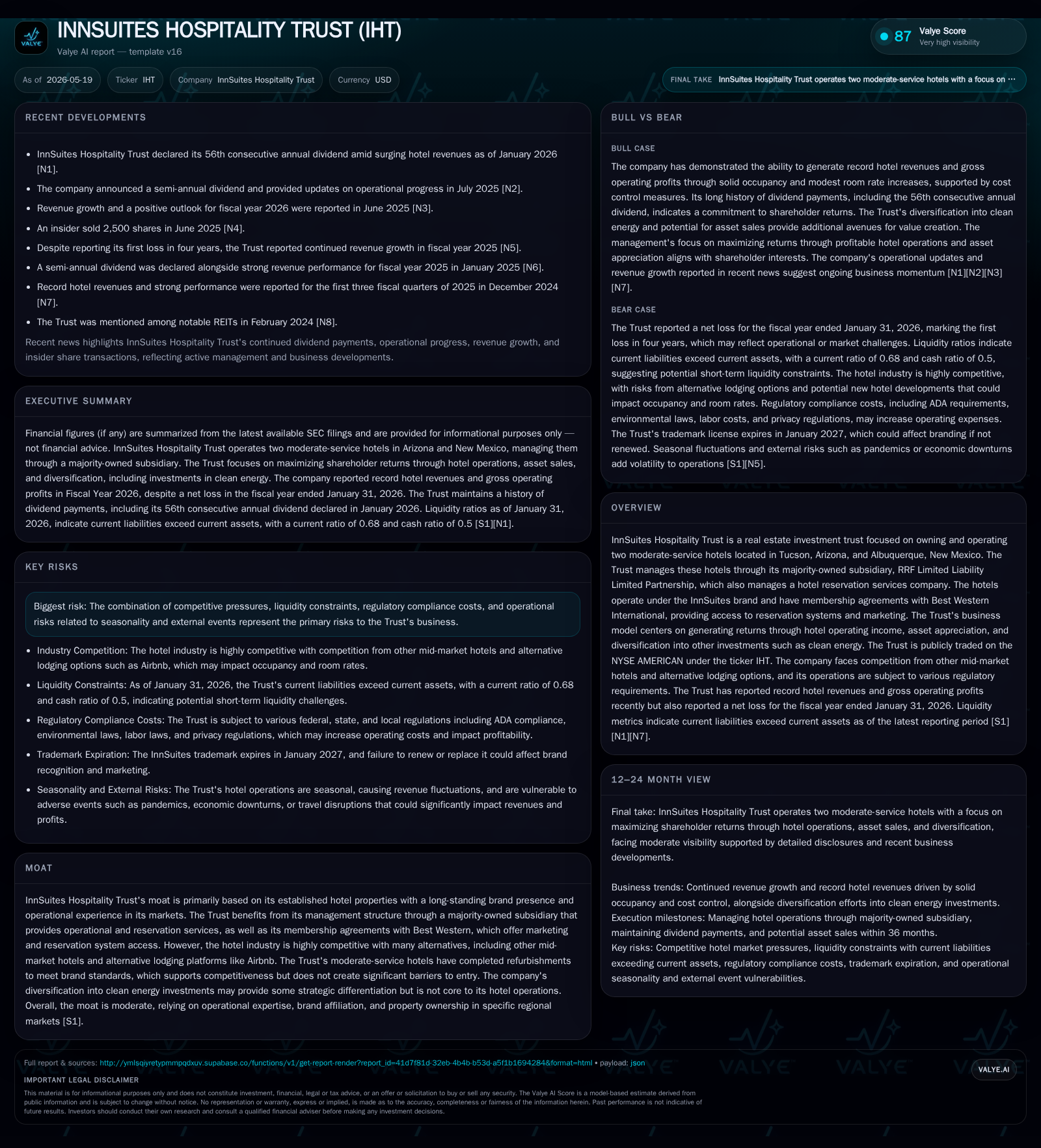
InnSuites Hospitality Trust operates two moderate-service hotels in Tucson, Arizona, and Albuquerque, New Mexico, managing these properties through its majority-owned subsidiary and leveraging Best Western membership for marketing and reservation support. Its latest quarterly disclosures reveal stabilized lodging demand following COVID-19 disruptions, with completed renovations enabling incremental growth over the next two years. Despite solid occupancy and pricing improvements driving near-record revenues in fiscal 2026, persistent competition from mid-market hotels and alternative lodging platforms restrains upside. The trust is pursuing a strategic path focused on maximizing shareholder returns through profitable hotel operations, potential asset sales within three years, and diversification investments including clean energy innovations. Operational risks include regulatory compliance costs, seasonality effects, labor market tightness, and potential adverse economic events.
Recent Operating Update
InnSuites Hospitality Trust’s latest quarterly filing from December 15, 2025 [S2] reveals that lodging demand has regained stability following the severe downturn during Fiscal Year 2021 caused by COVID-19. This stabilization marks a key inflection after the pandemic’s material impact on travel patterns and occupancy rates. The company's two hotels—one in Tucson, Arizona, and another in Albuquerque, New Mexico—recently completed renovations aligned with Best Western standards [S1], enhancing product quality to drive incremental demand over the next 24 months. The supply side in these regional markets remains relatively steady without major new entrants expected imminently.
Business Model
InnSuites Hospitality Trust operates as a real estate investment trust (REIT) structured as an unincorporated Ohio entity taxed as a C-corporation rather than a pass-through REIT structure [S1]. It owns interests in two moderate-service hotels totaling 270 suites via a majority-owned subsidiary partnership (RRF LLLP). This affiliate directly manages the day-to-day hotel operations and also manages a boutique hotel reservation services company (IBC Hotels LLC) enhancing operational control over booking channels.
Revenue primarily derives from hotel operating income generated by room bookings. Customers—primarily business travelers, leisure guests, group bookings, and government clients—pay daily room rates for either value studio suites or two-room suites designed under a philosophy dating back to 1980 emphasizing value within the moderate service segment [S1]. Additional ancillary amenities such as swimming pools, fitness centers, conference facilities, and onsite food & beverage outlets like PJ’s Pub at the Tucson location complement guest offerings.
Management agreements stipulate fees at 5% of room revenue plus fixed monthly accounting fees per hotel [S4]. The Trust also provides trademark licensing services for the “InnSuites” brand included within management fees. Meanwhile, membership agreements with Best Western International grant access to its branding arsenal and reservation systems in exchange for marketing fees proportional to room revenue plus monthly availability fees based on suite count [S11]. These agreements are annual renewals dependent on maintaining minimum room quality standards.
The Trust anticipates monetizing one or both hotel assets within the next three years [S1], aiming to capture asset appreciation alongside ongoing operational income.
Industry Structure and Competitive Position
The hospitality market served by InnSuites is characterized by moderate-service mid-market hotels competing primarily on location convenience, price-value ratio, and service consistency. Both geographic markets of Tucson and Albuquerque have relatively stable supply bases but face competitive pressures from peer mid-tier hotels as well as the disruptive emergence of alternative lodging platforms such as Airbnb [S6]. Although no single competitor dominates these local markets outright, some rivals possess superior financial or marketing resources that can exert pressure on pricing or occupancy.
InnSuites' competitive moat is modest: it benefits from established properties renovated to meet recognized brand standards under Best Western affiliation, facilitating access to widespread distribution channels including a global reservation system. However, barriers to entry remain limited given low differentiation in product features relative to other moderate-service suppliers; refurbishments increase competitiveness but not exclusivity.
The company's operational model leverages direct management through RRF LLLP allowing tighter expense controls yet does not insulate it fully from cyclical demand fluctuations or competitive shifts [S4]. Seasonality varies by location—with Tucson peaking in winter quarters aligned with regional travel patterns while Albuquerque benefits mostly from summer-season demand—exposing earnings volatility risks across fiscal quarters [S7].
Growth Drivers
- Renovation Impact: Completion of significant refurbishments meeting stringent brand standards should stimulate gradual occupancy improvements and allow modest rate increases next 24 months [S1][S6].
- Strategic Asset Sales: Planned divestiture(s) of one or both hotels within three years aim at monetizing appreciated real estate values offering potential capital recycling toward higher-return investments [S1].
- Diversification Strategy: Investments in emerging sectors such as clean energy generation technology via UniGen Power Inc. represent efforts to expand earnings base beyond hotel operations thereby reducing concentration risk [S1][S6].
- Marketing & Reservation Support: Ongoing affiliation payments to Best Western yield access to booking channel efficiency gains supporting steady demand inflows despite competitive headwinds [S11].
These drivers collectively position InnSuites for measured top-line expansion while maintaining operational profitability focus.
Risks / Watchpoints / Growth Constraints
- Competition & Market Saturation: Renewed development activity in local hotel markets or sudden declines in regional travel demand could erode occupancy rates or compress achievable pricing [S6]. Airbnb-style alternatives intensify competitive pressures by attracting discretionary travelers away from traditional hotels.
- Seasonality Risks: Distinct seasonal occupancy lulls in both locations heighten cash flow volatility requiring disciplined expense management especially during low-demand quarters [S7].
- Regulatory Burden: Compliance costs arising from federal/state/local regulations covering ADA accessibility upgrades, environmental liabilities related to property contamination risks (including pool chemicals), labor laws particularly wage hikes amid tight staffing markets, food & beverage safety licensing guidelines pose constant pressure on margins [S5][S12].
- Liquidity Constraints: The company’s current ratio stands at approximately 0.68, indicating modest short-term liquidity challenges, with net debt exceeding $10 million as of January 31, 2026 [F1]. These factors could limit financial flexibility especially if adverse market conditions worsen.
- Brand Renewal: The current InnSuites trademark expires January 2027 necessitating renewal or rebranding decisions that may affect customer perception or require investment [S11].
- Economic Sensitivity: Vulnerability to macro shocks including pandemics (COVID-19 impact felt significantly during FY2021), geopolitical tensions affecting tariffs/travel restrictions could stress revenue streams acutely given concentrated geographic exposure [S2][S16].
What to Watch Next
Upcoming milestones involve tracking progress against the planned sale timelines for one or both hotel assets within three years—a move that will materially influence capital structure and reinvestment capacity [S1]. Monitoring quarterly updates post-renovation impact will be critical for signs of sustained occupancy gains or rate improvements. Development updates from UniGen Power investments could provide indicators on diversification project viability. Additionally, managing regulatory compliance costs effectively amidst tight labor markets will remain a key operational metric alongside maintenance of Best Western membership status tied directly to property quality metrics.
Investor scrutiny should focus on any changes in covenant terms backed by current debt levels ($11.7 million) relative to cash balances ($1.3 million) suggestive of leverage considerations affecting future funding options as reported through latest filings [F1][S2]. Pricing power durability evidenced by ability to incrementally raise room rates despite increased competition presents an important parameter reflecting operational health.
Financial Profile Overview
Historical performance (annual)
Capital returns and efficiency (annual)
Annual revenues have shown modest growth recovering from pandemic lows around $7.6 million recorded in FY2025—a slight increase of ~1.3% over prior year—but operating losses persist expanding modestly with an operating loss reaching $560k in FY2026 versus $743k FY2025 indicating ongoing cost pressures [F1]. Net income shows further strain at approximately -$1.43 million FY2026 compared with -$1.39 million prior year driven partly by non-operating expenses or interest burdens connected to total debt near $11.7 million net of cash holdings above $1.3 million suggests structural leverage risk despite positive trends in gross profit due to occupancy improvements noted in annual commentary [F1][S11]. Operating cash flow remains negative albeit improved dramatically compared to FY2025 signaling better working capital management though free cash flow remains subdued without notable reinvestment capex recorded recently [F1]. Dividends continue at minimal levels reinforcing constrained distributable cash capacity [F1].
Conclusion
InnSuites Hospitality Trust stands at a crossroads balancing operational recovery post-pandemic with competitive challenges intrinsic to mid-market hotel segments. Completed renovations underpin cautious optimism for incremental demand growth over the medium term while strategic plans accommodate potential asset sales seeking portfolio optimization. Efforts towards diversification into clean energy ventures mark a notable departure from purely hospitality-centric revenue streams aiming to enhance resilience amid cyclicality and regulatory cost inflation pressures. Nonetheless, sector fragmentation and technological disruption through alternative lodging platforms underscore persistent vulnerabilities requiring adept management execution going forward.
This analysis is based solely on publicly available SEC filings up through May 2026 including latest annual (10-K) and quarterly (10-Q) reports enhanced by domain expertise contextualizing InnSuites Hospitality Trust's industry standing without providing investment advice or research views.
Disclaimer: This is research-only, informational analysis and not investment advice. It may include AI-generated interpretation and general industry context. Always verify important details using primary sources.

Comments