
IMA Tech's AI Avatars Target Multilingual Market with Scalability Challenge
IMA Tech advances AI-powered digital avatars for diverse industries, balancing innovation with acute early-stage liquidity and operational constraints.
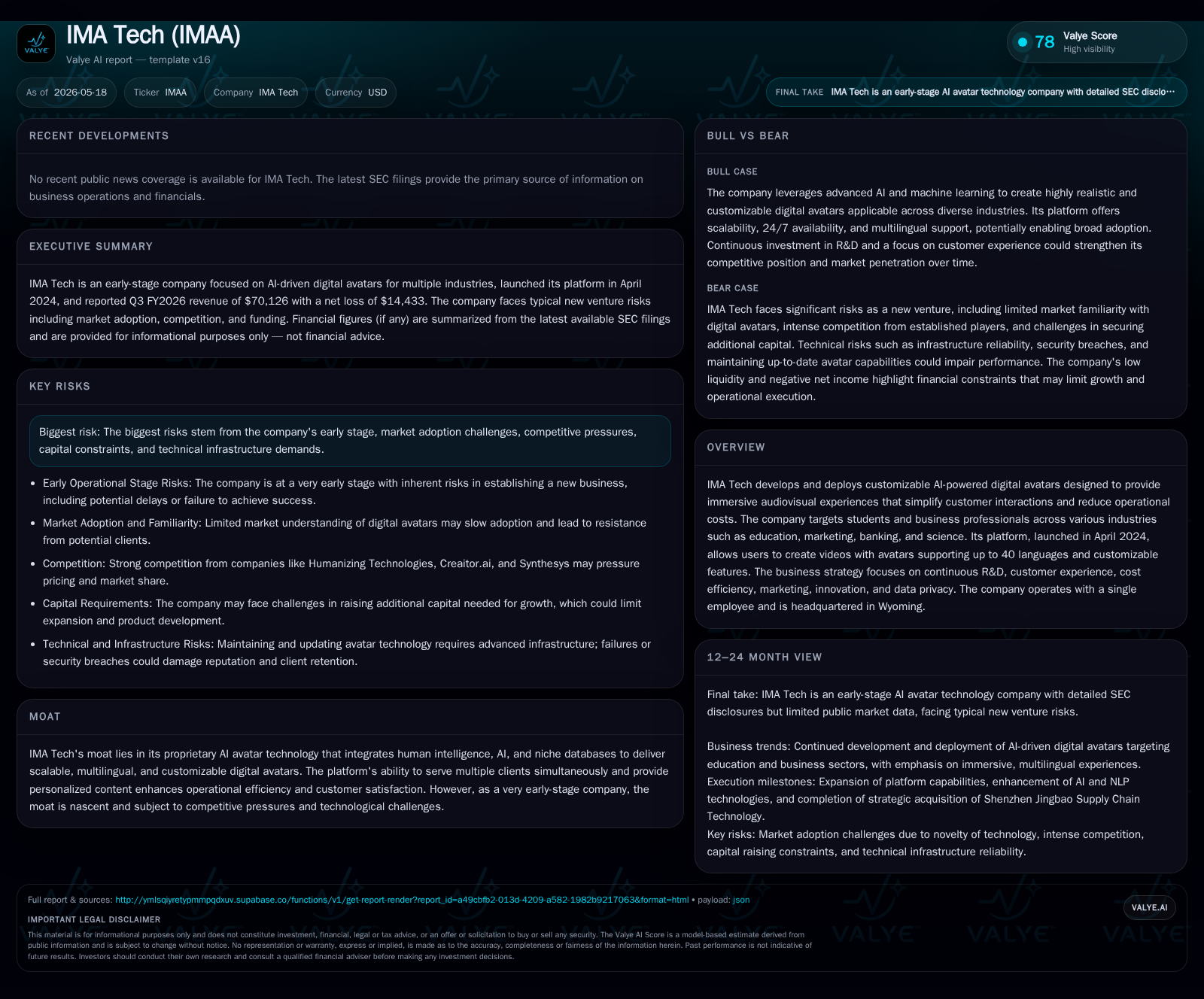
The latest 10-Q filing dated May 2026 reveals no new risk factors but highlights a strategic acquisition intent aimed at expanding logistics capabilities. IMA Tech’s business model centers on customizable, scalable AI avatars supporting up to 40 languages for immersive customer interactions in education, marketing, and finance sectors. While the proprietary AI platform offers a nascent moat, the company faces significant challenges from limited scale, capital scarcity, and competitive pressures. Near-term growth hinges on completing the Shenzhen Jingbao acquisition and accelerating user adoption via its imu.gg platform.
Latest Quarterly Operating Update and Significance
IMA Tech’s most recent Form 10-Q filed May 18, 2026 [S2] presents an operating environment free of newly identified risk factors after previous filings had outlined numerous challenges typical of an emergent tech venture. This pause in risk disclosures suggests stabilization or a deliberate recalibration of risk communication. Critically, the company disclosed a Letter of Intent signed January 29, 2026 to acquire Shenzhen Jingbao Supply Chain Technology Co., Ltd., with an anticipated closing by mid-February 2026 [S3]. The acquisition introduces logistics capacity aligned with e-commerce markets in Southeast Asia, expanding IMA Tech’s business scope beyond core digital avatars. Despite this strategic move, operational scale remains minimal: IMA Tech operates with a single full-time employee according to the latest annual filing [S1], emphasizing reliance on lean overhead but also highlighting execution capacity risks.
IMA Tech’s Business Model and Product Capabilities
IMA Tech monetizes through its AI-powered digital avatar platform designed to offer immersive audiovisual experiences that simplify complex customer interactions while reducing costs [S1]. Users—primarily students and business professionals—pay for access to create videos using highly customizable avatars capable of communicating in up to 40 languages [S9][S19]. Revenue mechanics involve subscription or usage-based fees for avatar generation services through the https://ima.gg website launched April 2024 [S19].
The platform integrates human intelligence datasets with AI algorithms and niche databases yielding personalization granularity absent in many competitors’ solutions. Product features include selectable voice styles (gender, age filters), background customization, and avatar appearance variation which support diverse applications across education (audiovisual learning aids) and consulting services (interactive client engagement) [S12][S23]. This multilingual capability positions IMA Tech advantageously for global markets requiring localized content delivery—a sector where competitors often lack scalability.
Competitive Environment and Industry Positioning
Operating within the burgeoning AI-driven digital avatar industry, IMA Tech contends with rivals like Humanizing Technologies, Creaitor.ai, and Synthesys as noted in multiple risk sections [S14]. These competitors vary in scale and product breadth but share similar technological ambitions: realistic avatar creation combined with natural language processing enhancements. IMA Tech’s moat currently is nascent, emerging from its proprietary integration of human intelligence data sources with AI models to augment personalization across multiple simultaneous users. However, this advantage faces pressure due to rapid innovation cycles demands substantial R&D investment—challenging given IMA’s small operational footprint.
Pricing pressure is likely elevated as the company must competitively price offerings without sacrificing developmental reinvestment so critical for technological differentiation [S14]. Marketing efforts focus on targeted advertising combined with SEO strategies to build brand awareness—a necessary strategy given market unfamiliarity around avatar utility outside entertainment sectors [S9][S13].
Scalability, Customer Segmentation, and Value Proposition
Scalability is central: digital avatars can engage multiple customers simultaneously while maintaining personalized interaction modalities [S19]. This scalability enables clients—ranging from virtual consultants to educational platforms—to deploy resources more efficiently by automating round-the-clock engagements in multilingual contexts without compromising quality of service.
Two primary customer segments are targeted:
- Students, who benefit from audiovisual avatar-enabled content which accelerates learning retention through visual and auditory stimuli.
- Business professionals, who use avatars for virtual consultations enhancing client service quality while reducing labor costs.
Avatars serve as cost and time savers by replacing repetitive human tasks; combined with customization options (language choice among 40 supported languages) they create switching costs that encourage user retention through tailored experiences [S12]
Growth Drivers: Innovation, Market Adoption, and Strategic Initiatives
IMA Tech’s growth strategy rests on continuous R&D advancements aimed at improving natural language processing accuracy, machine learning adaptability, and increasing avatar realism via API integrations [S9]. Marketing investments prioritize establishing digital presence across relevant platforms employing social media outreach plus search engine optimization to enhance inbound demand [S13].
The prospective acquisition of Shenzhen Jingbao Supply Chain Technology represents a diversification into logistics supportive of e-commerce sectors in Southeast Asia—potentially opening channels for avatar applications in supply chain communications or digital commerce assistant roles [S3]. This move could leverage synergies between avatar innovations with pragmatic logistics operations.
Expansion plans also envision new functionalities such as enhanced avatar expressiveness tied to instructional delivery improving usability in educational contexts or business training modules [S23]. Such innovation aims to establish barriers against commoditization pressures in a highly competitive market.
Risks and Challenges Facing Execution and Market Penetration
Near-Term Watchpoints: Milestones and Demand Indicators
Key metrics warranting attention include:
- Acquisition closing: Completion of Shenzhen Jingbao deal post administrative approvals expected by mid-February 2026; success here expands operational scope materially [S3].
- User base growth: Platform traffic statistics such as active users creating or downloading videos on imu.gg indicative of market traction.
- R&D pipeline progress: Deliverables related to feature rollouts enhancing avatar customization or language capability expansions.
- Marketing effectiveness: Measured via inbound lead generation attributable to SEO efforts or social campaigns aiming at awareness building.
- Any announcements concerning partnerships or client testimonials demonstrating avatar impact would strengthen validation narratives.
Financial Profile: Liquidity Status and Operating Performance
Financial data reveal an ongoing operating loss consistent with startup ventures: net income was negative $55,071 as of April 30, 2025 reflecting continued investment burn without material revenue scaling yet ($55K loss against top-line revenue around $55K) [F1]. Liquidity tension is acute with negligible cash reserves ($397) juxtaposed against substantial current liabilities ($278,966) leading to a severely impaired current ratio (~0.1), highlighting urgent need for capital infusion or rapid revenue acceleration to sustain operations without restructuring risk [F1]. The absence of debt detail or refinancing announcements indicates reliance on equity or shareholder funding thus far.
This analysis emphasizes IMA Tech’s dual narrative: a pioneering AI-avatar technology firm addressing global multilingual needs via scalable platforms amidst pressing early-stage financial constraints. Success hinges on execution agility both technologically and strategically along with favorable market reception overcoming adoption hurdles. The pending logistics acquisition adds an intriguing dimension beyond pure software-driven services that could catalyze future enterprise value if integrated effectively.
Financial position in context
As of 2026-01-31, companyfacts shows $397 in cash and equivalents [F1]. Current assets of $26532 and current liabilities of $278966 imply a current ratio near 0.1x for 2026-01-31 [F1].
This report is based solely on publicly filed SEC documents as cited along with Valye News proprietary sector analysis frameworks. It does not constitute investment advice.
Disclaimer: This is research-only, informational analysis and not investment advice. It may include AI-generated interpretation and general industry context. Always verify important details using primary sources.

Comments