
Immunome’s Oncology Ambition: Advancing ADCs and Radioligand Therapies Toward Commercial Validation
Immunome’s clinical progress—anchored by positive Phase 3 results for varegacestat and a growing pipeline of antibody-drug conjugates—offers both high-impact upside and execution risk as the company approaches pivotal regulatory milestones and eventual commercialization.
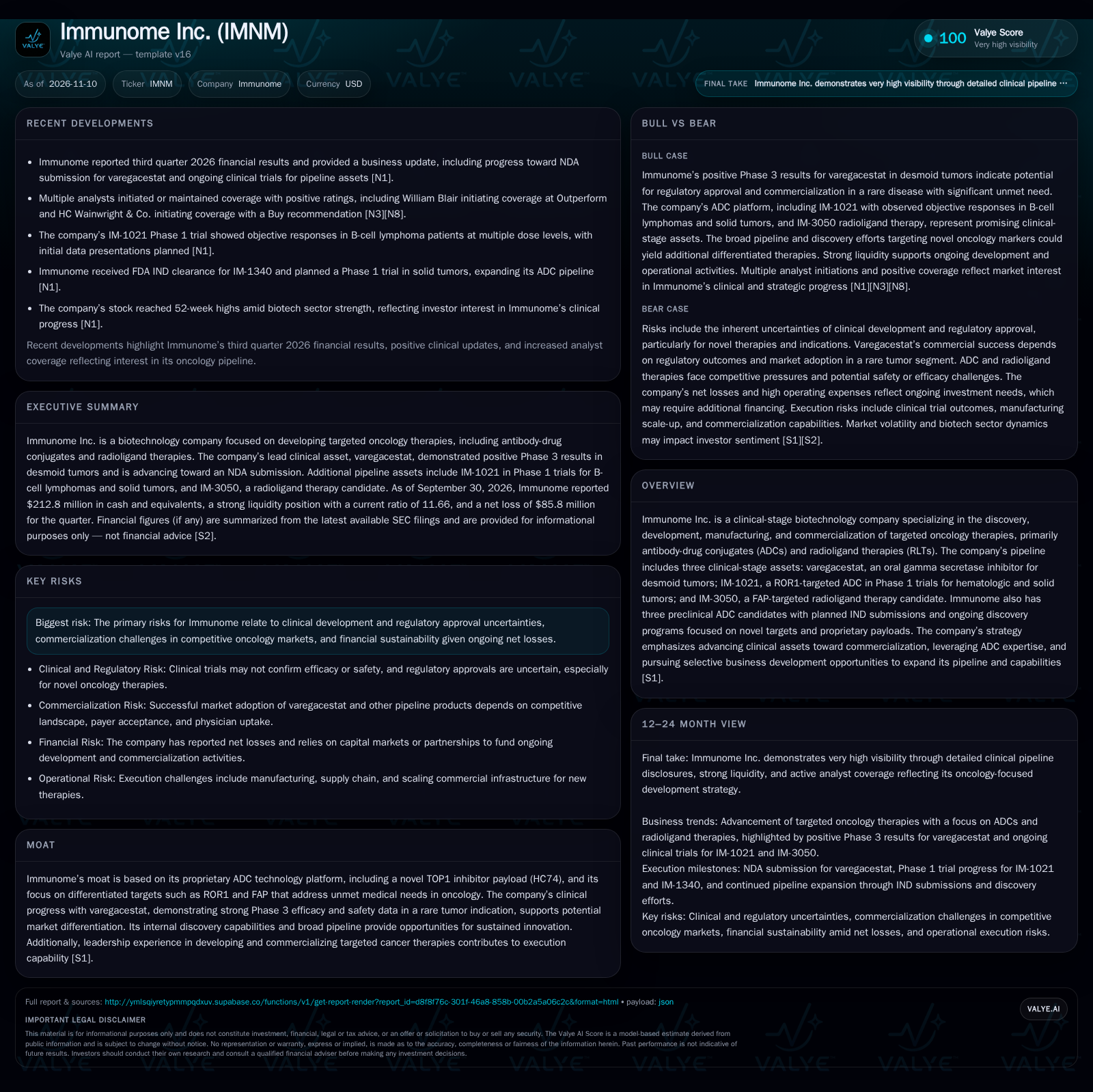
Immunome’s lead asset, varegacestat, achieved strong Phase 3 results in desmoid tumors and is under regulatory review, while the ADC and radioligand pipeline advances through early-stage trials. Execution, competition, and ongoing losses remain central challenges.[S1] [S2] [N1]
Immunome Inc. stands at a pivotal juncture in its evolution as a targeted oncology innovator, with its lead asset varegacestat advancing through regulatory review following positive Phase 3 results in desmoid tumors. The company’s broad clinical and preclinical pipeline—spanning antibody-drug conjugates (ADCs) and radioligand therapies—reflects a multi-pronged approach to cancer therapeutics.
Clinical Milestones and Regulatory Submissions Define Immunome’s Near-Term Arc
The most material current developments for Immunome are the positive topline Phase 3 results for varegacestat (an oral gamma secretase inhibitor) in desmoid tumors, the subsequent new drug application (NDA) submission to the FDA (with a PDUFA date of April 28, 2027), and the European MAA submission, both now under regulatory review. Varegacestat’s 84% reduction in risk of disease progression or death and a 56% objective response rate versus 9% for placebo represent a pivotal efficacy signal for a rare, high-unmet-need indication.[S2]
Beyond varegacestat, Immunome’s pipeline includes IM-1021, a ROR1-targeted ADC with observed objective responses in Phase 1, and IM-3050, a FAP-targeted radioligand therapy now dosing in a Phase 1 trial for solid tumors. These assets demonstrate the company’s intent to build a multi-asset oncology franchise.[S2]
Financially, Immunome reported $212.8 million in cash and cash equivalents as of September 30, 2026, alongside a net loss of $85.8 million for the quarter, reflecting the high cost of advancing multiple clinical programs and preparing for potential commercialization.[S2]
The regulatory review process for novel oncology agents like varegacestat often involves rigorous scrutiny of both clinical efficacy and safety profiles, with particular attention to long-term outcomes and quality-of-life measures in rare tumor populations. Given the rarity of desmoid tumors, real-world evidence generation post-approval could be critical for payer negotiations and broader market access. Additionally, the company’s simultaneous advancement of ADC and radioligand therapies introduces operational complexity, requiring strategic allocation of resources to balance near-term regulatory milestones with sustained pipeline development. This multi-asset progression necessitates robust project management and adaptive clinical trial designs to optimize timelines and minimize risk.
R&D Investment and the Economics of Oncology Innovation
Immunome’s business model is predicated on high-value, high-risk innovation in oncology, with the majority of expenses tied to R&D and the progression of clinical assets. The economics of this model are characterized by significant upfront investment—clinical trials, manufacturing scale-up, regulatory engagement—offset by the potential for outsized returns if one or more therapies achieve approval and commercial uptake.
Pricing for rare oncology indications such as desmoid tumors is typically robust, often supported by orphan drug incentives, but ultimate revenue will depend on market size, payer acceptance, and competitive dynamics. Should varegacestat reach market, fixed costs—especially in manufacturing and commercial infrastructure—may drive operating leverage, but variable costs (COGs, ongoing trial expenses, post-marketing studies) remain significant until meaningful product sales are achieved.
The company reported cash and liquidity metrics for the period; these figures do not by themselves establish operating runway, investment capacity, financial flexibility, or financing capacity. Business development, partnerships, or out-licensing could provide non-dilutive funding, but the terms and timing are uncertain.
The economics of oncology innovation are further complicated by reimbursement dynamics that vary significantly across global markets. Immunome’s pricing strategy for varegacestat and subsequent assets will need to account for health technology assessment (HTA) frameworks that emphasize cost-effectiveness and comparative clinical benefit. In rare diseases, these assessments may be more favorable but remain contingent on demonstrating meaningful patient outcomes beyond surrogate endpoints. Moreover, the company’s investment in manufacturing scale-up must consider supply chain resilience and cost optimization to maintain gross margins as commercial volumes increase. Conditional on successful launches, expanding indications or label extensions could enhance revenue potential but require additional clinical investment and regulatory engagement.
Differentiation in ADCs and Rare Oncology: Opportunity and Counterforces
Immunome’s competitive thesis rests on its proprietary ADC platform—featuring a novel TOP1 inhibitor payload and targeting underexplored antigens like ROR1 and FAP—and its focus on indications with limited effective therapies. This positions the company to potentially deliver first-in-class or best-in-class assets in both hematologic and solid tumor oncology.
However, the ADC and radioligand therapy landscape is increasingly crowded, with large pharma and established biotech peers advancing competing platforms and candidates. Commercial success will depend not only on clinical differentiation (efficacy, safety, dosing convenience) but also on Immunome’s ability to secure regulatory approvals, reimbursement, and physician adoption ahead of or alongside better-resourced competitors.
Switching costs in oncology may be high if Immunome’s therapies deliver substantial benefit, but entrenched treatment paradigms and the rapid evolution of the field create ongoing risk of competitive displacement or pricing pressure.
Immunome’s differentiation strategy in ADCs and radioligand therapies hinges not only on novel payloads and targets but also on optimizing therapeutic windows to improve safety profiles relative to competitors. Given the crowded landscape, incremental clinical benefits may not suffice; demonstrating superior tolerability or convenience—such as less frequent dosing or outpatient administration—could be decisive for market adoption. Furthermore, the company’s ability to generate compelling biomarker-driven patient selection strategies may enhance clinical trial success and commercial uptake by identifying subpopulations most likely to benefit. However, the rapid evolution of competing modalities, including bispecific antibodies and CAR-T therapies, introduces potential displacement risk that Immunome must monitor closely.
If Varegacestat and Pipeline Assets Drive Early Adoption, Value Creation Could Accelerate
The bull case for Immunome centers on the successful regulatory approval and rapid commercial uptake of varegacestat in desmoid tumors, catalyzing revenue inflection and validating the company’s clinical and regulatory strategy. Early signals of payer acceptance and physician adoption, coupled with strong post-marketing data, could establish varegacestat as a standard of care in its niche.
Pipeline progress—such as IM-1021 demonstrating durable responses in B-cell lymphomas or IM-3050 showing efficacy in solid tumors—would further diversify the revenue base and reduce dependence on a single asset. Strategic partnerships or out-licensing could bring in non-dilutive capital and accelerate development.
Confirmation would come from regulatory approvals on or ahead of schedule, positive launch metrics (scripts, market share, pricing), and early pipeline milestones (e.g., advancement to Phase 2/3, new indications).
Clinical Execution and Commercial Build-Out Shape Immunome’s Probable Trajectory
The most plausible scenario is that Immunome navigates the complex path from late-stage development to early commercialization with incremental progress and setbacks. Varegacestat may secure regulatory approval, but adoption could be gradual, limited by the rare nature of desmoid tumors and the need to build physician and payer awareness.
Evidence for this scenario would include regulatory approvals with moderate market uptake, ongoing clinical progress in the pipeline without breakthrough results, and continued investment in infrastructure and commercial capabilities.
Clinical or Regulatory Setbacks Could Force Strategic Reassessment and Capital Raising
The bear case for Immunome is anchored in the risk of clinical or regulatory disappointment—such as unexpected safety signals, efficacy questions, or regulatory delays for varegacestat or pipeline assets. Failure to achieve approval or meaningful commercial traction could materially impair the company’s valuation and strategic options.
Downside confirmation would be signaled by regulatory rejections, clinical trial terminations, material delays in key programs, or substantial increases in net loss without offsetting capital inflows or partnership announcements.
What Will Determine Immunome’s Transition from Clinical Promise to Commercial Reality?
FDA and EMA regulatory decisions and timelines for varegacestat, including any requests for additional data or post-marketing commitments.
Initial launch metrics for varegacestat if approved: prescription volumes, payer coverage decisions, and real-world patient outcomes.
Progression of IM-1021 and IM-3050 through clinical trials, including safety, efficacy, and durability of response (if disclosed).
Updates on IND submissions and advancement of preclinical ADC assets, particularly IM-1340 and IM-1335.
Cash burn trends and any announced financing events, business development deals, or partnerships that affect capital runway.
Market feedback from physicians and payers regarding the clinical value and positioning of Immunome’s lead and pipeline assets (would help test the thesis).
Competitive developments in ADCs and radioligand therapies that could affect Immunome’s differentiation or commercial opportunity.
Disclaimer: This is research-only, informational analysis and not investment advice. It may include AI-generated interpretation and general industry context. Always verify important details using primary sources.

Comments