
Immuneering Advances Phase 3 Trial of Atebimetinib Targeting Pancreatic Cancer with Solid Liquidity
Immuneering’s late-stage clinical progress and proprietary Deep Cyclic Inhibition platform position it distinctively in oncology drug development amid a competitive and regulated environment.
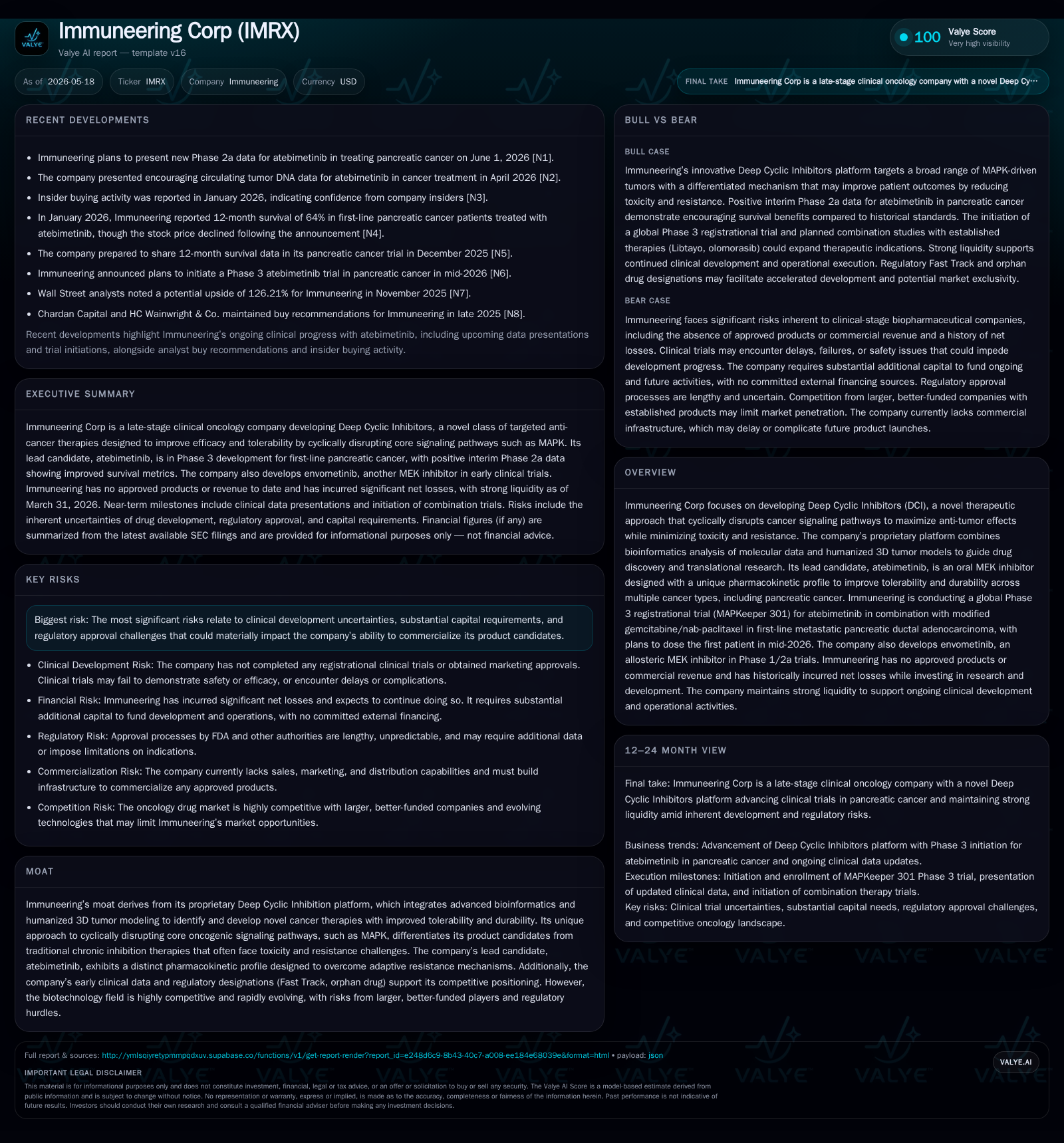
In its recent quarterly filing, Immuneering Corporation detailed plans to initiate a pivotal Phase 3 trial for atebimetinib in first-line metastatic pancreatic ductal adenocarcinoma by mid-2026. The company’s novel Deep Cyclic Inhibition approach aims to deliver improved tolerability and durability over traditional chronic pathway inhibitors. Clinical milestones including interim Phase 2a data support advancement, while significant risks remain from capital intensity, regulatory complexity, and clinical uncertainties. Immuneering’s strong liquidity, with approximately $47 million in cash and a high current ratio as of March 31, 2026, underpins ongoing R&D efforts as it prepares for potential commercialization.
Recent Operating Update
Immuneering Corporation’s latest quarterly filing dated May 15, 2026 [S2] highlights the planned initiation of the MAPKeeper 301 global Phase 3 registrational trial for its lead candidate atebimetinib. This trial targets first-line metastatic pancreatic ductal adenocarcinoma (PDAC) patients with dosing of the first participant expected by mid-2026 [S1]. The randomized study will compare atebimetinib combined with modified gemcitabine/nab-paclitaxel (mGnP) against standard-of-care gemcitabine/nab-paclitaxel alone across approximately 510 patients worldwide.
The primary endpoint is overall survival; secondary endpoints include progression-free survival, overall response rate, disease control rate, and quality-of-life measures [S1]. Interim results from the ongoing Phase 2a portion reported in early 2026 demonstrate encouraging efficacy and tolerability signals that support this advancement into a pivotal trial stage [N1][N2].
Recent event filings on May 15, 2026 [S3] confirm these operational developments without indicating material changes to capital structure or liquidity.
Business Model
Immuneering is a late-stage clinical oncology biotechnology company focused on developing Deep Cyclic Inhibitors (DCI), a novel therapeutic category designed to cyclically inhibit core oncogenic signaling pathways such as MAPK. This approach aims to selectively deprive tumor cells of proliferative signaling while minimizing toxicity to healthy cells—a limitation often seen with chronic pathway inhibition therapies [S1].
The company has not yet commercialized any products nor generated product revenue; funding has been primarily through capital raises and prior computational biology services [F1][S1][S2]. The business model centers on advancing pipeline candidates through clinical development toward regulatory approval and eventual commercialization.
Key value drivers include:
- Proprietary translational bioinformatics integrated with humanized tumor models informing target selection and therapeutic optimization [S1].
- Orally administered small molecules like atebimetinib optimized for once-daily dosing to enhance patient compliance.
- A diversified pipeline including envometinib and early-stage research programs.
Transitioning from an R&D-focused entity to one capable of supporting commercial activities remains a critical challenge requiring significant investment in manufacturing scale-up and sales infrastructure.
Industry Structure and Competitive Position
Operating within the oncology pharmaceutical sector characterized by rapid innovation cycles, Immuneering faces competition from established pharmaceutical companies with extensive portfolios targeting MAPK pathways using chronic inhibitors. These incumbents possess scale advantages in trial execution and commercial reach.
Immuneering’s differentiation lies in its DCI mechanism designed to improve tolerability and combat resistance issues inherent in existing therapies. By integrating advanced computational biology with translational models better capturing tumor heterogeneity, the company aims to establish defensible niches despite competitive pressures.
Regulatory designations such as Fast Track status for atebimetinib may expedite development timelines but do not eliminate inherent industry risks.
Growth Drivers
Clinical Development Milestones
Successful completion of the MAPKeeper 301 Phase 3 trial will be pivotal for marketing approval submissions. Key performance indicators include survival outcomes, safety profiles, and biomarker validation.
Platform Expansion Potential
The DCI platform offers opportunities to extend beyond pancreatic cancer into other tumors driven by similar pathways, diversifying risk and market potential.
Strategic Partnerships
Collaborations with larger pharmaceutical or biotech companies could provide resources for late-stage development, commercialization capabilities, or geographic expansion.
Market Access Initiatives
Early engagement on payer coverage strategies focusing on quality-of-life improvements and biomarker-driven patient selection may facilitate adoption within cost-sensitive healthcare systems.
Operational Scalability
Establishing reliable manufacturing processes that maintain quality while optimizing cost efficiency is essential for commercial readiness.
Risks / Watchpoints / Growth Constraints
Clinical Development Risks
Late-stage oncology trials carry high attrition risk; delays or negative outcomes could materially impact prospects.
Capital Requirements and Financial Sustainability
Despite solid liquidity ($47.3 million cash as of March 31, 2026) [F1], ongoing R&D expenses necessitate careful cash management; additional financing may be required before commercialization.
Regulatory Compliance Challenges
Adherence to evolving FDA/EMA regulations is critical; improper promotional practices post-approval could result in significant penalties [S4][S10][S18]
Intellectual Property Litigation Exposure
Patent disputes or derivation proceedings could impose financial burdens or restrict exclusivity [S7][S14].
Manufacturing Dependencies
Reliance on contract manufacturers introduces risks related to supply continuity affecting trials or market supply [S19].
Healthcare Fraud & Abuse Laws Exposure
Compliance with anti-kickback statutes and other healthcare laws is mandatory; violations could disrupt operations [S10][S15].
Pricing & Reimbursement Uncertainty
Securing adequate coverage from government payors and insurers remains unpredictable; pricing pressures could affect margins internationally [S20][S25]
What to Watch Next
- Initiation of patient dosing in MAPKeeper 301 Phase 3 trial expected mid-2026.
- Presentation of updated circulating tumor DNA data at scientific meetings during Q2–H1 2026 [N1][N2].
- Further survival data disclosures from ongoing Phase 1/2a pancreatic cancer cohorts targeted for H1 2026.
- Start of atebimetinib plus Libtayo combination trials in non-small cell lung cancer planned for second half of 2026 [S1].
- Monitoring cash burn relative to liquidity levels to assess financing runway.
- Regulatory feedback influencing clinical protocols or trial design adjustments.
- Progress on manufacturing partnerships ensuring GMP-compliant scalable drug supply ahead of potential commercialization.
Financial Summary
As of March 31, 2026, Immuneering held approximately $47.3 million in cash and equivalents supported by a robust current ratio exceeding 32x due to relatively low current liabilities ($5 million) against current assets ($161 million) [F1]. This strong liquidity position provides a solid near-term funding base for ongoing clinical operations.
The company continues to report substantial operating losses consistent with its focus on clinical development. For fiscal year ended December 31, 2025, net losses were approximately $56 million reflecting absence of product revenues thus far [F1]. Sustained capital needs emphasize reliance on successful execution of development milestones and access to capital markets.[S26]
This analysis synthesizes information primarily from Immuneering Corp's SEC filings through May 15, 2026 ([S1], [S2], [S3]) supplemented by recent news releases ([N1], [N2]). It does not constitute investment advice. The biotechnology sector’s inherent uncertainties require ongoing monitoring of developmental progress and regulatory landscape shifts that could materially affect prospects discussed herein.
Financial position in context
As of 2026-03-31, companyfacts shows $47mm in cash and equivalents [F1]. Current assets of $161mm and current liabilities of $5mm imply a current ratio near 32.45x for 2026-03-31 [F1].
Disclaimer: This is research-only, informational analysis and not investment advice. It may include AI-generated interpretation and general industry context. Always verify important details using primary sources.

Comments