
Immunovant Accelerates IMVT-1402 Focus After Batoclimab Setbacks with Strong Capital Runway
Immunovant pivots to its next-generation FcRn inhibitor IMVT-1402 amid halted development of batoclimab, supported by a robust cash position and ongoing registrational trials across multiple autoimmune diseases.
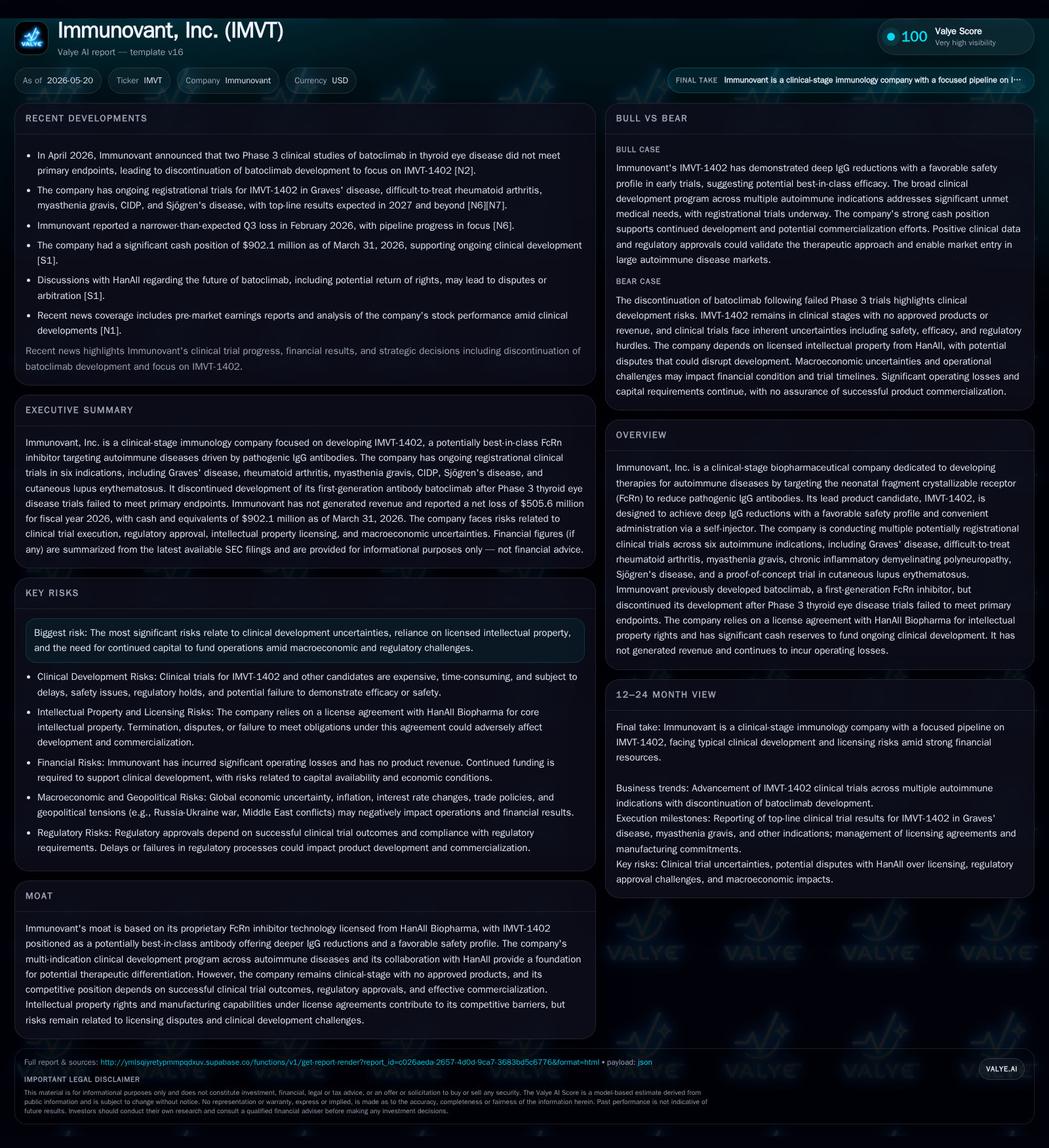
In its latest quarterly and annual filings, Immunovant, Inc. confirmed a strategic shift concentrating resources on IMVT-1402, its lead product candidate targeting FcRn to reduce pathogenic IgG in autoimmune diseases. This pivot follows the discontinuation of batoclimab development after failed Phase 3 trials in thyroid eye disease. The company maintains a solid financial foundation, with over $900 million in cash as of March 31, 2026, sufficient to fund anticipated operations through regulatory milestones. Immunovant’s multi-indication clinical development program aims for potential registrational studies across six autoimmune conditions, leveraging proprietary technology licensed from HanAll Biopharma. Key risks include clinical trial execution, dependency on licensed intellectual property, and the need for additional capital beyond the current runway.
Recent Operating Update
The most immediate and material development for Immunovant has been the April 2026 announcement halting further development of batoclimab following failure to meet primary endpoints in two Phase 3 thyroid eye disease studies [S1]. This generated strategic refocus solely on IMVT-1402 as the lead FcRn program. IMVT-1402 demonstrated promising Phase 1 data with deep dose-dependent IgG reductions approaching 80%, superior to previous competitor results from first-generation inhibitors [S1]. Ongoing potentially registrational clinical trials span six distinct autoimmune indications including Graves' disease (GD), difficult-to-treat rheumatoid arthritis (D2T RA), myasthenia gravis (MG), chronic inflammatory demyelinating polyneuropathy (CIDP), Sjögren's disease (SjD), and a proof-of-concept study in cutaneous lupus erythematosus (CLE) [S1]. Importantly, all studies employ the marketed YpsoMate® autoinjector device ensuring scalability to patient self-administration.
Financially, Immunovant reported a robust liquidity position with $902.1 million in cash and equivalents alongside current assets of $948.8 million against current liabilities of $104.4 million as of March 31, 2026 [F1]. Management anticipates that this liquidity will support operations through commercial launch preparations for IMVT-1402 in Graves' disease though acknowledges additional funding will likely be required for full pipeline execution [S7].
Business Model
Immunovant operates as a clinical-stage biopharmaceutical firm focused exclusively on leveraging neonatal fragment crystallizable receptor (FcRn) inhibition to therapeutically reduce pathogenic IgG antibodies characteristic of many autoimmune disorders [S1]. The company licenses core intellectual property rights regarding its antibody candidates from HanAll Biopharma under an exclusive royalty-bearing agreement covering key global territories [S24].
Revenue generation is entirely prospective: current operations consume significant R&D resources without any approved products or commercial sales to date [S11]. The business model hinges on successful clinical validation of IMVT-1402’s efficacy and safety profile across multiple autoimmune indications followed by regulatory approvals and market launch. Pricing power will derive from differentiation achieved through deeper IgG reduction — correlated with improved clinical outcomes — combined with convenient subcutaneous administration via widely accepted autoinjector technology [S1]. Such factors may engender durable competitive advantage subject to broader class competition risks.
Expenditures are dominated by multi-indication clinical trial costs, contract manufacturing scale-up for the drug substance/product, legal/IP maintenance under license agreements, personnel costs related to research and general administrative functions, and compliance overhead typical in biotechnology public companies [S27],[S21].
Risk mitigation within the business model also involves managing intellectual property disputes inherent in complex licensing agreements—particularly ongoing negotiations about batoclimab rights with HanAll—highlighting dependence on this counterparty relationship for future development freedom [S11],[S21].
Industry Structure and Competitive Position
Immunovant operates within the immunology-biopharma sub-sector specializing in antibody therapeutics targeting FcRn-mediated pathways. This is an emerging field characterized by growing interest due to significant unmet medical needs across broad autoimmune categories estimated to impact millions in US and European markets [S1]. Multiple developers pursue anti-FcRn agents with at least two products approved commercially demonstrating rapid market uptake worldwide.
Competitive benchmarks focus on depth of IgG reduction achieved in trials vis-à-vis safety profiles reflecting off-target effects such as albumin decrease or LDL cholesterol elevations shown by certain competitors’ antibodies [S1]. IMVT-1402’s profile evidences minimal such abnormalities alongside deeper IgG lowering—a critical differentiator implying potentially best-in-class positioning.
Other structural considerations include manufacturing complexity for monoclonal antibodies requiring high-purity biologics production capabilities managed through contract manufacturers under non-cancelable commitments totaling almost $23 million over fiscal years ending March 31, 2027 and 2028 [S18]. Distribution channels remain nascent pending approval but hinge upon specialty pharmacy networks typical for injectable autoimmune drugs.
Growth Drivers
The primary growth catalyst rests on advancing IMVT-1402 through late-stage registrational trials that could underpin subsequent FDA/EMA approvals across multiple autoimmune indications. This multi-indication strategy diversifies risk while addressing large patient populations showing pathological IgG involvement.
Key growth drivers include:
- Demonstrated superior efficacy in reducing pathogenic IgG titers (~80% reduction) compared with prior generation agents.
- Favorable safety profile supporting chronic self-administered dosing via an established auto-injection platform.
- Expansion into rheumatology (D2T RA), neurology (MG, CIDP), endocrinology (GD), and dermatology (CLE) indication verticals where unmet needs persist despite existing therapies.
- Potential milestone payments stemming from successful clinical endpoints triggering regulatory submissions farther down the pipeline.
- Capital adequacy allowing continuous R&D investment without immediate dilution pressure.
Risks / Watchpoints / Growth Constraints
Significant risks largely revolve around execution uncertainty typical for clinical-stage biotechs:
- Clinical outcome risk: Efficacy or safety shortfalls during ongoing Phase 3 programs could delay approval or reduce commercial viability.
- Licensing dependency risk: Heavy reliance on HanAll Biopharma’s licensed IP subjects Immunovant to potential dispute or contractual negotiation failures possibly restricting commercialization or increasing costs [S11],[S21].
- Capital intensity risk: While cash runway is currently strong ($902 million), total cost to complete development across all indications plus commercialization may exceed available funds necessitating further equity raises amidst volatile macroeconomic conditions affecting biotech financing dynamics [S7],[S9].
- Manufacturing constraints: Scaling complex biologics production presents risks around supply continuity/cost escalation tied to minimum purchase obligations [S18].
- Competitive risk: Other FcRn inhibitors with differing mechanisms or administration routes could capture market share if proven superior or cost-effective.
What To Watch Next
Investors and analysts should focus attention on:
- Readout timing and interim data releases from registrational Phase 3 studies in GD, D2T RA, MG, CIDP, SjD scheduled throughout the coming quarters/year(s) [N1],[S3].
- Regulatory filing milestones associated with positive clinical outcomes enabling new drug applications/marketing authorization applications.
- Developments in negotiation outcomes with HanAll regarding batoclimab rights which may clarify future product portfolio strategies [S11],[S22].
- Manufacturing ramp progress evidenced by fulfillment capability ahead of anticipated launch dates.
- Capital market activity signaling confidence or dilution necessity after current cash runway expiration horizon.
Financial Profile Summary
As per the most recent reports through fiscal year ended March 31, 2026, Immunovant maintains a strong liquidity base totaling approximately $902 million in cash and equivalents against modest current liabilities at $104 million yielding a substantial current ratio (>9x) reflective of ample near-term operating coverage capacity [F1],[S7]. Net losses have accelerated consistent with expanded clinical activities totaling approximately $505.6 million annually without any product revenue generation expected until regulatory approval—typical for clinical-stage specialty biopharmas investing heavily upfront before potential commercialization [F1],[S11]. The capital structure remains equity driven backed by recent $543.7 million underwritten offerings sustaining mid-term development plans with no debt levered currently disclosed [F1],[S6].
This financial stance supports Immunovant's continuation along its developmental trajectory but future growth scaling will be highly sensitive to milestone achievements enabling definitive regulatory pathways and concurrent capital sourcing strategies.
This analysis is based solely on publicly filed SEC documents and news releases without any investment research view or forward-looking financial advice.
Disclaimer: This is research-only, informational analysis and not investment advice. It may include AI-generated interpretation and general industry context. Always verify important details using primary sources.

Comments