
Professional Diversity Network: AI Investment, Platform Differentiation, and the Realities of Tight Operating Margins
Professional Diversity Network, Inc. is sharpening its focus on AI-driven recruitment solutions and diversity-centric talent management.
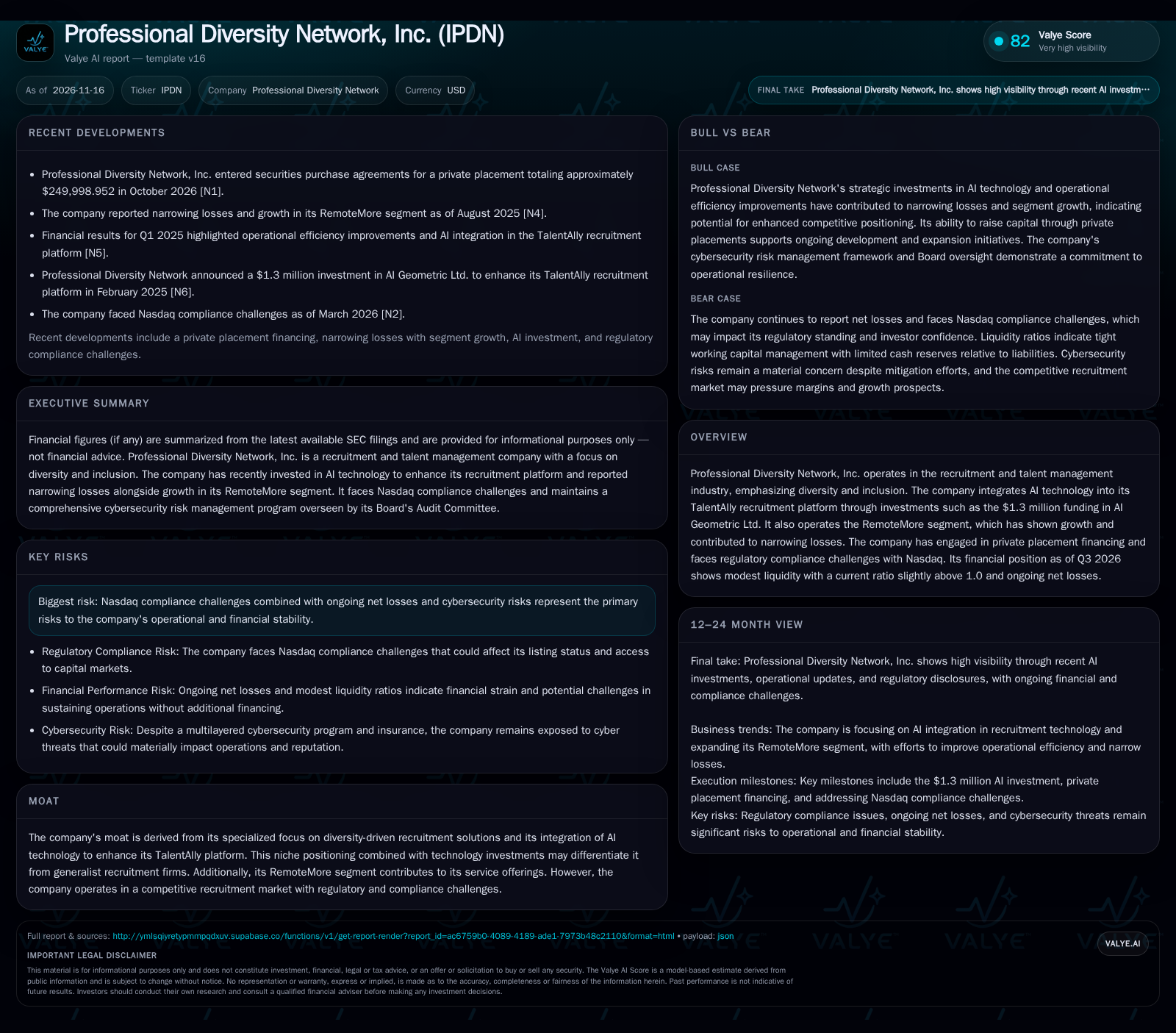
Professional Diversity Network is investing in AI and efficiency improvements to differentiate its diversity-focused recruitment platform, but continues to operate with reported liquidity position, ongoing net losses, and regulatory headwinds. Sustained execution on technology integration and segment growth could shift the narrative, but risks around compliance, financial resilience, and competitive pressure remain material. [S2] [N1] [N2] [N5] [N6]
Its $1.3 million investment in AI Geometric Ltd. and growth in the RemoteMore segment underscore efforts to modernize and diversify offerings. However, the company’s reported cash balance, continued reliance on external capital, and unresolved Nasdaq compliance issues raise the stakes for execution and financial discipline in the quarters ahead. [S2] [N1] [N2] [N5] [N6]
Recent Capital Moves, AI Investment, and Compliance Risks Shape the Near-Term Outlook
Professional Diversity Network, Inc. has made several material moves in 2025 and 2026 that define its current strategic and financial position. The headline development is the $1.3 million investment in AI Geometric Ltd., intended to enhance the TalentAlly platform with advanced AI capabilities, reflecting a commitment to technology-driven differentiation in recruitment. [N6] The RemoteMore segment, focused on remote work enablement, has shown growth and contributed to narrowing losses, but the company remains unprofitable, with a net loss of $2.4 million and EPS of -$4.32 for the quarter ended September 30, 2026. [S2] [N5] To shore up liquidity, the company executed a $250,000 private placement in October 2026. [N1] At the same time, it faces Nasdaq compliance challenges, which could affect its listing status and restrict future access to capital markets. The company reported cash and liquidity metrics for the period; these figures do not by themselves establish operating runway, investment capacity, financial flexibility, or financing capacity. [N2] [S2]
How AI Integration and Platform Expansion Could Reshape Revenue and Cost Dynamics
Professional Diversity Network’s core economics hinge on its ability to monetize recruitment and talent management services, with a niche focus on diversity and remote work. Revenue is likely driven by a mix of employer subscriptions, job postings, and talent matching services, though the specific commercial mechanics of its AI-enhanced TalentAlly platform are not fully disclosed. If AI integration leads to better candidate matching and higher placement rates, the company could command premium pricing or increase customer retention. However, with ongoing net losses and a reported cash balance, operating leverage remains constrained: fixed costs for platform development, cybersecurity, and compliance must be absorbed by a relatively modest revenue base.
The $1.3 million AI investment represents both a capital outlay and a bet on future revenue scalability—if successful, the incremental cost of serving additional customers could decline, supporting margin expansion. Yet, the need for periodic capital raises (as seen with the recent private placement) suggests the business is not yet self-funding. The RemoteMore segment’s growth hints at a potential volume lever, but unless this translates into sustained, recurring revenue and improved gross margins, the company’s economics may remain vulnerable to competitive pricing pressure and ongoing cash burn.
Diversity Focus and Technology Investments: Differentiation or Table Stakes?
Professional Diversity Network positions itself at the intersection of diversity-focused recruitment and AI-driven talent management, seeking to carve out space from generalist recruitment platforms and large HR technology players. Its moat rests on two pillars: a specialized commitment to diversity and inclusion, and a willingness to invest in advanced technology for better talent matching. In theory, this could allow the company to attract employers with ESG mandates or those seeking to broaden their talent pools, while AI enhancements may improve placement effectiveness.
However, the broader recruitment industry is crowded, with established job boards, enterprise HR software vendors, and niche competitors all pursuing similar technology upgrades. Larger players may have greater resources to invest in AI, while smaller competitors can pivot quickly or undercut on price. The RemoteMore segment targets the remote work trend, but this is also a rapidly commoditizing space. The company’s competitive position will depend on its ability to convert its niche focus and technology spend into tangible customer loyalty, higher-value contracts, or superior outcomes—none of which are proven at scale yet.
If AI-Driven Differentiation Spurs Recurring Revenue and Margin Expansion
A favorable scenario for Professional Diversity Network would see its AI-driven TalentAlly platform demonstrably improving recruitment outcomes for clients, leading to higher employer retention, increased subscription renewals, and the ability to command premium pricing. If the RemoteMore segment maintains growth and shifts toward recurring, multi-year contracts, the company could achieve operating leverage and reduce its reliance on external capital.
Evidence supporting this scenario would include: sustained quarter-over-quarter revenue growth, gross margin improvement, and disclosures of multi-year or recurring customer agreements. Customer testimonials or case studies highlighting AI-driven placement success would further validate the technology differentiation thesis.
Incremental Technology Progress Amid Persistent Financial Pressure
The most plausible middle path is that Professional Diversity Network continues to make incremental progress on AI integration and operational efficiency, but remains constrained by industry competition, reported liquidity position, and ongoing net losses. The company may achieve gradual revenue growth in the RemoteMore and TalentAlly segments, but pricing power and customer retention could remain challenged by larger, better-capitalized competitors.
Under this scenario, the company stays listed by addressing Nasdaq compliance issues, but is forced to periodically raise new capital through small placements or other instruments to support operations. Margins may improve slightly if AI investments yield cost efficiencies, but the business does not achieve break-even in the near term. This scenario would be confirmed by continued reliance on external funding, net losses narrowing only modestly, and current ratios hovering near 1.0. Falsification would require evidence of either sustained profitability or a dramatic deterioration in liquidity or compliance status.
Escalating Cash Burn and Regulatory Setbacks Undermine Platform Ambitions
The adverse scenario centers on Professional Diversity Network failing to translate its AI investments and segment growth into meaningful revenue gains or cost savings. If customer adoption of the TalentAlly platform stalls or RemoteMore’s momentum fades, revenue could stagnate while fixed costs persist.
If the company is unable to resolve Nasdaq compliance challenges, it could lose its listing, sharply reducing access to capital and further damaging customer and partner confidence. Evidence for this scenario would include accelerating quarterly losses, a current ratio falling below 1.0, repeated compliance warnings or delisting notices, and a lack of visible progress on AI-driven customer acquisition or retention. Any material cybersecurity breach could also threaten reputation and operational continuity.
Milestones and Metrics That Will Define Professional Diversity Network’s Trajectory
Quarterly revenue growth rates in both the TalentAlly and RemoteMore segments, if disclosed, to gauge adoption and pricing power.
Gross margin trends, especially any improvement attributable to AI-driven operating efficiencies.
Disclosure of recurring or multi-year customer contracts, which would test the platform’s stickiness and revenue visibility.
Progress updates on Nasdaq compliance status and any communications regarding listing risks.
Net cash provided by (used in) operating activities, to assess whether the business is approaching self-funding status.
Current and quick ratios over time, to monitor liquidity stress or improvements in working capital management.
Incidence and impact of cybersecurity events, as reported to the Audit Committee or in public filings.
Details on customer retention rates and customer acquisition costs, if disclosed, to evaluate the effectiveness of AI and marketing investments.
Disclaimer: This is research-only, informational analysis and not investment advice. It may include AI-generated interpretation and general industry context. Always verify important details using primary sources.

Comments