
IP Strategy Holdings Expands Stake and Validator Operations in $IP Token Ecosystem While Streamlining Craft Spirits Segment
Latest quarterly filing highlights intensified focus on digital asset yield generation alongside a transition to an asset-light craft spirits model.
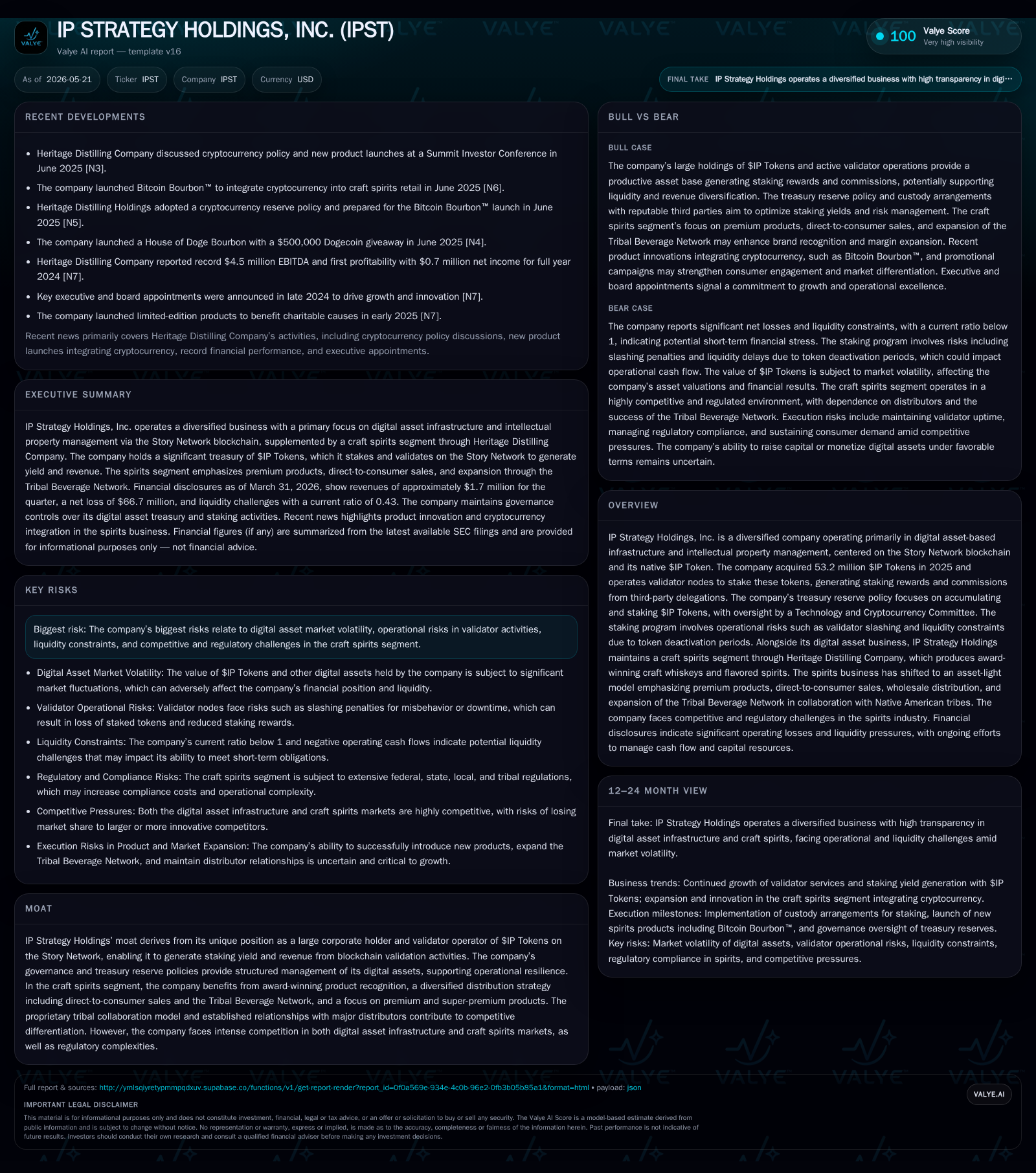
IP Strategy Holdings has solidified its position as a major corporate holder of $IP Tokens through a substantial PIPE investment and active validator operations on the Story Network blockchain. The company is leveraging these holdings to generate staking rewards and transaction fees, aiming for recurring revenue while navigating operational and market risks inherent in digital assets. Concurrently, its Heritage Distilling subsidiary is shifting towards asset-light operations emphasizing wholesale, direct-to-consumer sales, and a tribal licensing network. Liquidity remains dependent on digital asset valuations amid ongoing operating losses and cash flow challenges.
Recent Operating Update
The latest quarter ending March 31, 2026, as filed on May 20, 2026 [S2], confirms continued execution of IP Strategy Holdings’ dual-segment approach: advancing the digital asset infrastructure business alongside reshaping its craft spirits operations. The company’s focus remains predominantly on its substantial $IP Token holdings acquired via a $223.8 million PIPE in August 2025, representing one of the largest corporate stakes in this blockchain ecosystem. With approximately 43.5 million tokens actively staked, IPST operates validator nodes responsible for verifying transactions, earning gas fees plus native token rewards for validated blocks—forming the cornerstone of its recurring revenue model.
Complementing this, the spirits business under Heritage Distilling Company emphasizes premium whiskey production but is moving aggressively toward cost efficiency and operational streamlining through restructuring initiatives announced in late 2025 [S1][S14]. The continuing decline in physical asset intensity signals a pivot toward wholesale distribution partnerships, direct-to-consumer (DtC) sales across a broad geolocation footprint (~96.8% US population coverage), and the expansion of the Tribal Beverage Network (TBN) which leverages tribal partnerships for brand licensing and royalty income.
Business Model
Digital Asset Infrastructure
IP Strategy Holdings’ business model centers on acquiring and staking $IP Tokens—the native cryptocurrency of the Story Network blockchain designed for intellectual property management services—and generating yield from validation services. As validators, IPST nodes authenticate transactions by maintaining consensus rules, adding blocks to the chain, and collecting gas fees (minimum required transaction fees denominated in $IP) plus protocol-issued block rewards.
Revenue flows derive primarily from:
- Staking Rewards: Issued by the network to validators for successfully proposing blocks.
- Transaction Fees (Gas Fees): Paid by network users and awarded to validators.
- Delegation Commissions: While currently not delegated, future plans may include delegating tokens to third parties for commissions.
Operational considerations involve maintaining high validator uptime to avoid slashing penalties—losses incurred due to misbehavior or unavailability—and managing liquidity constraints given tokens staked must be held undelegated for deactivation periods before accessible. Such factors present operational risks impacting consistent revenue generation.
The treasury reserve policy mandates holding no less than 95% of treasury assets in $IP Tokens at all times [S1][S23]. This concentrated digital asset exposure ties company financial results closely to volatile cryptocurrency markets; accounting standards require marking these intangible digital assets at fair value each reporting period—leading to significant earnings volatility despite underlying cash-generative staking operations.
Craft Spirits Segment
Heritage Distilling Company operates within the broader global spirits market valued at roughly $288 billion but focuses specifically on craft super-premium whiskeys and premium flavored whiskey categories [S1]. Its revenue is generated through three primary channels:
- Wholesale Distribution: Targeting national and regional accounts with growing volumes supported by brand equity built via other sales channels.
- Direct-to-Consumer Sales: Enabled via compliant third-party fulfillment platforms that reach customers across most U.S. states offering granular consumer data insights supporting marketing optimization.
- Tribal Beverage Network (TBN): A proprietary collaborative licensing model partnering with Native American tribes who operate production and retail businesses using IPST’s brands and receive royalties based on gross sales—a unique approach fostering local engagement while driving regional scale synergy with wholesale efforts.
Recent restructuring aimed at reducing overhead costs—the writeoff of property, equipment, lease liabilities—and converting towards an increasingly asset-light footprint illustrates management’s attempt to improve margins and adapt distribution capabilities [S14][S1]. This balance between maintaining premium positioning while optimizing capital intensity reflects industry best practices where scale economies in distribution underpin profitability.
Industry Structure and Competitive Position
In the digital assets domain, IP Strategy Holdings occupies a niche as one of the largest corporate holders validating within the Story Network ecosystem—a layer 1 blockchain built for intellectual property-centric activities. The validator service industry requires significant technical expertise to maintain secure node operation alongside risk management protocols related to crypto custody and network rules enforcement.
Competitors include other blockchain infrastructure providers that may operate validators or delegate tokens within decentralized proof-of-stake networks. However, few public companies combine validator operations with deep treasury commitments tied directly to their token holdings coupled with structured governance over treasury reserve management (e.g., Technology and Cryptocurrency Committee oversight) [S23].
In craft spirits—a crowded category marked by intense competition from both large conglomerates and independent craft distillers—heritage matters alongside product innovation. IPST's strategy focusing on award-winning super-premium segments supports brand differentiation with demonstrated recognition from industry awards [S1]. The deployment of distribution through DtC channels aligns with broader market shifts toward personalized consumer access models prevalent in beverage alcohol sectors.
The Tribal Beverage Network adds proprietary differentiation enabling penetration into regional markets facilitated by tribal partners’ local knowledge and regulatory navigation—creating switching costs for competitors lacking such embedded distribution arrangements.
Growth Drivers
Digital Asset Infrastructure Growth Drivers
- Token Accumulation & Staking Expansion: Continuous acquisition of $IP Tokens increases validation capacity and potential reward income; management highlights intent to grow holdings over time [S1][S23].
- Validator Performance & Network Adoption: Higher transaction volume on Story Network translates into increased gas fee revenue; effective validator uptime promotes reliability premiums.
- Delegation Market Entry: Future plans may include delegating tokens to third-party operators generating commission-based fees without operational overhead expansion.
- Blockchain IP Monetization: Potential acquisitions or licensing of IP-related digital assets could add new revenue streams connected to underlying blockchain transaction activity.
Craft Spirits Growth Drivers
- Expansion of Direct-to-Consumer Sales: DtC growth driven by geographical coverage expansion facilitating access to broad consumer bases ([~97% US population]) potentially lifts margin profiles due to reduced intermediary costs.
- Wholesale Volume Growth Supported by Brand Building: Investment in marketing linked with DtC customer insights supports retail placement velocity boosting sales volume.
- Tribal Beverage Network Licensing Expansion: Scaling TBN partners enhances localized production/distribution capacity while increasing royalty-based recurring revenues with limited capital outlay.
- Product Innovation & Awards Recognition: Sustained acclaim promotes consumer trial and loyalty enhancing repeat purchase cycles critical in premium beverage categories.
Risks / Watchpoints / Growth Constraints
- Cryptocurrency Price Volatility & Fair Value Impact: The company’s core treasury exposure results in earnings variability driven by quarterly mark-to-market adjustments unrelated directly to operational cash flow [S1][S14].
- Validator Operational Risks: Slashing penalties due to downtime or protocol breaches can materially reduce staking yields; liquidity is also constrained during token deactivation periods limiting flexibility [S1].
- Regulatory Uncertainty: Classification risks regarding $IP Tokens potentially being deemed securities impose legal/regulatory compliance burdens that could alter treasury strategies or limit operational scope [S1][S18].
- Liquidity Constraints: Current ratio stands low (~0.43), indicating short-term obligations significantly exceed liquid assets; liquidity heavily tied to crypto market conditions affects ability to meet near-term cash requirements [F1][S2].
- Competition Intensity: Both segments face robust competition — blockchain infrastructure players may compete on scalability/security/features; craft spirits face consolidated incumbents with established brands limiting pricing power [S1].
- Nasdaq Compliance Risk: Prior minimum bid price deficiencies led to a reverse stock split—ongoing market capitalization and trading liquidity monitoring remain necessary [S3][S9].
What to Watch Next
- Quarterly updates on staking yields, validator uptime statistics, total staked tokens vs delegation activities will illuminate sustainability of crypto infrastructure revenue trajectories.
- Progress reports on tribal licensing agreements growth or DtC customer base expansions can serve as leading demand indicators for spirits segment scaling potential.
- Any announcements regarding new treasury capital raises aimed at acquiring additional $IP Tokens or IP-related digital rights that could influence asset base size.
- Regulatory developments around digital assets classification or tax treatment impacting valuation models or operational flexibility would materially affect outlooks.
- Balance sheet improvements if any deleveraging actions occur addressing current liquidity imbalance noted at quarter-end March 2026 [F1]
Financial Profile Summary
As of March 31, 2026 [F1], IP Strategy Holdings maintains total debt near $2.56 million against current assets approximating $3.82 million but faces current liabilities exceeding $8.79 million resulting in a suboptimal current ratio near 0.43 indicating working capital constraints sustained from ongoing operation losses reported at year-end December 31, 2025 (-$137.7 million net loss) reflecting mainly fair value losses on their digital token portfolio rather than pure operational results [F1][S14]. Cash flow remains challenged with negative operating cash usage continuing into recent periods suggesting an urgent need for managing spending relative to inflows from staking revenues or external funding sources.
The company projects stable going concern status over the next twelve months contingent on steady execution of business plans combined with stabilization in key digital asset valuations supporting liquidity measures outlined by management [S6][S14]
This analysis synthesizes facts disclosed in SEC filings up through May 21, 2026 without speculative projections beyond official statements or financial reports. All forward-looking references are presented per issuer statements without endorsement or investment advice implication.
Disclaimer: This is research-only, informational analysis and not investment advice. It may include AI-generated interpretation and general industry context. Always verify important details using primary sources.

Comments