
Iridium Communications Advances Global Reach Despite Near-Term Profit Pressure
Q1 2026 results reveal execution challenges amid a resilient business underpinned by its unique satellite network and growing commercial footprint.
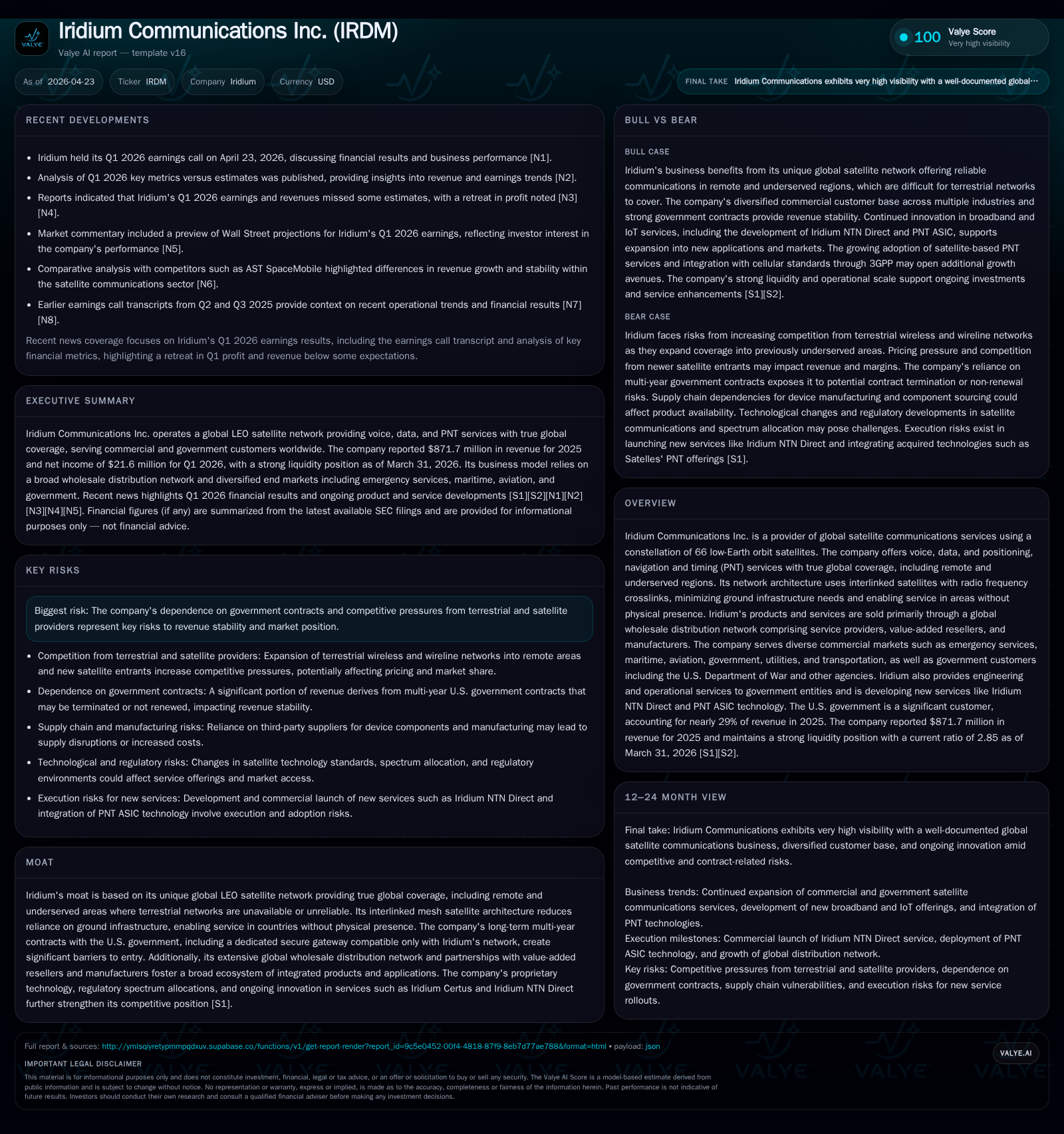
Iridium Communications reported Q1 2026 revenue and profit results below analyst expectations, signaling some near-term margin pressures. Despite this, the company’s unique interlinked mesh LEO constellation continues to enable reliable global coverage across diverse commercial and government markets. Iridium’s wholesale distribution model, robust product portfolio including Iridium Certus and new PNT ASIC offerings, and significant U.S. government contracts provide a durable moat. Growth is supported by expanding IoT applications and new partnerships, although government contract reliance and emerging competitors present risks.
Q1 2026 Operating Update: Missed Estimates and Profit Pressures
Iridium Communications’ first quarter ended March 31, 2026 report ([S2], [N3], [N11]) revealed revenue and earnings shortfalls relative to analyst expectations. Although specific quarter-over-quarter figures were not detailed here explicitly, the reported commentary emphasized weaker than anticipated top-line growth alongside a noticeable retreat in operating profit margins. These results partly reflect increased operational costs amid competitive pricing pressures and broader macroeconomic factors impacting customer spending patterns.
This near-term softness represents a pause against the backdrop of steady longer-term demand growth but highlights execution challenges in converting expanding commercial opportunities into immediate financial gains. The accompanying April 23 8-K filing ([S3]) reiterated continuing investments in new technology launches like Iridium NTN Direct but underscored the necessity to manage margin compression.
Iridium’s Business Model: Unique Global Coverage via Interlinked LEO Satellite Network
Iridium's core asset is its constellation of 66 low-Earth orbit (LEO) satellites configured in a uniquely interlinked mesh architecture employing radio frequency crosslinks between satellites ([S1], [S4], [S6], [S10]). This design reduces reliance on ground stations by routing traffic directly through satellites themselves and allows true pole-to-pole global coverage—even over remote land masses, open oceans, polar regions, or conflict zones where terrestrial networks are absent or unreliable.
This architecture supports voice communications, data transfer services including broadband capabilities (Iridium Certus), Internet of Things (IoT) telematics, as well as positioning navigation and timing (PNT) applications delivered via both Iridium-owned payloads and hosted secondary payloads (e.g., Aireon LLC). The company primarily sells such products and airtime through an expansive wholesale distribution network comprising approximately 120 service providers, around 310 value-added resellers (VARs), and about 90 value-added manufacturers (VAMs). These partners repackage and integrate Iridium’s core connectivity with complementary software/hardware solutions tailored for vertical markets including emergency services, maritime shipping, aviation operations, energy exploration, mining sectors, forestry management, transportation logistics and recreation ([S6], [S10], [S22]).
This distribution strategy shifts direct customer relationship burdens—billing management, credit risk—from Iridium to its channel partners while enabling faster penetration into geographically diverse niche markets leveraging specialized reseller expertise.
Product Portfolio Quality and Diverse End Markets Supporting Durable Demand
Iridium offers a broad suite of products ranging from legacy narrowband voice/data offerings to advanced midband broadband through the Iridium Certus platform launched in early 2019 ([S16], [S18]). Their broadband capabilities extend into maritime sectors via services like Iridium OpenPort—a safety-critical companion broadband provider—supporting crew/passenger communications as well as operational data transmission. Aviation customers utilize the network for flight tracking, weather updates, electronic flight bag content delivery alongside secure voice services.
IoT innovation remains a key growth driver underpinning recurring revenue streams; verticals such as heavy equipment telematics with partners like Caterpillar employ Iridium-enabled trackers for asset performance monitoring remotely ([S16], [S22]). The recently acquired Satelles portfolio enhances time synchronization security complementing GPS systems widely used in financial transactions and cybersecurity identity management ([S13]).
Government remains a strategic pillar; notably the U.S Department of War is among the largest customers with multi-year EMSS contracts providing unlimited secure voice/data access via a dedicated military gateway exclusively compatible with the Iridium constellation. This gateway facilitates accredited NSA Type I encryption capabilities for top-secret communications—establishing high entry barriers for competitors ([S15]). Ongoing contract renewals including EMSS and newer SDA agreements support sustained engineering service revenues beyond pure airtime sales ([S24]).
Competitive Environment: Moat Evaluation and Industry Dynamics
Iridium’s competitive differentiation resides in its possession of contiguous L-band spectrum licenses across 8.725 MHz allowing two-way mobile satellite communications unparalleled for breadth of coverage ([S23]). The inter-satellite crosslink architecture eliminates dependence on geographical ground stations required by bent-pipe GEO systems deployed by competitors like Globalstar or ORBCOMM which suffer regional coverage gaps.
Additionally, long-term contractual relationships with U.S. national security agencies confer significant economic moat due to specialized encryption requirements backed by a sole compatible secure gateway system ([S15], [S23]). This exclusivity impedes new entrants from easily capturing government business.
Nonetheless industry headwinds persist as new players target adjacent geographies or functionalities using alternative spectrum bands or hybrid terrestrial-satellite solutions — such as SpaceX's plans for an S-band D2D global satellite solution or expanded terrestrial wireless footprints potentially encroaching upon rural markets traditionally served by Iridium ([S23], [N12]). Regulatory uncertainties around spectrum allocation further complicate prospects.
Cybersecurity governance also merits attention; Iridium maintains ISO 27001:2022 certification reflecting robust information security management processes administered through board-level oversight alongside dedicated executive committees—a critical risk mitigation given communication service sensitivity ([S1]).
Growth Catalysts and Constraints: Commercial Expansion Meets Government Reliance
Future growth hinges on continuous expansion of the wholesale distribution footprint by onboarding new VARs/VAMs targeting diverse industries that benefit from global connectivity beyond traditional use cases ([S5], [S6]). New product introductions such as Iridium NTN Direct—a future-proof NB-IoT compliant satellite IoT service integrated into standard cellular chipsets—promise to open sizeable addressable market segments tapping mobile network operator partnerships ([S14]).
Furthermore product innovation in PNT solutions including an ASIC slated for commercial release in 2026 anticipates driving additional revenue streams tied to highly secure timing/location use cases across finance, telecom infrastructure synchronization and cybersecurity identity validation applications ([S12], [S13]).
Conversely dependency on large-scale U.S. government contracts presents risk; these agreements are terminable at will subject to federal acquisition rules. Political budget pressures or technological shifts may reduce spending impacting near-term top-line visibility despite recent uplifts via SDA contract awards ([S26], [S24]). Competition intensification within maritime broadband commoditization also limits premium pricing potential requiring vigilant innovation ( [S21], [N5]).
Upcoming Milestones and Key Execution Metrics to Watch
Market participants should closely monitor Q2 guidance updates post April earnings releases for signs of stabilization or improvement in revenue/margin trends following recent softness reported in Q1 ([N1], [N2]). Attention is warranted regarding progress on U.S. government contract negotiations especially regarding EMSS renewal potential set before expiry late 2026 ([S15], [N4]).
Rollout metrics concerning commercial adoption rates for NTN Direct service deployment throughout the year will signal traction within mobile operator ecosystems fostered since initial announcements ([S14], [N1]). Meanwhile additional certifications of partner-developed products incorporating new transceivers or PTT functionalities remain crucial catalysts supporting scaling efforts within existing wholesale channels ([S27]). Subscriber count trends in IoT segments leveraging broadband upgrades from legacy narrowband terminals will be prominent leading indicators revealing underlying demand strength amidst broader macroeconomic sensitivities.
Financial Overview: Revenue Trends, Margins, Cash Flow, and Capital Investment
Iridium has demonstrated steady financial progress evidenced by a compound annual revenue increase from $721 million in FY2022 to $872 million in FY2025—a roughly 4.9% CAGR—coupled with more substantial operating income improvement fueled by operating leverage (operating income rose approximately 17.8% YoY to $236 million) ([F1]). Net income maintains positive momentum albeit at a slower pace (+1.4%), consistent with strategic reinvestments.
Free cash flow generation remains robust; FY2025 operating cash flow touched about $400 million while capital expenditures held around $100 million reflecting the current lower capex cycle given constellation maturity phases ([F1]). Liquidity stands healthy with cash & equivalents near $112 million as of March 31st 2026 yielding a current ratio exceeding 2.8x suggesting solid short-term balance sheet positioning.
Share repurchase activity remains active though below prior peak levels which had been elevated due to strong cash flow conversion rates ( [F1]). This balanced capital allocation profile supports investing behind product innovation while maintaining disciplined shareholder returns.
Historical performance (annual)
| FY | Rev ($mm) | Net ($mm) | CFO ($mm) | OpInc ($mm) | Rev YoY | Net YoY |
|---|---|---|---|---|---|---|
| 2025 | 872 | 114 | 400 | 236 | +4.9% | +1.4% |
| 2024 | 831 | 113 | 376 | 200 | +5.1% | +631.6% |
| 2023 | 791 | 15 | 315 | 82 | +9.7% | +76.7% |
| 2022 | 721 | 9 | 345 | 77 |
Source: SEC companyfacts cache [F1].
Capital returns and efficiency (annual)
| FY | Buybacks ($mm) | FCF ($mm) | ROE% |
|---|---|---|---|
| 2025 | 186 | 300 | 24.7 |
| 2024 | 408 | 306 | 19.6 |
| 2023 | 247 | 241 | 1.7 |
| 2022 | 257 | 273 | 0.8 |
Source: SEC companyfacts cache [F1].
In sum, while short-term earnings have encountered pressure due to competitive dynamics and cost volatility demonstrated in Q1 results ([N3]), Iridium’s entrenched position driven by its unique LEO constellation assets combined with digital ecosystem-driven product innovation sets a foundation for enduring commercial relevance across multiple high-value verticals.
This analysis synthesizes publicly filed SEC reports dated up through April 23rd, 2026 along with recent market commentary without offering investment advice or price opinion.
Disclaimer: This is research-only, informational analysis and not investment advice. It may include AI-generated interpretation and general industry context. Always verify important details using primary sources.

Comments