
Investors Title’s Cyclical Sensitivity: Underwriting, Exchange Services, and the Stakes of Real Estate Volatility
Recent quarters highlight both the earnings potential and the volatility inherent in Investors Title’s dual focus on title insurance and tax-deferred exchange services. As the company navigates a shifting real estate cycle, its exposure to transactional volume, regulatory compliance, and claims reserve management will determine whether its multi-state platform delivers resilience or amplifies cyclicality.
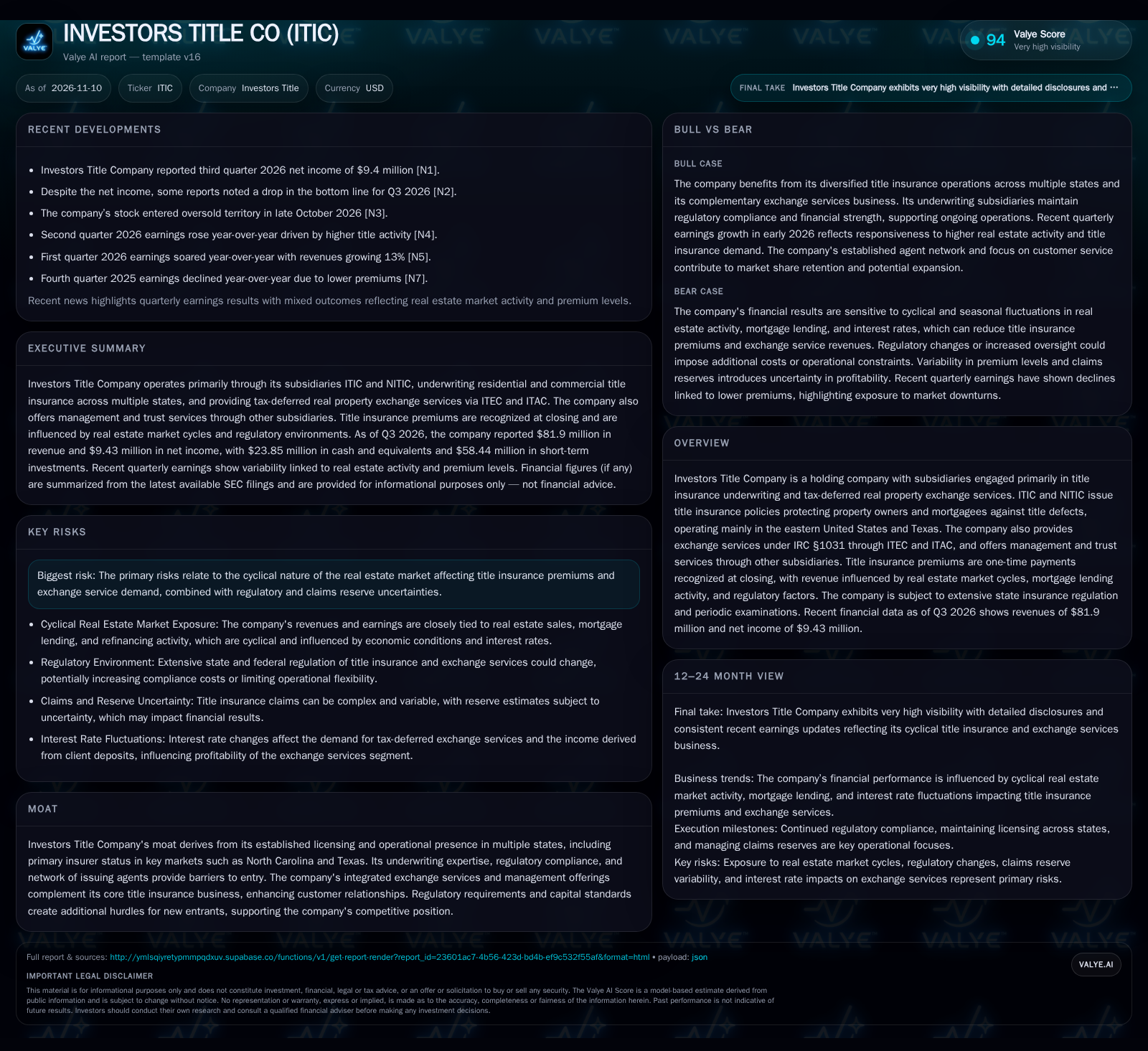
Investors Title reported Q3 2026 net income of $9.43 million on $81.9 million in revenue, but this represented a bottom-line decline amid real estate market fluctuations. The business remains anchored in title insurance underwriting and exchange services, both highly sensitive to property sales, interest rates, and regulatory shifts. Recent financial swings underscore the company’s dependence on transaction volumes and highlight the importance of claims management and regulatory discipline going forward. [S2] [N1] [N2]
Investors Title Company’s most recent results reflect the fundamental tension at the heart of the title insurance business: while the company’s broad licensing and complementary exchange services should, in theory, deliver diversified earnings, the reality is significant exposure to real estate transaction cycles. The third quarter of 2026 saw profitability drop despite ongoing revenue, underscoring how even a geographically diverse underwriting platform is not immune to volume-driven swings. As regulatory and claims risks persist, Investors Title’s ability to manage volatility and adapt its cost structure will be central to its long-term value proposition.
Recent Results Highlight Transactional Volatility and Profit Compression
In the third quarter of 2026, Investors Title reported $81.9 million in revenue and $9.43 million in net income, translating to basic EPS of $4.99 [S2] [N1]. While the company remained profitable, some reports noted a drop in the bottom line compared to prior periods, signaling a reversal from earlier-year momentum [N2]. The stock entered oversold territory in late October 2026, reflecting market apprehension about the company’s sensitivity to real estate cycles [N3]. These developments matter because they demonstrate that even with a multi-state footprint and multiple service lines, Investors Title’s earnings are still heavily contingent on underlying property transaction volumes and the broader macroeconomic environment.
Title Insurance Economics: One-Time Premiums, Agent Commissions, and Claims Leverage
Investors Title’s core revenue model is built on the underwriting of title insurance policies, with premiums recognized as one-time payments at the closing of real estate transactions [S1]. Agents—who originate a majority of policies—retain a significant portion of the premium as commission, often varying by state and local market dynamics. The company’s net revenue per transaction is therefore a function of gross premium levels, agent commission splits, and the volume/mix of direct versus agency business.
Operating leverage is complex: while some costs (such as personnel, regulatory compliance, and claims management) are relatively fixed in the short term, revenue is highly variable and transaction-dependent. Claims costs can be lumpy and unpredictable due to the nature of title defects and litigation. Capital requirements are dictated by state insurance regulations, with minimum surplus and reserve levels required to support underwriting risk [S1].
The company’s exchange services, performed under IRC §1031, generate fee and interest income, but these revenues are also tied to property sales activity and prevailing interest rates. This segment offers some diversification, but does not fundamentally change the company’s exposure to real estate cycles. Investment income from client deposits and company capital provides an additional, but rate-sensitive, revenue stream.
Barriers to Entry, Agent Relationships, and the Limits of Geographic Diversification
Investors Title’s competitive profile is shaped by regulatory licensing, its established agent network, and its operational presence in key markets such as North Carolina and Texas [S1]. The need for state-by-state licensing, capital reserves, and regulatory compliance creates a meaningful barrier for new entrants—especially those seeking to operate across multiple jurisdictions.
However, the company faces competition from both national underwriters and regional players. While its multi-state reach and complementary exchange services help attract and retain agent relationships, these advantages do not fully insulate the business from broader market swings. Substitution risk is limited, as title insurance is typically required for mortgage origination, but pricing power is constrained by state regulation and competitive pressure. The company’s moat is thus grounded in execution (claims management, agent service, compliance), but not immune to macro or industry shocks.
Sustained Real Estate Recovery Could Amplify Earnings and Capital Efficiency
If real estate transaction volumes rebound—driven by lower interest rates, increased housing turnover, or commercial activity—Investors Title stands to benefit from increased premium revenue and higher fee income from exchange services. With much of the cost structure relatively fixed in the short term, incremental volume could drive substantial operating leverage, expanding margins and returns on equity.
A favorable scenario would be supported by evidence of sustained increases in transaction counts, improved net premium retention (perhaps through a higher share of direct business), and benign claims experience. Confirmation would come from consecutive quarters of revenue and earnings growth, along with stable or improving loss ratios and reserve adequacy. Expansion of exchange services into new markets or product adjacencies could further diversify revenue streams and smooth cyclicality.
Normalization of Transaction Volumes and Margin Management in a Mixed Market
The most plausible path is that Investors Title continues to operate in a choppy real estate environment, with transaction volumes fluctuating around long-term averages. Title insurance premiums and exchange service fees would track these volumes, while claims and regulatory costs remain manageable but persistent.
In this scenario, the company’s earnings power is neither structurally impaired nor poised for runaway growth. Evidence supporting this trajectory would include modest sequential changes in revenue and net income, stable expense ratios, and consistent reserve releases or strengthening in line with claims activity. The company’s ability to maintain regulatory compliance and agent relationships would keep its multi-state platform operational, but not shield it from broader economic headwinds.
Adverse Cycle: Prolonged Real Estate Slump and Claims Pressure Erode Profitability
A negative scenario would unfold if real estate transaction volumes remain depressed for multiple quarters—due to persistently high interest rates, economic slowdown, or regulatory disruptions. Lower premium and fee revenue would coincide with fixed operating costs, compressing margins and potentially leading to operating losses.
Further downside risk arises if claims severity or frequency increases, requiring reserve strengthening and eroding reported profits. Regulatory changes could also introduce new compliance costs or constrain pricing flexibility. Evidence confirming this scenario would include successive quarters of declining revenue and net income, rising combined ratios, and negative reserve developments.
What Will Test Investors Title’s Resilience Through the Next Real Estate Cycle?
Quarterly trends in title insurance premium volume—by state and segment—would provide direct evidence of transactional health and market share, if disclosed.
Net claims paid and changes in loss reserves: tracking these figures would reveal whether claims experience is benign or deteriorating.
Expense ratio and combined ratio trends: shifts here would test whether the company is maintaining or losing operating leverage.
Growth or contraction in exchange services fee and interest income: this would show the real-world sensitivity of the segment to property sales and interest rate changes.
Regulatory developments or compliance costs: new state or federal requirements could materially affect expense structure and capital needs.
Agent retention and network expansion or contraction: changes in agency relationships could impact premium flow and competitive positioning.
Sustained changes in investment yields on float and short-term investments: this would affect non-underwriting income, especially in volatile rate environments.
If disclosed, the share of direct versus agency-written premiums: a shift toward direct business would alter commission outflows and margin structure.
Disclaimer: This is research-only, informational analysis and not investment advice. It may include AI-generated interpretation and general industry context. Always verify important details using primary sources.

Comments