
Ituran Strengthens Subscriber Base While Expanding Telematics Services and Product Mix
Ituran's Q1 2026 update reveals robust subscriber growth and evolving service offerings reinforcing its competitive foothold in fragmented telematics markets.
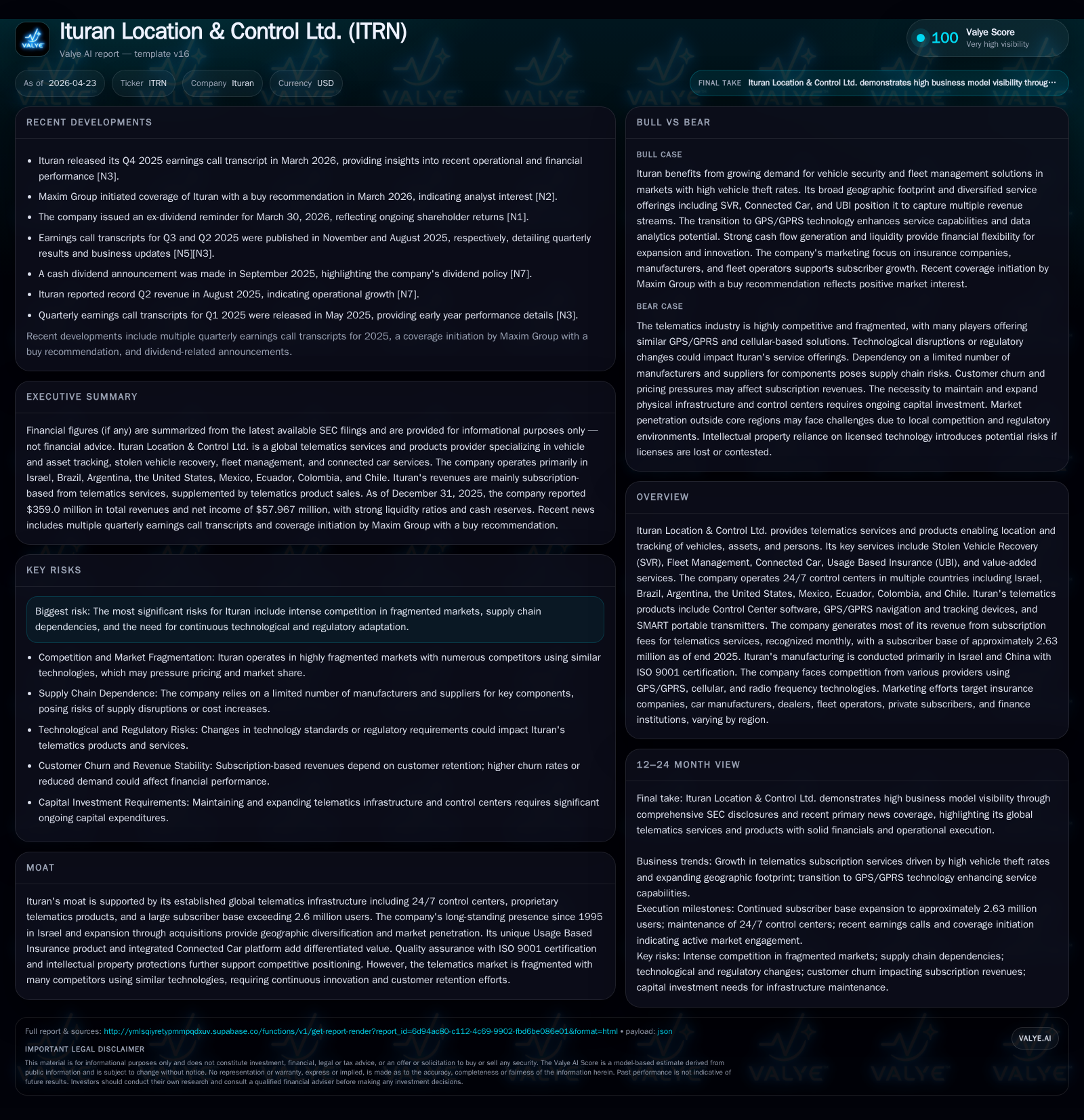
In its latest quarterly disclosure, Ituran Location & Control Ltd. reported a notable increase in its subscriber base to approximately 2.63 million by year-end 2025, driven largely by expansions in Israel and Brazil. Revenue growth accelerated alongside a diversified product-service mix that combines Stolen Vehicle Recovery (SVR), Fleet Management, Connected Car, and Usage Based Insurance (UBI) offerings. The company’s business model centers on recurring subscription fees supplemented by product sales, supported by integrated control center infrastructure and proprietary telematics devices manufactured primarily in Israel and China. Despite competitive intensity and technological challenges within the fragmented industry, Ituran’s geographic diversification, strong customer retention metrics, and ongoing R&D investments position it for sustained structural growth. Key upcoming markers include monitoring churn dynamics, expansion of value-added services, and regulatory adaptations impacting tax procedures.
Latest Quarterly Operating Update Reflects Accelerated Subscriber Expansion
Ituran’s latest interim filings through March 31, 2026 [S2][S3] reaffirm the company’s operational momentum entering 2026. The subscriber base expanded materially over the course of 2025 from roughly 2.41 million to approximately 2.63 million as of December end [S1][S15]. Growth was notably concentrated in Israel, which crossed the one million subscriber threshold (1.039 million), representing nearly 40% of total subscribers; Brazil followed closely with a substantial increase to 814k users [S15]. The "Others" category covering Latin America and the U.S. held steady at around 777k subscribers.
This scale-up reflects successful penetration in geographies characterized by elevated vehicle theft rates—boosting demand for Ituran's core Stolen Vehicle Recovery (SVR) services—and underwriting partnerships for usage-based insurance (UBI) products increasingly gaining traction [S1]. Subscription revenues recognized monthly provide predictable cash flow patterns aided by a manageable average churn rate near 3% per month within telematics services [S1][S6], underpinning approximately 90% quarterly subscriber retention absent voluntary terminations.
The company also disclosed updates related to withholding tax procedures impacting cross-border operations [S3], potentially influencing net cash flows but also signaling management’s attention to compliance amid complex tax environments. These operational highlights set the stage for Ituran’s continued market consolidation while maintaining shareholder-friendly policies such as consistent dividend distributions highlighted in recent Nasdaq reminders [N1].
Revenue Segmentation and Evolving Product-Service Mix Define Business Model
Ituran’s business model is anchored predominantly on recurring subscription fees tied to telematics services including SVR, fleet management solutions, connected car platforms, usage-based insurance (UBI), and related value-added offerings [S1][S5]. In 2025, telematics services revenue totaled approximately $265 million out of $359 million total revenues (~74%), growing steadily year-on-year due to subscriber expansion and deeper service integration [F1][S1].
Subscription fees are recognized monthly with customers typically free to terminate anytime; however, historical churn stability allows reliable revenue forecasting with retention programs focused on increasing customer stickiness via ancillary services like concierge or maintenance alert features embedded within the Connected Car platform [S5][S13]. The complementary telematics products segment accounts for about $94 million of revenue (~26%), primarily derived from GPS/GPRS tracking devices sold or leased mainly across Israel and Brazil markets. These hardware sales underpin subscription growth since most subscribers have at least one device installed in their vehicle or asset [S13].
Manufacturing infrastructure relies principally on Israel-based facilities supplemented by China operations both holding ISO9001 quality certifications ensuring consistent product standards crucial for reliability-sensitive applications . Cost control initiatives within product sales contributed to a decline in product segment cost of revenues from 80.5% to 76.2% between 2024-25 illustrating improving unit economics amid sales mix shifts [S1].
Overall gross margin benefits from operational leverage inherent in the control center-driven service delivery model where fixed costs are spread over an expanding subscriber base. Investment in R&D increased modestly to $20.8 million supporting ongoing product innovation especially for cellular/GPS new platforms vital to maintaining technological differentiation against competitors deploying network cellular or homing technologies [S9][S10].
Global Telematics Industry Dynamics and Ituran’s Competitive Positioning
The global telematics sector remains highly fragmented with numerous regional players employing varied technological approaches such as GPS/GPRS hardware, cellular network communications, or RF-based systems [S14][S20]. Ituran has cultivated a presence across Israel, several Latin American nations including Brazil, Argentina, Mexico, Ecuador, Colombia plus the United States—with operational control centers staffed around the clock facilitating central monitoring and rapid intervention capabilities critical for stolen vehicle recovery effectiveness [S13][S14].
Competitive pressures arise from multitudes of challengers: well-entrenched incumbents like Pointer Telocation in Israel; GPS Insight and Verizon in the US; Sascar in Brazil; LoJack variants across Latin America; among others [S20]. Many competitors offer overlapping fleet management or asset tracking services often coupled with third-party hardware.
Ituran's differentiation emerges from an integrated platform combining proprietary GPS/GPRS tracking devices tightly linked with its software-enabled control centers allowing holistic service delivery tailored by region-specific requirements including enforcement cooperation with law enforcement agencies [S13][S14]. The evolution towards unified Connected Car solutions integrating infotainment interfaces along with remote diagnostics further enhances customer value propositions distinguishing Ituran relative to more fragmented competitors relying solely on hardware or basic tracking functionalities.
Regulation adds complexity especially regarding data privacy laws varying by country as well as taxation regimes exemplified by recent withholding tax procedural updates disclosed in Q1 filings reflecting ongoing adaptation needs [S3]. Supply chain dependencies particularly highlighted by reliance on specific manufacturing hubs introduce operational risk warranting continual strategic oversight.
Underlying Growth Drivers Versus Structural Constraints in Telematics Markets
Demand fundamentals reflect structural drivers rather than cyclical phenomena given persistent high vehicle theft rates particularly within Latin America and parts of Israel where automotive crime incentivizes adoption of remote tracking solutions partnering closely with insurers aiming to mitigate losses via SVR contracted protections [S1]. Furthermore, growing embrace of Usage Based Insurance powered by telematics data supports an expanding revenue pool favoring Ituran's diversified services beyond pure location/tracking models.
Connected Car demand benefits from broader trends encompassing vehicle digitalization requiring real-time operational data accessible remotely enhancing user experience while supporting preventive maintenance cost reductions — a logical upsell avenue augmenting subscription income streams [S5]. Fleet management targets corporate clients seeking operational efficiencies again driving value-add upselling opportunities.
Nevertheless constraints persist due to market fragmentation diluting pricing power while steady churn near industry-typical ~3% per month necessitates continuous customer engagement efforts ensuring renewal rates maintain structural revenue resilience without aggressive discounting undermining margins [S6]. Supply chain costs remain volatile influenced by component availability drawing attention amid recent global logistical challenges although improved manufacturing efficiency has partly mitigated margin dilution effects [S1]. Regulatory compliance across multiple jurisdictions requires resource allocations that may impact near-term profitability yet represent necessary investments securing long-term license-to-operate.
Key Upcoming Milestones and Critical Execution Insights to Monitor
Investor focus should pivot towards subscriber base trajectory particularly whether robust net additions can be sustained beyond current mid-2020s expansion supporting upward pressure on recurring revenues amid intensifying competition [S2][S3]. Penetration rates for value-added modules including Connected Car functionality and UBI contracts represent critical execution vectors influencing customer lifetime value metrics.
Churn optimization initiatives remain pivotal; incremental improvements here could disproportionately lift financial performance given stable underlying subscriber volumes coupled with monthly billing recognition structures reducing revenue volatility exposures [S1]. Monitoring enhancements at geographic control centers regarding uptime reliability will also provide tangible indicators of operational excellence sustaining customer satisfaction.
Regulatory shifts such as withholding tax procedural refinements signed off in early 2026 convey management diligence though warrant attention for potential cash flow timing impacts or compliance costs affecting net income profiles short term [S3]. Market expansions especially deeper into Latin America may reveal organic versus acquisition-led growth balance strategies essential for scaling profitably.
Analyst coverage initiation like recent Maxim Group buy rating underscores emerging institutional recognition potentially catalyzing valuation reappraisal if execution confirms forecast trajectories [N2]. Shareholder returns through dividends—which were recently upped—plus measured buybacks amplify importance of free cash flow sustainability anchoring investment-community confidence [F1][S17].
Financial Performance Overview Supporting Operational Developments
The annual results ending December 31, 2025 portray solid financial progress aligned with operational gains summarized above. Revenues rose to approximately $359 million reflecting a +6.8% year-over-year advance driven by a broad-based subscriber increase primarily in Israel (+12%) and Brazil (+12%) alongside stable 'Others' segments maintaining aggregate scale [F1][S1][S15].
Operating income advanced even more briskly (+8.2%), reaching $77 million facilitated by improved service segment efficiency where cost of revenue percentages dropped slightly (from 52.2% in prior year to ~50.3%) reflecting better fixed-cost absorption amidst rising scale combined with manufacturing cost optimizations lowering product segment unit expenses [F1][S1][S22]. Net income margin improvement paralleled this trend culminating at roughly $58 million yielding an approximate return on equity near 27%, underscoring effective capital deployment given steady equity base expansion funded both internally and modestly via share repurchases totaling ~$3 million annually recently executed alongside healthy dividend payments ($38 million paid out in fiscal 2025) reaffirming balanced capital stewardship philosophy [F1][S17].
Cash flow strength is notable as operating cash flow moved up approximately +19%, enabling capex spend doubling from ~$13.6 million to $21.8 million supporting infrastructure upgrades without compromising liquidity reserves which stood robust at over $107 million cash plus equivalents year-end providing ample cushion for working capital needs ($133 million net working capital) and credit line availability not utilized at year close ensuring financial flexibility for future growth initiatives or unforeseen contingencies.[F1][S7][S8]
Historical performance (annual)
| FY | Rev ($mm) | Net ($mm) | CFO ($mm) | OpInc ($mm) | Rev YoY | Net YoY |
|---|---|---|---|---|---|---|
| 2025 | 359 | 58 | 89 | 77 | +6.8% | +8.0% |
| 2024 | 336 | 54 | 74 | 71 | +5.1% | +11.5% |
| 2023 | 320 | 48 | 77 | 66 | +9.2% | +29.7% |
| 2022 | 293 | 37 | 45 | 59 |
Source: SEC companyfacts cache [F1].
Capital returns and efficiency (annual)
| FY | Div ($mm) | Buybacks ($mm) | FCF ($mm) |
|---|---|---|---|
| 2025 | 38 | 3 | 67 |
| 2024 | 28 | 7 | 61 |
| 2023 | 12 | 7 | 63 |
| 2022 | 11 | 5 | 19 |
Source: SEC companyfacts cache [F1].
This financial profile substantiates the operational narrative portraying Ituran as effectively leveraging its expanding subscriber ecosystem coupled with service-product innovation paying off via margin enhancement despite inherent market challenges.
This analysis is based solely on publicly available regulatory filings dated through April 23, 2026,[F1] vetted industry context,, news disclosures[N#], and SEC reports[S#]. It does not constitute investment advice.
Disclaimer: This is research-only, informational analysis and not investment advice. It may include AI-generated interpretation and general industry context. Always verify important details using primary sources.

Comments