
INVO Fertility’s Expansion Strategy Collides with Volatile Profitability and Tight Liquidity
INVO Fertility’s push into telehealth and advanced therapies has delivered revenue growth and a fleeting return to profitability, but persistent net losses and a zero-cash balance highlight critical financial fragility. The company’s commercial evolution—centered on device innovation and broader access—faces the test of competitive intensity, capital scarcity, and execution risk.
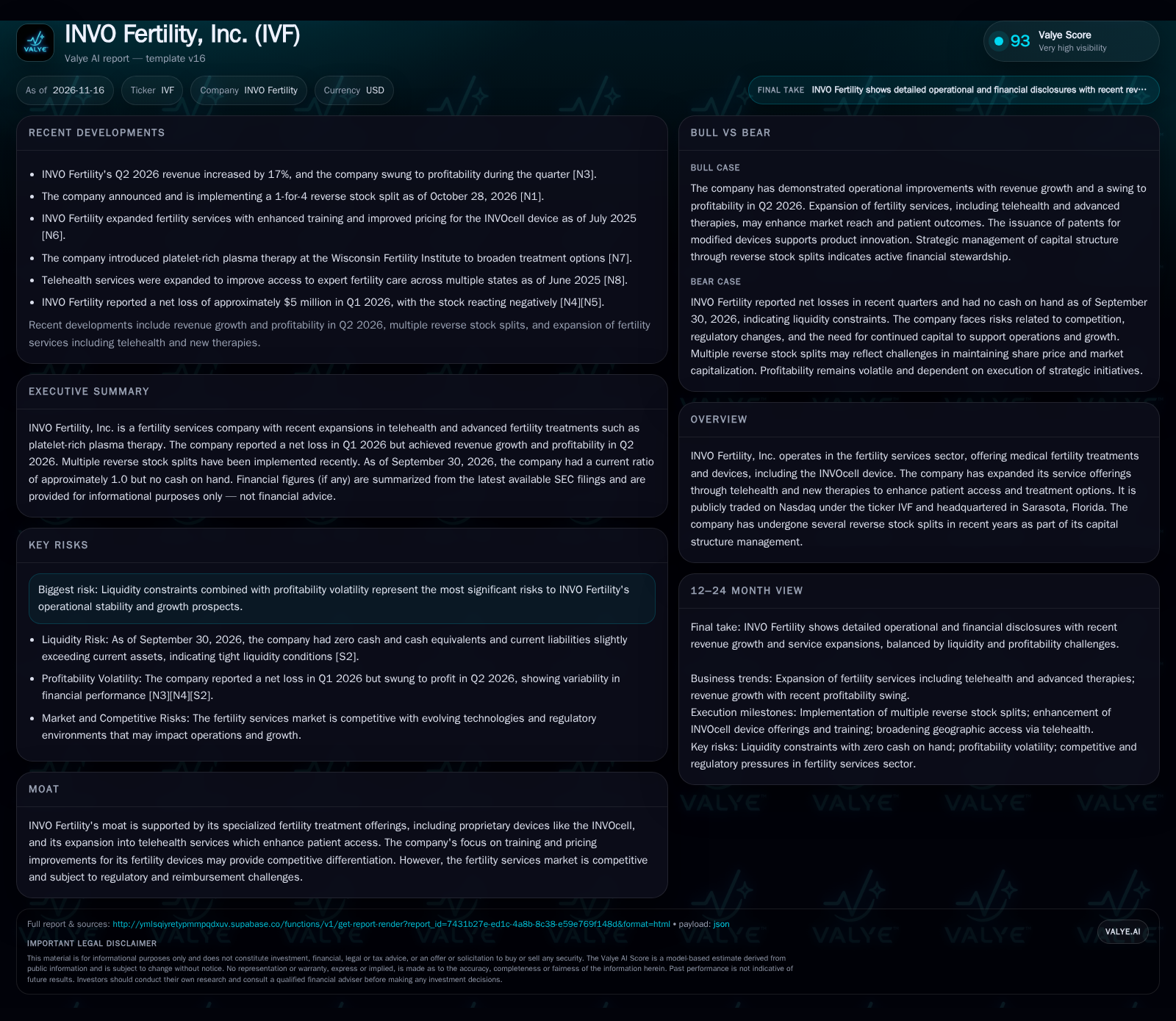
INVO Fertility posted a 17% revenue jump and turned a profit in Q2 2026, but ended September with zero cash and a current ratio of 1.0. The path forward hinges on stabilizing margins, managing capital needs, and demonstrating sustainable adoption of proprietary offerings. [N2] [N3] [S2]
INVO Fertility, Inc. is attempting to redefine its business model through service expansion and device innovation in a highly competitive fertility market. While its Q2 2026 financials showed a sharp revenue uptick and a brief return to profit, the subsequent quarter’s losses and the absence of a reported cash balance spotlight the company’s vulnerability.
Recent Results Reveal Fragile Financial Progress Amid Growth Initiatives
INVO Fertility’s Q2 2026 results offered a rare bright spot: a 17% revenue increase and a swing to profitability, which briefly buoyed the company’s market sentiment. However, this momentum proved short-lived; by the quarter ending September 30, 2026, INVO Fertility had reported a net loss of approximately $2.15 million, with basic and diluted EPS at -$2.44 per share. [N2] [N3] [S2]
Operationally, the period was marked by aggressive moves to expand service offerings. These included the introduction of platelet-rich plasma therapy at the Wisconsin Fertility Institute and the rollout of telehealth services across multiple states. Additionally, INVO Fertility has undergone multiple reverse stock splits, including a 1-for-4 split announced for late October 2026. While these splits may help maintain Nasdaq listing compliance, they also spotlight ongoing capital structure pressures. [N1] [N7] [N8]
How INVO Fertility’s Revenue Model Relies on Service Diversification and Cost Discipline
INVO Fertility’s business model is built around a mix of direct fertility services and proprietary device offerings, with the INVOcell device positioned as a differentiator in the assisted reproductive technology (ART) space. Historically, fertility clinics generate revenue through a combination of procedure fees, device sales or rentals, and ancillary therapies. Margins can be attractive at scale due to high average revenue per patient, but the sector is capital-intensive and exposed to significant fixed costs—facility overhead, clinical staff, and regulatory compliance.
The company’s recent expansion into telehealth and advanced therapies such as platelet-rich plasma treatment aims to capture a broader patient base and unlock new revenue streams. If these initiatives lead to higher patient throughput or enable premium pricing, INVO Fertility could improve utilization and operating leverage. However, the company’s zero cash position and repeated net losses highlight that fixed costs may be outpacing revenue growth, and any delay in scaling new services could exacerbate cash burn.
Reverse stock splits, while often used to shore up share price and avoid delisting, do not directly address underlying capital needs. If INVO Fertility cannot generate sustainable free cash flow, it may require new equity, debt, or partnership capital to fund operations—a challenge in a sector where investor appetite can be fickle.
Competitive Pressures Intensify as INVO Fertility Pursues Differentiation
The fertility services industry is characterized by intense competition from both established clinic networks and independent practices, as well as increasing innovation in ART devices and digital health platforms. INVO Fertility’s proprietary INVOcell device and its push into telehealth represent attempts at differentiation, potentially offering greater patient convenience and lower procedural invasiveness compared to traditional IVF.
However, these advantages may be eroded if larger competitors adopt similar technologies, offer bundled services, or undercut on price. Telehealth expansion, while promising for geographic reach, faces its own set of challenges: regulatory variability across states, patient acquisition costs, and the need to integrate digital and in-person care seamlessly.
Switching costs for patients are low, as fertility care is typically episodic and highly price- and outcome-sensitive. Sustained advantage may depend on clinical outcomes, patient experience, and the ability to build referral relationships with OB/GYNs and primary care providers. Without demonstrably superior results or a strong brand, INVO Fertility could struggle to defend margins.
Scaling New Therapies and Telehealth Could Unlock Margin Expansion
If INVO Fertility successfully drives adoption of its expanded therapy offerings—such as platelet-rich plasma treatments—and leverages telehealth to access underserved geographies, it could achieve higher patient volumes and improved operating leverage. The INVOcell device, if widely adopted, may enable the company to offer a differentiated, lower-cost alternative to conventional IVF, boosting both revenue and gross margin.
Evidence supporting this scenario would include several quarters of sequential revenue growth, positive EBITDA or operating cash flow, and clear signs that new service lines are contributing meaningfully to top-line and margin improvement. Announcements of strategic partnerships, payer contracts, or expansion into additional states would further strengthen the case for sustainable growth.
This upside is most plausible if INVO Fertility manages to control fixed costs, keep patient acquisition costs in check, and demonstrate that its model can scale without continual external capital infusions.
Volatility Persists as Service Expansion Battles Margin Pressure
The most plausible trajectory for INVO Fertility is continued revenue growth driven by new therapies and telehealth, but with profitability and cash flow remaining volatile. The company may deliver intermittent quarters of profit, as seen in Q2 2026, but struggle to maintain consistent earnings due to high fixed costs, competitive pricing pressure, and the need to invest in patient acquisition and regulatory compliance.
Confirmation of this scenario would include ongoing revenue increases but with persistent swings between profit and loss, limited or no improvement in cash position, and further capital structure adjustments such as additional reverse splits or dilutive financings. If disclosed, trends in patient volume per clinic, average revenue per patient, and cost per acquisition would clarify whether operating leverage is being realized.
This base case assumes INVO Fertility avoids insolvency but remains vulnerable to shocks, with little margin for execution missteps or unforeseen regulatory changes.
Liquidity Constraints Force Retrenchment or Dilution
The principal risk is that INVO Fertility’s cash burn continues at a pace that outstrips any revenue or margin gains from new services. With zero cash and current liabilities matching current assets, even minor revenue shortfalls or unexpected expenses could force the company to curtail operations, delay expansion plans, or seek emergency capital on punitive terms.
Evidence for this scenario would be missed payroll, delayed vendor payments, or regulatory filings indicating going-concern risk. Additional reverse stock splits or highly dilutive equity issuances would reinforce the impression of financial distress. Patient attrition, negative clinical outcomes, or a competitor’s rapid share gain could further erode confidence.
In this scenario, INVO Fertility’s ability to remain a going concern would hinge on either a rapid and sustained improvement in profitability or the successful completion of a significant capital raise.
Milestones That Will Determine INVO Fertility’s Viability and Growth
Quarterly revenue trends, especially sequential growth rates and the contribution from new service lines such as telehealth and platelet-rich plasma therapy.
Patient volume per clinic and average revenue per patient—if disclosed—to assess whether service expansion is driving meaningful scale.
Operating cash flow and EBITDA margins as indicators of underlying business health and progress toward self-sufficiency.
Disclosure of additional reverse stock splits, equity raises, or debt financings, which would signal ongoing or worsening capital structure stress.
Updates on geographic expansion, including entry into new states or payer partnerships, to track the effectiveness of telehealth and new therapy rollouts.
Any regulatory filings or auditor commentary regarding going-concern status or liquidity risk.
Retention rates and patient satisfaction metrics, if disclosed, to gauge competitive positioning and brand strength.
Gross margin trends for device sales and ancillary therapies, which would clarify whether product mix or pricing is improving overall profitability.
Disclaimer: This is research-only, informational analysis and not investment advice. It may include AI-generated interpretation and general industry context. Always verify important details using primary sources.

Comments