
Innovative Food Holdings Strengthens Specialty Food Distribution Following Strategic Refocus
The company’s latest quarterly filing highlights operational streamlining and ongoing customer concentration challenges amid its niche specialty foodservice distribution model.
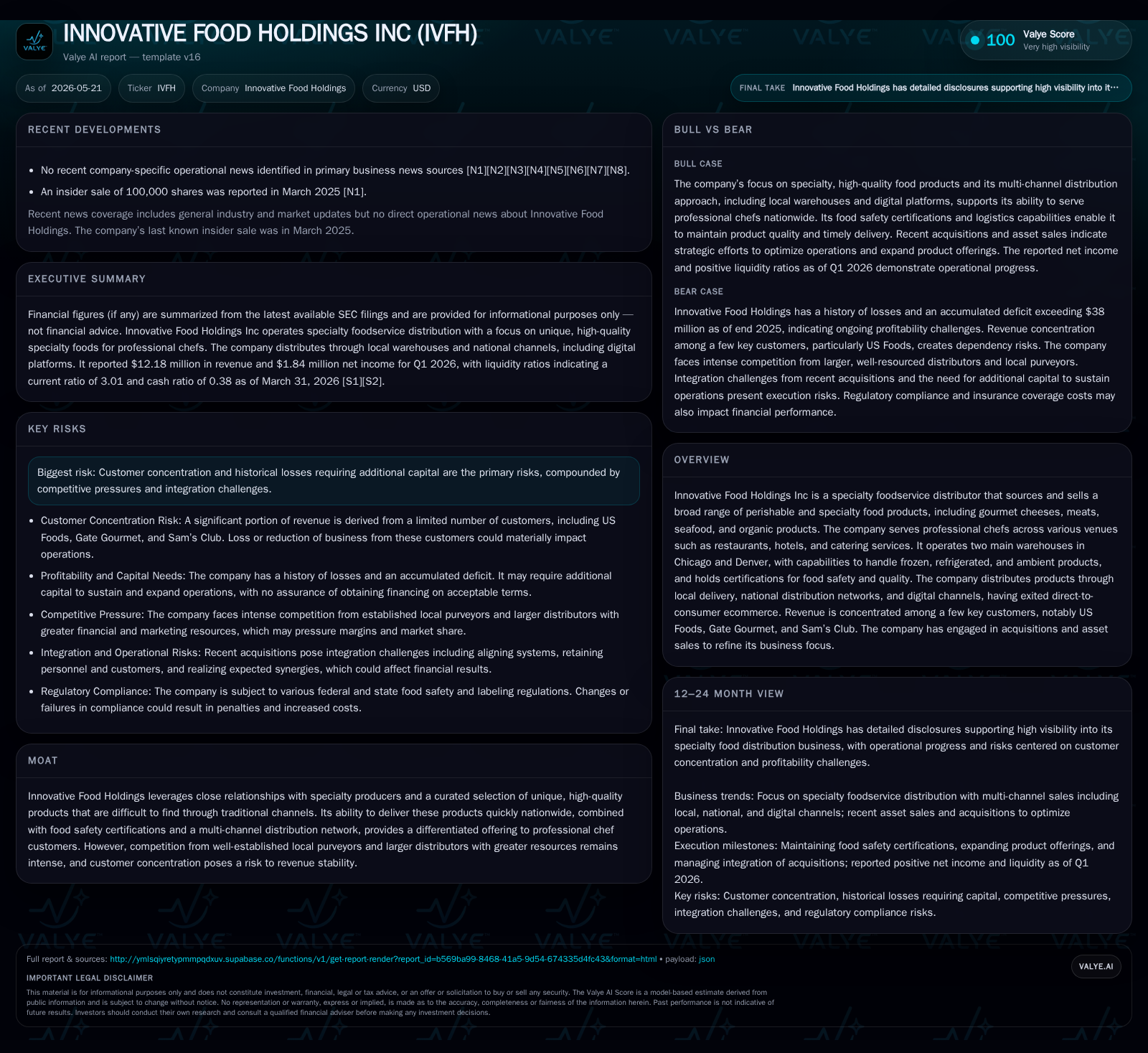
Innovative Food Holdings Inc’s May 2026 quarter shows continued focus on specialty foodservice distribution with strategic asset sales and operational refinement. The company's business centers on sourcing unique, perishable gourmet products delivered from two certified warehouses to professional chefs, primarily through a small group of large customers like US Foods and Gate Gourmet. While the company benefits from product differentiation and multi-channel distribution capabilities, risks from customer concentration, competitive pressure, and integration challenges persist. Future growth hinges on expanding customer channels and optimizing digital drop-ship partnerships, even as liquidity remains adequate with net cash exceeding debt.
Latest Operating Developments and Their Significance
Innovative Food Holdings Inc's latest quarterly filing dated May 20, 2026 [S2] confirms the completion of a significant asset disposition: the sale of its Mountaintop, Pennsylvania warehouse facility plus associated contracts and intangibles for $9.225 million [S3]. This transaction closes a chapter on non-core assets and signals a sharper strategic focus on its core distribution hubs in Chicago and Denver. Concurrently, the company has intensified its withdrawal from direct-to-consumer channels by exiting ecommerce platforms such as igourmet.com and associated subsidiaries in prior quarters [S1], redirecting resources towards business-to-business (B2B) specialty foodservice distribution.
Operationally, this divestiture reduces overhead tied to underutilized facilities while potentially enhancing capital liquidity. The narrowing of physical footprint is aligned with management's stated objective to develop more scalable and profitable specialty food distribution within their established warehouse network [S23]. Notably, recent filings also affirm continued dependency on major wholesale partners for channel reach despite initiatives to diversify [S18]. These near-term changes underscore a tradeoff between streamlining operational complexity and the imperative to broaden sales sources beyond concentrated clients.
Business Model and Product Quality: Serving a Premium Niche
At its core, Innovative Food Holdings sources and distributes specialized perishable foods that are difficult for standard broadline distributors to provide [S1]. The product mix includes artisan cheeses, premium meats, seafood selections, organic ingredients, and other origin-specific gourmet items sought after by professional chefs operating in restaurants, hotels, country clubs, casinos, hospitals, and catering services. The company’s expertise lies in forging close relationships with small batch producers who often lack broad sales channels but offer unique product quality that commands premium pricing [S1].
The company leverages two strategically located warehouses — a 28,000-square-foot facility near Chicago and a 22,000-square-foot facility near Denver — both equipped for frozen, refrigerated, and ambient storage [S1]. Critical certifications to industry-leading food safety standards such as GFSI/SQF are maintained ensuring compliance with rigorous quality handling requirements demanded by high-end foodservice customers. This infrastructure enables order fulfillment typically within a tight 24–72 hour window following receipt [S1], an important differentiation in perishable logistics.
Additionally, the firm packages and brands a proportion of these specialty products internally under proprietary labels. This vertical integration grants superior assortment control while improving flexibility for customers who require tailored ingredient mixes or exclusive product variants that enhance menus. The capacity for overnight shipping of varied package sizes further supports service excellence versus competitors reliant solely on larger pallet movements.
Multi-channel sales encompass direct local deliveries via company-operated fleets particularly around Chicago (under Artisan Specialty Foods) [S1], national distribution using third-party logistics partners outside core footprints, plus digital channels operating via drop-ship arrangements on major distributor platforms such as US Foods’ ecommerce site. Notably, the business exited direct-to-consumer online retail platforms reflecting a strategic realignment favoring the professional chef market segment where switching costs are higher due to curated supplier relationships [S1],[S23].
Competitive Environment and Industry Dynamics
Innovative Food Holdings operates in an intensely competitive segment where rivalries emerge both from specialized local purveyors with deep regional roots as well as broadline distributors commanding scale advantages [S23],[S27]. While few competitors match IVFH’s nationwide next-day delivery capability combined with an extensive chef-driven specialty product platform, local purveyors’ entrenched customer loyalties challenge expansion efforts.
Pricing power within this niche is subject to downward pressure because many buyers remain price sensitive despite valuing quality uniqueness. Maintaining durable margins demands continuous innovation in product mix plus consistent quality assurance backed by certifications. Switching costs exist due to customization needs but can be undermined if competitors replicate specialty assortments or improve service turnaround times.
Customer revenue concentration is significant risk: US Foods accounted for approximately 37% of consolidated sales in 2025; Gate Gourmet contributed around 14%; Sam’s Club roughly 12%, though Sam’s Club-related cheese sales are expected to wind down following business exits [S1],[S22]. This reliance creates vulnerability should any client shift buying patterns or terminate contracts unexpectedly. The company recognizes this exposure is material but faces challenges developing alternate sizable partnerships rapidly in a fragmented distributor landscape.
Regulatory compliance including federal/state food safety laws adds operational complexity but is also an entry barrier protecting supply chain integrity [S27]. Capacity constraints derive primarily from perishability logistics requiring cold chain adherence with limited warehouse space flexibility; hence recent real estate divestitures aim to optimize utilization without sacrificing fulfillment speed.
Critical Growth Drivers for Specialty Food Distribution
Key growth avenues lie first in leveraging the proprietary branded specialty lines acquired or developed internally [S18]. With better margin control over these products relative to third-party offerings, expanding penetration across existing broadline distributor digital marketplaces could enhance profitability.
Secondarily, scaling drop-ship ecommerce partnerships aligns well with current B2B channel shifts — allowing IVFH to extend reach geographically without incremental warehouse capex [S1],[S3]. Management’s focus remains on nurturing relationships that complement rather than compete with core warehouse shipments.
Incremental revenue generation may stem from cross-selling among existing clients by incrementally broadening product assortment informed by Chef Advisor teams who help tailor menus — serving as value-added touchpoints strengthening retention [S1]
Warehouse efficiency gains through technology upgrades or logistics fleet optimization would improve order fulfillment KPIs (targeted at next-day or within 72 hours) reducing lead times crucial for chefs’ planning cycles.
With an accumulated deficit north of $38 million at year-end 2025 [S1], the firm must balance growth investments against cash flow preservation.
Customer concentration sharply elevates revenue volatility risk; loss of one or more major clients could force significant operational contraction given limited sales diversification currently achievable [S22]. Dependency on US Foods’ sales force efforts exacerbates this fragility as direct IVFH marketing is limited.
Competition from both legacy purveyors comfortable serving bespoke markets regionally as well as global broadline distributors equipped with scale-driven pricing pressures constrains margin expansion potential. Emerging entrants or well-financed incumbents could outpace IVFH’s capability to sustain unique product curation.
Past acquisitions have introduced integration difficulties including aligning systems/processes plus retaining specialized personnel or supplier networks critical for product uniqueness; failure here could impair reputation or operational output adversely impacting financial results [S11],[S18].
Regulatory changes affecting permissible sourcing or labeling requirements may increase compliance costs negatively impacting gross margins if not passed onto customers promptly [S27],[S24]. Macroeconomic headwinds such as inflationary cost pressures may tighten operating margins absent volume growth or pricing adjustments.
Upcoming Catalysts and Operational Milestones
Key milestones include monitoring quarterly guidance updates reflecting successful diversification away from concentrated customer reliance especially beyond US Foods-linked revenues [S2],[S3].
Renewal or extension of large-scale contracts incorporate visibility into mid-term revenue stability while new client wins remain essential development markers.
Improvement trajectories for order fulfillment efficiency—measured by reduction in shipment lead times within target windows—will signal operational scalability vital for next phase growth.
Advancement of further vendor certifications or onboarding signature specialty producers would enhance portfolio differentiation reinforcing competitive moat.
Monitoring fleet delivery capacity enhancements that serve local metropolitan markets delineate ability to maintain service levels even amid volume surges or geographic expansion scenarios.
Financial Condition Overview: Liquidity and Capital Structure
As of March 31, 2026 ([F1]), Innovative Food Holdings presents a liquidity position highlighted by cash and equivalents amounting to approximately $1.23 million against total debt near $267 thousand yielding a net cash surplus (negative net debt) just under $965 thousand.
Overall financial profile aligns coherently with strategic efforts prioritizing capital efficiency alongside selective growth investments targeting specialty foodservice niches less vulnerable to commoditization dynamics seen broadly across food distribution sectors.
This analysis reflects information available as of May 21, 2026 based exclusively on publicly filed SEC documents supplemented by sector-context analytical insights relevant to Innovative Food Holdings Inc's business environment. It does not constitute investment advice. Readers should consult official filings directly for precise financial data or disclosures.
Disclaimer: This is research-only, informational analysis and not investment advice. It may include AI-generated interpretation and general industry context. Always verify important details using primary sources.

Comments