
Invivyd’s Monoclonal Antibodies: Managing Variant Risks and Regulatory Barriers in Infectious Disease Markets
Invivyd’s near-term prospects rest on the commercial and regulatory trajectory of PEMGARDA and next-generation VYD2311 for COVID-19 prevention in immunocompromised patients, but viral evolution and uncertain market adoption complicate the path to sustainable revenues.
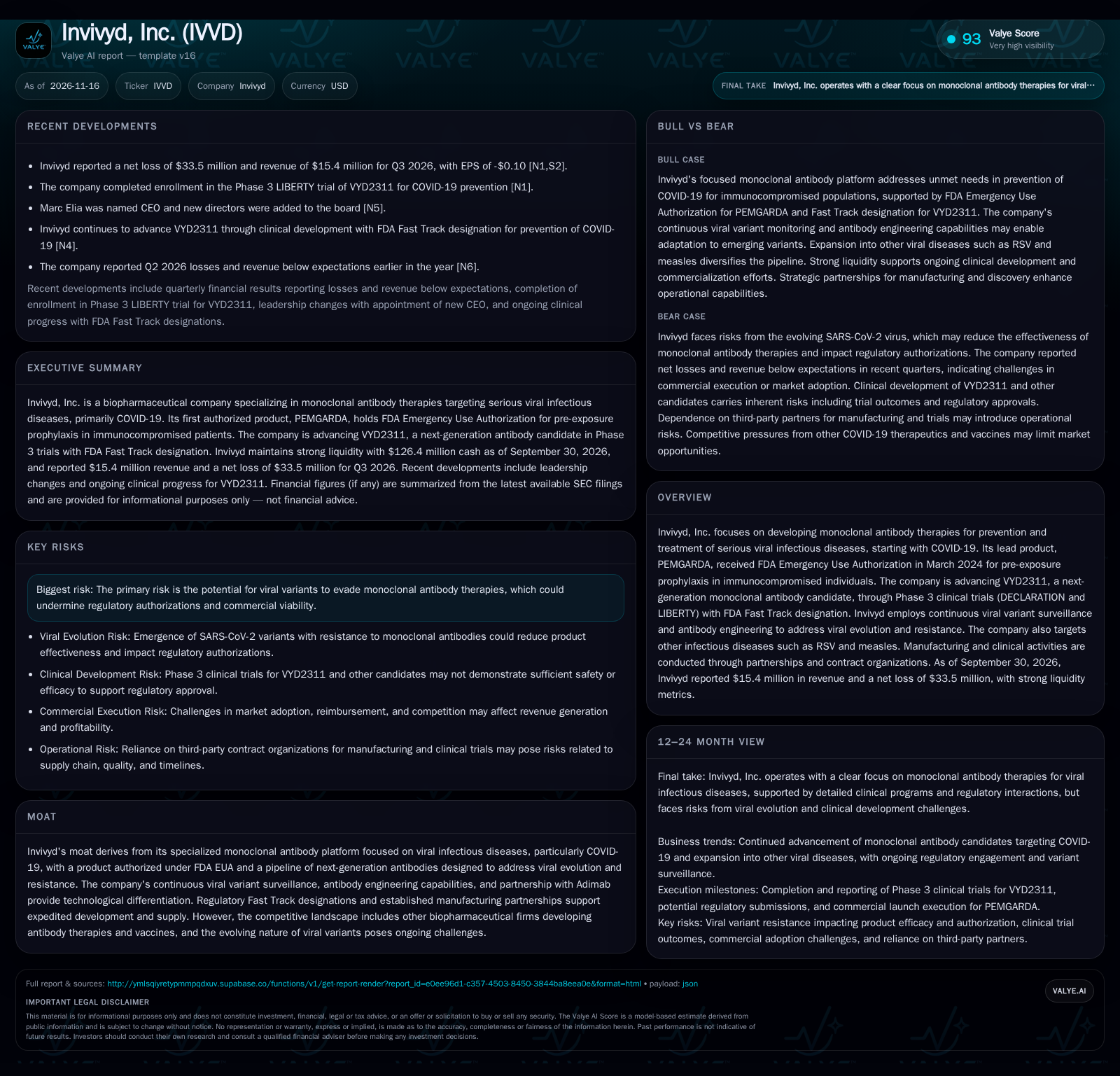
Invivyd reported $15.4 million in Q3 2026 revenue and a $33.5 million net loss, with PEMGARDA under FDA Emergency Use Authorization and VYD2311 advancing into Phase 3 trials for COVID-19 prevention. The core risk remains viral escape and uncertain long-term demand for monoclonal antibody prophylaxis.
Invivyd, Inc. stands at a pivotal juncture in the fight against viral infectious diseases, focusing on monoclonal antibody therapies for high-risk populations, especially the immunocompromised. With Q3 2026 revenue of $15.4 million and a net loss of $33.5 million, the company’s fortunes are closely tied to the regulatory and commercial trajectory of its first authorized therapy, PEMGARDA, and the progress of next-generation candidate VYD2311. As Invivyd seeks to expand its pipeline to additional viral threats beyond COVID-19, the sustainability of its business model hinges on the unpredictable dynamics of viral evolution, regulatory flexibility, and the willingness of healthcare systems to adopt antibody-based prevention.
PEMGARDA’s Conditional Approval and Pipeline Milestones Shape Today’s Outlook
As of September 30, 2026, Invivyd had $15.4 million in quarterly revenue and a net loss of $33.5 million, indicating that commercial operations remain in an early stage and are not yet profitable [S2] [N1]. The company’s first authorized product, PEMGARDA, is under FDA Emergency Use Authorization (EUA) for pre-exposure prophylaxis of COVID-19 in immunocompromised patients, but this authorization is conditional—limited to periods when susceptible variants are prevalent and the emergency declaration is in effect [S1]. VYD2311, a next-generation monoclonal antibody candidate, has completed Phase 1/2 trials with positive safety and pharmacokinetic data and is now in Phase 3 trials with FDA Fast Track designation [S1]. As of September 2026, Invivyd reported $126.4 million in cash and a current ratio of 5.51 [S2]. These facts underscore a company with clinical momentum and reported liquidity, but high dependence on regulatory and epidemiological variables.
Financial Dynamics of Prophylactic Antibody Treatments: Pricing, Volume, and Cost Considerations
Invivyd’s revenue model is built on developing monoclonal antibody therapies for infectious diseases, initially targeting immunocompromised populations who are less responsive to vaccines. In this niche, payers may tolerate premium pricing due to the high-risk profile and lack of alternatives. However, the market is inherently limited in size compared to broader prophylactic or therapeutic indications. The variable cost structure is driven by the complexity of biologic manufacturing, clinical trial costs, and post-market surveillance. Margins for monoclonal antibodies can be attractive if high utilization and premium reimbursement are achieved, but high fixed R&D investment and ongoing variant surveillance create a need for scale or sustained reimbursement.
Because Invivyd outsources manufacturing and much of its clinical development to partners like WuXi Biologics and Adimab, capital requirements for in-house infrastructure are reduced, but the company is exposed to supply chain, quality, and cost risks typical of contract-based models [S1]. The early revenue and persistent net losses suggest that either pricing, volume, or both have not yet reached break-even levels. The expansion into RSV and measles offers a path to higher addressable markets, but those candidates are pre-commercial and require further investment.
Adapting to Variants and Differentiating Platforms in a Competitive Infectious Disease Landscape
Invivyd’s potential competitive advantage lies in its rapid antibody engineering and continuous viral surveillance, enabling adaptation to new variants—critical in a landscape where viral evolution can rapidly render therapies obsolete [S1]. The partnership with Adimab may provide access to advanced antibody discovery tools, while a focus on immunocompromised populations addresses an unmet need underserved by vaccination.
However, the company faces threats from both direct competitors—other biopharma firms developing monoclonal antibodies for COVID-19 and emerging infectious diseases—and from alternative modalities, especially small-molecule antivirals and improved vaccines. Regulatory timelines, real-world efficacy against new variants, and payer willingness to reimburse for ongoing prophylaxis are all external forces that could erode Invivyd’s position. The company’s technology and regulatory speed may allow for temporary differentiation, but any durable moat will depend on the ability to consistently produce antibodies effective against circulating strains and to expand into non-COVID-19 indications.
Potential Impact of Broad Authorization and Adoption of Next-Generation Antibodies
The most favorable scenario is that VYD2311 demonstrates robust efficacy and safety in Phase 3, leading to full FDA approval (BLA) for prophylaxis in immunocompromised and potentially other high-risk populations. If variant surveillance and antibody engineering continue to outpace viral evolution, Invivyd could maintain regulatory authorization as variants shift, providing steady or growing revenue from both PEMGARDA (if still viable) and VYD2311. Expansion into additional indications (RSV, measles) could further diversify revenue and justify continued high R&D investment.
Confirmation of this scenario would include: positive Phase 3 data for VYD2311, timely BLA submission and approval, sustained or growing sales of authorized antibodies despite variant turnover, and evidence of payer and provider adoption for routine prophylaxis. Pre-commercial pipeline progress—such as RSV candidate advancement into late-stage trials—would further support the long-term upside.
Revenue Patterns in a Post-Emergency Environment
The most plausible trajectory is that Invivyd’s revenues remain variable and closely tied to the regulatory environment and the prevalence of antibody-susceptible SARS-CoV-2 variants. EUA for PEMGARDA may lapse if dominant variants become resistant or if the emergency declaration ends, creating revenue gaps until (and unless) VYD2311 or other candidates achieve broader approval. Clinical and regulatory progress continues, but commercial adoption is gradual, limited to high-risk subpopulations, and dependent on payer willingness.
Evidence confirming this scenario would include continued net losses, moderate but variable revenue, and clinical milestones achieved on schedule but without major inflection in adoption or market size. Falsification would require either a step-change in market uptake or a major regulatory setback.
Consequences of Viral Mutation, Regulatory Setbacks, and Market Inertia
The core risk is that viral evolution renders current and next-generation antibodies ineffective, leading to loss of EUA for PEMGARDA and regulatory reluctance to approve new antibodies unless they demonstrate broad neutralization. If Phase 3 data for VYD2311 disappoint or the FDA requires additional studies, Invivyd could face extended revenue droughts. Even with technical success, if payers or providers do not adopt antibody prophylaxis due to cost, logistics, or perceived marginal benefit over vaccines and antivirals, commercial scaling may stall.
This scenario would be confirmed by the withdrawal of EUA, poor clinical trial outcomes, lack of BLA progress, or material delays in pipeline development. Declining revenue, persistent net losses, and lack of adoption in additional indications would further support the downside case.
Clinical, Regulatory, and Commercial Developments Defining Invivyd’s Progress
Progress and outcomes of VYD2311 Phase 3 trials (DECLARATION and LIBERTY), including efficacy against circulating variants and safety profile.
Status and continuity of FDA Emergency Use Authorization for PEMGARDA, especially in relation to variant susceptibility and emergency declaration status.
Rate of revenue generation from monoclonal antibody products—quarterly sales trends, payer coverage, and adoption in target populations, if disclosed.
Milestones in pipeline expansion, notably preclinical or clinical advancement of RSV (VBY329) and measles candidates.
Updates on variant surveillance and antibody engineering capabilities, including the speed of new candidate development in response to emerging viral threats.
Changes in operational partnerships, especially with contract manufacturers and discovery partners, that could impact cost structure or supply chain resilience.
Disclaimer: This is research-only, informational analysis and not investment advice. It may include AI-generated interpretation and general industry context. Always verify important details using primary sources.

Comments