
Wright Investors Service Holdings: Shell Company Mechanics, Governance Levers, and the Pathways to Value Creation
Wright Investors Service Holdings, Inc. remains a shell company focused on managing a modest investment portfolio, with recent net losses and constrained operational options. The company’s trajectory hinges on the board’s ability to either unlock value through portfolio management or transition to an active business model—a process complicated by limited resources and exposure to market volatility.
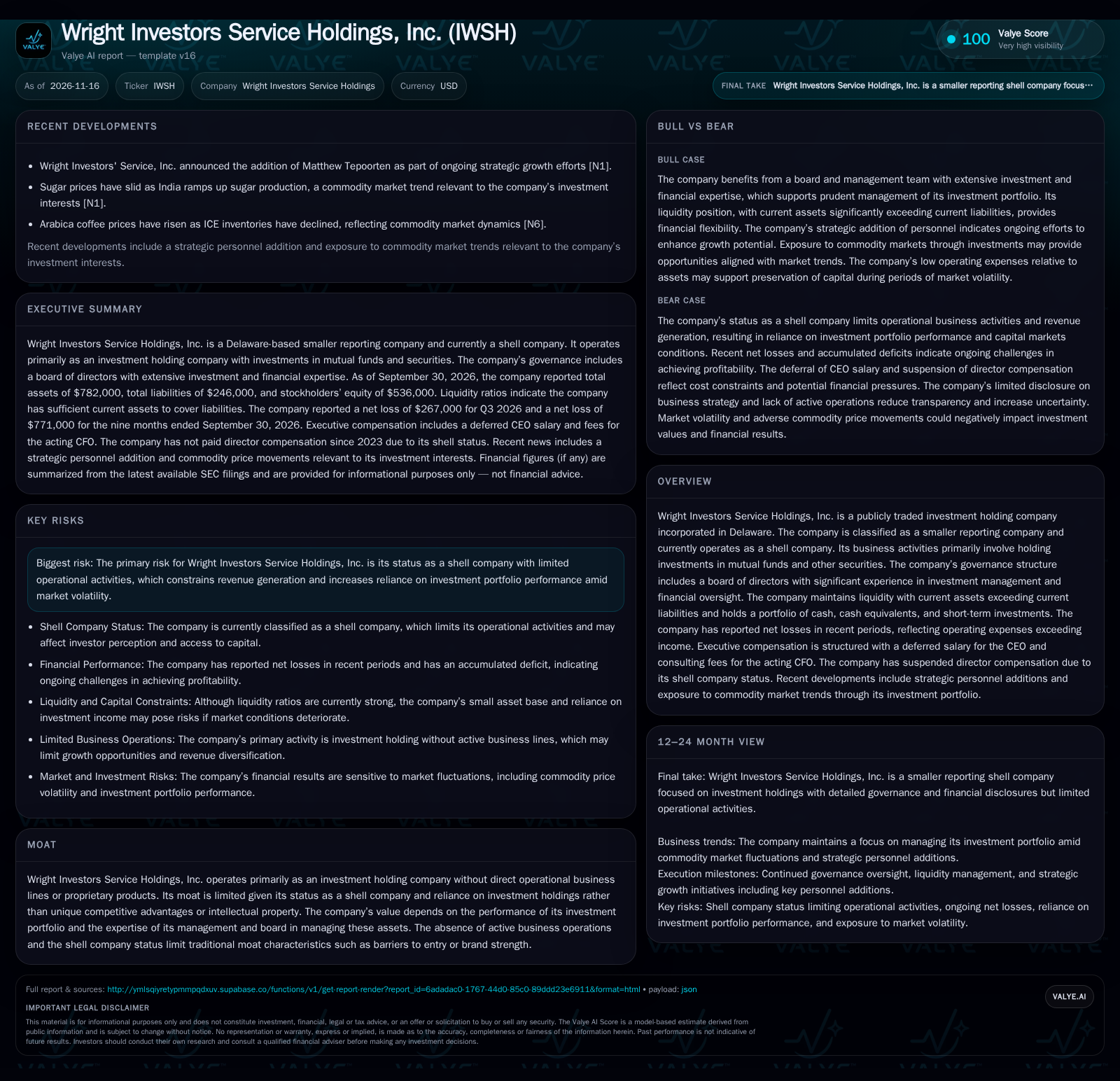
Wright Investors Service Holdings, Inc. continues to operate as a shell investment holding company, reporting net losses and minimal operating activity. Its strong governance and liquidity ratios contrast with a persistent lack of revenue generation, making future value creation dependent on either strategic portfolio moves or a business model shift. The company’s exposure to market fluctuations and the absence of active operations pose ongoing challenges, with any upside contingent on effective capital redeployment or a successful operational pivot. [S2]
Wright Investors Service Holdings, Inc. stands at a crossroads familiar to many small-cap shell companies: with no active operating business, its value proposition is almost entirely a function of its investment portfolio and the strategic decisions of its experienced board. Recent financials reveal continued net losses, modest assets, and a high liquidity ratio—indicating prudent cash management but underscoring the lack of scalable revenue streams. The company’s future, therefore, will be determined by its ability to either deploy capital more productively or execute a transformative transaction, both of which are complicated by its limited balance sheet and exposure to market swings.
Snapshot: Shell Status, Net Losses, and Portfolio-Driven Prospects
As of September 30, 2026, Wright Investors Service Holdings, Inc. reported $782,000 in total assets, primarily comprised of $32,000 in cash and $727,000 in short-term investments, against $246,000 in total liabilities. This yields $536,000 in stockholders’ equity and high liquidity ratios (current ratio 3.15; cash ratio 3.09) [S2]. The company reported cash and liquidity metrics for the period; these figures do not by themselves establish operating runway, investment capacity, financial flexibility, or financing capacity. [S2] The company remains a shell by SEC definition, holding investments in mutual funds and securities but lacking active business operations [S1] [S2]. Executive compensation reflects cost constraints, with the CEO’s $300,000 salary deferred since April 2026 and no director compensation paid since 2023 [S1]. These facts underscore both the company’s financial discipline and the acute absence of a scalable business engine.
Shell Company Economics: Fixed Costs, Investment Returns, and Capital Constraints
Wright Investors Service Holdings’ economics are shaped almost entirely by investment income and the fixed costs of maintaining a public company structure. With no operating revenue, all expenses—board and executive compensation, regulatory compliance, and administrative costs—must be covered by returns on its investment portfolio. The company’s asset base is modest, with the vast majority in liquid securities or cash. This structure creates negative operating leverage: even small fixed expenses quickly erode equity in the absence of outsized investment gains. The deferral of CEO salary and suspension of director compensation are attempts to preserve capital, but with ongoing net losses, the company’s ability to sustain itself depends on either portfolio outperformance or drastic cost reduction. As a shell, Wright Investors Service Holdings does not require significant capital expenditure, but any effort to acquire an operating business or expand investment activities would require additional funding, either through equity issuance or new capital inflows.
Investment Shells in the Public Markets: Positioning and Constraints
The competitive landscape for public shell companies is defined less by traditional industry rivals and more by the availability of compelling acquisition targets, investor appetite for reverse mergers, and the board’s ability to source and execute value-accretive transactions. Wright Investors Service Holdings’ primary assets are its public listing, modest liquid portfolio, and the investment experience of its board. However, the absence of proprietary assets, recurring revenue, or operating scale significantly limits its competitive moat. The company competes with other shells and special purpose vehicles for both capital and acquisition opportunities, often facing better-capitalized or more actively managed peers. Its reliance on passive investment returns exposes it to market volatility, and without a differentiated investment strategy or unique access to deal flow, it is vulnerable to being overlooked in strategic transactions. The company’s ability to attract partners or acquisition candidates is also hampered by its small equity base and history of net losses.
Unlocking Value: What a Strategic Transaction or Portfolio Outperformance Could Deliver
The most plausible upside scenario for Wright Investors Service Holdings is a successful pivot from shell status to active operations, either through a reverse merger, acquisition of a high-potential private business, or a series of portfolio reallocations that meaningfully outperform benchmarks. If the board leverages its investment expertise to identify and execute a transformative transaction, the company could attract new capital, restore director and executive compensation, and generate a sustainable revenue stream. Alternatively, if the current investment portfolio significantly outperforms—perhaps by capitalizing on commodity cycles or identifying overlooked securities—net income could turn positive, supporting a gradual rebuild of equity. Confirming evidence would include announcements of definitive agreements to acquire or merge with an operating business, substantial new capital commitments, or a marked reversal from net losses to positive net income driven by realized investment gains.
Persistence as a Shell: Portfolio Drifts and Ongoing Cost Discipline
The most likely near-term scenario is continued operation as a shell company with passive investment management and disciplined cost control. The company is expected to maintain high liquidity ratios and preserve capital by limiting executive and director compensation, while absorbing modest ongoing net losses. Absent a major transaction or portfolio windfall, management will likely focus on incremental improvements: opportunistic rebalancing of the investment portfolio, seeking to minimize expenses, and monitoring the market for potential reverse merger candidates. Evidence supporting this scenario would be continued quarterly net losses, no significant increase in operating expenses, and incremental portfolio adjustments without major new business announcements.
Asset Erosion and Strategic Drift: How Value Could Be Destroyed
The adverse scenario for Wright Investors Service Holdings is continued operating losses and portfolio underperformance eroding the company’s already modest equity base. If investment returns falter—due to market downturns or poor security selection—fixed costs could consume a growing proportion of assets, eventually forcing asset sales, further compensation cuts, or even regulatory delisting if minimum listing standards are not met. The inability to attract acquisition opportunities or new capital would amplify this risk. Confirming evidence would include a continued or accelerating decline in total assets and equity, further deferral or elimination of executive compensation, or disclosures indicating going concern doubts or regulatory risks related to shell status.
Milestones That Will Clarify Wright Investors Service Holdings’ Path Forward
Quarterly net income or loss trends—especially any reversal from persistent losses to profitability—would provide critical evidence for or against a turnaround.
Disclosure of any definitive agreements for acquisition, reverse merger, or entry into an active business line would materially alter the company’s risk/reward profile.
Changes in the composition, size, or risk profile of the investment portfolio (if disclosed) would help assess the likelihood of outsized investment returns or new strategic directions.
Announcements regarding new capital raises, equity issuance, or significant external investment would signal potential for transformative transactions or operational expansion.
Executive compensation arrangements—such as resumption of CEO salary payments or director fees—would indicate improving potential financial flexibility or renewed business momentum.
Regulatory filings or auditor notes on going concern status would serve as early warnings for downside risk or potential delisting.
A useful metric would be portfolio performance versus relevant benchmarks, to test the board’s investment acumen and the company’s ability to generate alpha.
Disclaimer: This is research-only, informational analysis and not investment advice. It may include AI-generated interpretation and general industry context. Always verify important details using primary sources.

Comments