
JAB Acquisition Corp I: Blank-Check Structure, Trust Capital, and the Stakes of Target Selection
JAB Acquisition Corp I, recently listed as a blank-check company with over $389 million in cash and no active operations, faces the critical challenge of identifying and executing a value-accretive business combination. The company’s robust balance sheet underscores its potential firepower, but its future hinges entirely on deal sourcing, market timing, and post-merger execution.
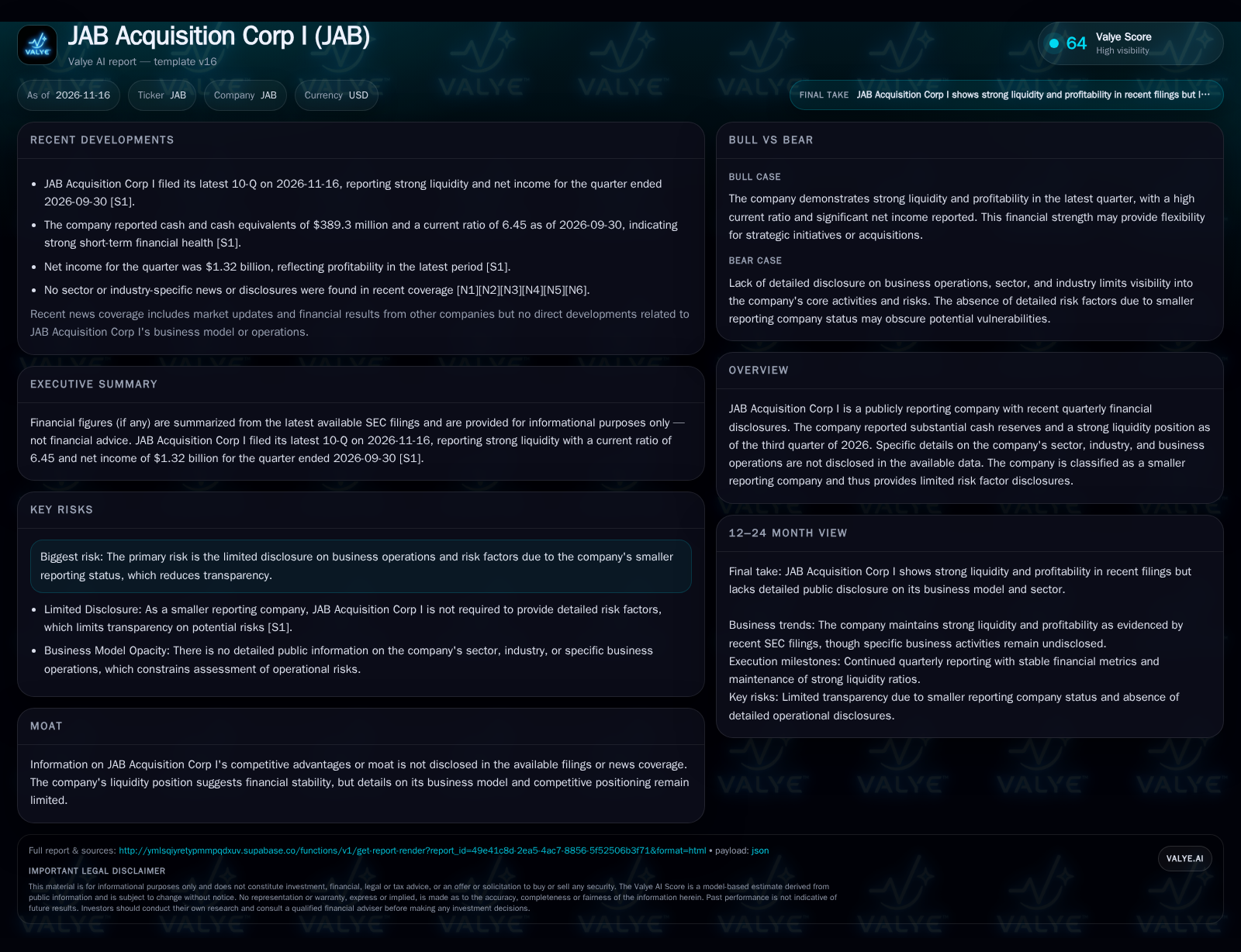
JAB Acquisition Corp I is a newly formed SPAC with $389 million in cash and a current ratio of 6.45 as of September 2026, but has not yet identified or announced a business combination. Its economics, risks, and future value depend on the selection and execution of a suitable merger target, making capital preservation and deal quality the central thesis levers. Transparency is limited, and the absence of operational disclosures leaves significant uncertainties around sector focus and risk profile. [S1]
JAB Acquisition Corp I enters the public markets as a classic special purpose acquisition company (SPAC), armed with $389 million in cash and a mandate to seek out a merger or acquisition target. With no current business operations, the company’s economics and long-term value are entirely contingent on its ability to identify, negotiate, and close a business combination that can justify the trust capital raised from investors. The present financial strength is a function of IPO proceeds parked in trust, not operating momentum—making the SPAC’s success all about what comes next, not what’s on the balance sheet today. For investors, the key questions are: Will JAB’s team source a high-quality target? Can they execute a merger that delivers value beyond the cash in trust? And how will dilution, deal terms, and target sector shape the risk/reward profile going forward?
Trust Account Strength and the Absence of Operations Define the Starting Point
As of September 30, 2026, JAB Acquisition Corp I reported cash and cash equivalents of $389.3 million and total current assets of $571.7 million, with current liabilities of $88.7 million. The company posted net income of $1.32 billion for the quarter, but as a blank-check entity, this figure is likely related to accounting treatment of warrants or trust-related returns, not traditional business activity. JAB has not commenced any operating business; all activity since inception has been related to its IPO and trust management. The company’s high current and cash ratios (6.45 and 4.39, respectively) reflect the structure of its trust account and limited liabilities, not underlying operating strength. No business combination has been announced or completed, and the company’s sector or target focus remains undeclared. [S1]
How SPAC Economics Work: Capital in Trust, Sponsor Incentives, and Post-Merger Uncertainty
JAB’s revenue and profit are currently artifacts of its SPAC structure: interest income on trust assets and accounting gains or losses on derivative instruments such as warrants. The core economic mechanism is straightforward: the SPAC raises capital via IPO, holds it in a trust account, and seeks a private company to merge with, thereby taking it public. Sponsor economics typically include a promote (often 20% of post-IPO equity), which creates dilution for public shareholders if a deal is completed. Investors in the IPO have redemption rights, allowing them to withdraw their pro rata share of the trust if they dislike the proposed merger.
The company’s cost structure is minimal until a transaction is pursued, but post-merger economics are highly variable. If a target is found and a deal is approved, the resulting combined entity’s economics—growth, margins, capital needs—will depend entirely on the target’s business model. The SPAC itself does not generate operating cash flow or recurring revenue prior to a business combination. The primary capital need is to preserve trust assets and manage sponsor and administrative expenses. If no deal is consummated within the regulatory timeframe (typically 18–24 months post-IPO), the trust is liquidated and funds returned to shareholders.
SPAC Market Dynamics: Sponsor Reputation, Deal Pipeline, and the Race for Attractive Targets
JAB’s competitive context is defined not by product or service differentiation, but by its ability to identify and secure a compelling merger target before trust expiration. The SPAC sector is crowded, with many blank-check companies vying for a finite pool of attractive private businesses. Competitive advantages may stem from sponsor reputation, network, sector expertise, and the ability to offer favorable deal terms. However, with no disclosed focus or sponsor track record in the supplied evidence, it is unclear how JAB differentiates itself.
The main competitive threat is the abundance of capital chasing similar opportunities, driving up valuations and potentially resulting in deals with less attractive economics for public shareholders. Other SPACs, private equity funds, and direct IPOs are all substitutes for both targets and investors. If the SPAC fails to secure a deal, capital is returned, but the opportunity cost for investors is the foregone upside of a successful business combination.
Value Creation If JAB Sources and Closes a High-Quality Business Combination
The primary upside scenario is that JAB leverages its ample trust capital and sponsor network to identify a private company with strong growth prospects, scalable economics, and a clear path to public-market value creation. If the target company operates in an expanding sector (e.g., technology, healthcare, or climate solutions) and can use the SPAC proceeds for accretive growth or consolidation, public shareholders could benefit from post-merger appreciation. The most favorable outcomes occur when the deal is structured to minimize dilution, align incentives, and attract additional PIPE (private investment in public equity) financing to support the merged entity’s growth.
Evidence that would confirm this thesis includes a well-vetted deal announcement, strong target fundamentals (revenue growth, profitability, or compelling TAM), positive market reaction upon deal disclosure, and limited redemptions at the merger vote. The scenario is falsified if JAB fails to announce a deal, proposes a target with weak financials or questionable governance, or faces heavy redemptions and post-merger underperformance.
Most Likely Outcome: Prolonged Target Search, Deal Uncertainty, and Capital Preservation
The most plausible outcome is that JAB spends the next several quarters evaluating potential targets, incurring modest administrative costs, and ultimately either announces a business combination or returns capital to shareholders if no deal materializes. This reflects the experience of many recent SPACs, where deal timelines have elongated due to market volatility, valuation mismatches, and increased regulatory scrutiny.
Confirmation would come from a steady burn rate, periodic SEC filings reflecting trust preservation, and eventual deal announcement or liquidation. Falsification would occur if JAB rapidly closes a deal with a highly attractive target or, conversely, if material trust erosion or sponsor-related controversies arise prior to deal formation.
Risks of Sponsor Dilution, Poor Target Selection, or Failure to Complete a Business Combination
The most adverse scenario involves JAB either failing to identify a viable target or pursuing a merger with a business of questionable quality, resulting in heavy shareholder redemptions and post-merger stock underperformance. Sponsor promote structures can exacerbate dilution, especially if PIPE financing is unavailable or deal terms are unfavorable.
Further downside risk includes the erosion of trust assets due to excessive administrative costs, litigation, or unexpected liabilities. If no business combination is completed before the regulatory deadline, the trust is returned to shareholders, typically at a slight loss after deducting expenses. Confirmation of this scenario would be a lack of deal activity as deadlines approach, high redemption rates upon deal announcement, or negative market reaction to the proposed target.
What Could Change the JAB Thesis: Deal Sourcing, Trust Preservation, and Regulatory Timelines
Announcement of a definitive merger agreement, including target identity, sector, and financial profile.
Quarterly updates on trust account balance and any material changes in cash or current assets.
Level of shareholder redemptions at the time of merger vote, if a deal is proposed.
Disclosure of PIPE financing commitments or other third-party capital to support a transaction, if announced.
Sponsor-related developments, including changes to promote structure or additional capital commitments.
SEC filings indicating extension of the business combination deadline or material changes to the SPAC’s charter.
If disclosed, details on the backgrounds and networks of management and directors, which may affect deal sourcing capability.
Any regulatory or legal developments affecting the broader SPAC sector that might constrain JAB’s ability to close a transaction.
Disclaimer: This is research-only, informational analysis and not investment advice. It may include AI-generated interpretation and general industry context. Always verify important details using primary sources.

Comments