
Kochav Defense Acquisition Corp. Approaches Critical Acquisition Deadline with Strategic Focus on Defense Sector
As Kochav Defense Acquisition Corp. nears its business combination deadline, its focused strategy in the defense and aerospace sectors faces time-sensitive execution amid competitive SPAC market dynamics.
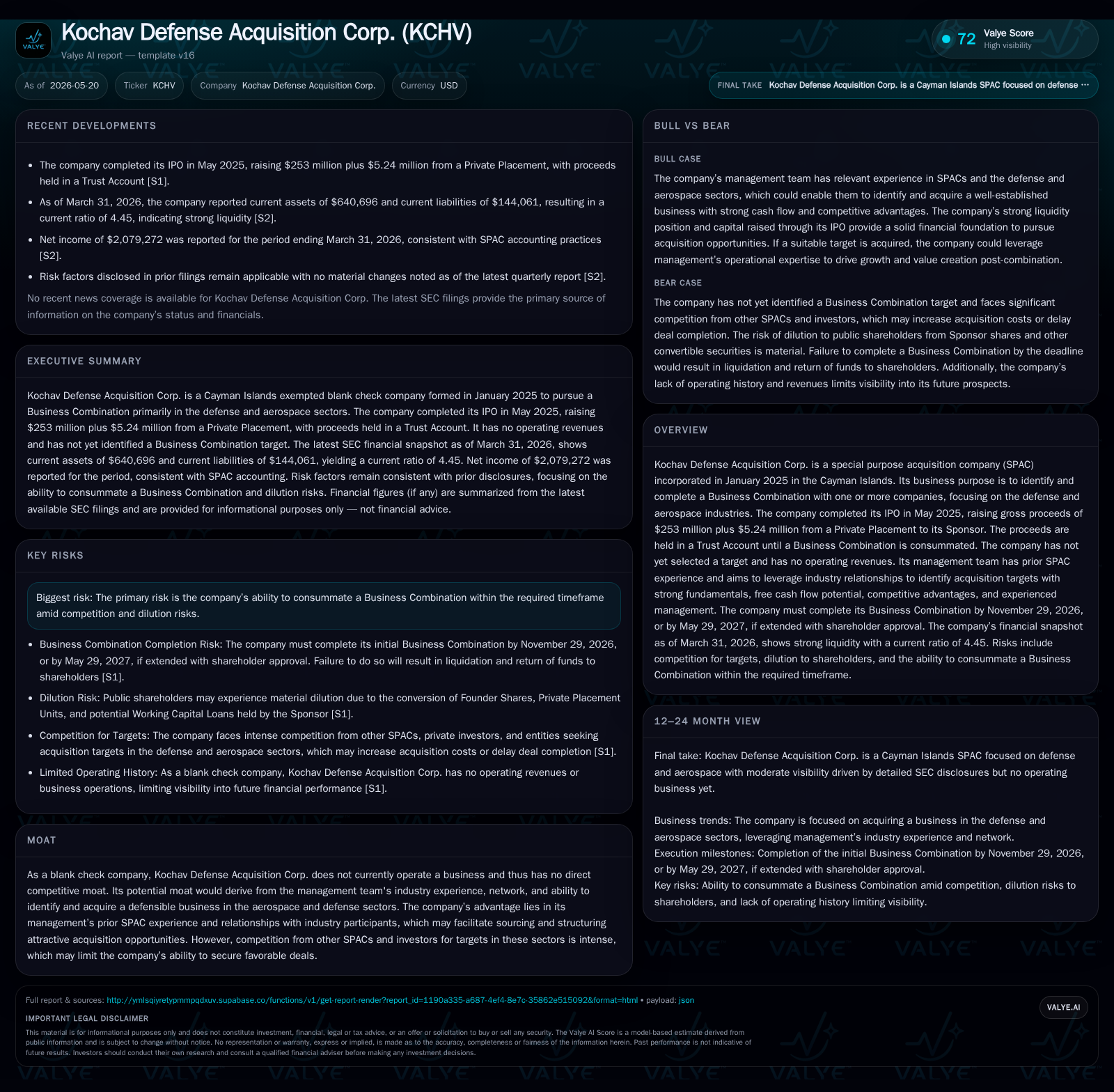
Kochav Defense Acquisition Corp., a Cayman Islands-domiciled SPAC formed in January 2025, holds $253 million plus sponsor proceeds in trust awaiting acquisition targets in defense and aerospace. The company must finalize a business combination by November 29, 2026 (potentially extendable to May 29, 2027), operating under growing temporal pressure as it remains without a selected target as of its May 14, 2026 quarterly filing. Its management team's prior SPAC experience and industry connections anchor its strategic advantage in a landscape where the backlog of private aerospace and defense companies seeking liquidity remains substantial but competition among SPACs intensifies. Liquidity conditions are strong with a high current ratio and minimal liabilities supporting deal flexibility, yet significant risks persist around deal execution, dilution, and regulatory scrutiny.
Latest Operating Update: Countdown to Business Combination Deadline
Kochav Defense Acquisition Corp.'s most recent quarterly filing dated May 14, 2026 [S2] confirms that the company has yet to consummate its initial business combination nearly fifteen months after its May 2025 IPO. This milestone introduces growing strategic urgency with an impending November 29, 2026 deadline mandated by its governing agreements to complete a qualified transaction or face mandatory liquidation. While provisions allow a possible extension through May 29, 2027 if shareholder approval is secured, the narrow timeframe constrains negotiation latitude and heightens execution risk.
As of the latest quarter-end, Kochav remains a shell entity without operational revenues or expenses aside from administrative overheads related to regulatory compliance and governance activities [S2]. No material developments have altered previously disclosed risk factors or operational contingencies [S2]. The company’s financial position is anchored by approximately $253 million raised in gross IPO proceeds plus $5.24 million from sponsor private placement units held in an independent trust account pending deployment into an acquisition [S1].
Business Model and Value Proposition of a Defense-Focused SPAC
Kochav’s business model reflects the standard blank check company archetype: it raises capital from public investors with the sole intent of identifying one or more private companies within the targeted aerospace and defense sectors for acquisition and transition into a public entity [S1]. It generates no operating revenue pre-deal; value realization depends entirely on acquiring businesses with strong fundamentals—typically characterized by steady free cash flow profiles, defensible competitive positions, and capable management teams—which align with long-term industry secular growth trends.
The company strategically limits focus to defense and aerospace given management's domain expertise. This vertical specialization aims to improve deal sourcing efficacy and post-merger value creation through improved diligence capabilities compared to generalized SPACs without industry focus [S1]. The approach hinges on leveraging insider knowledge of sector idiosyncrasies including technology life cycles, government contracting nuances, and evolving regulatory environments.
Competitive Environment and Industry Context for Acquisition Targets
The broader market for aerospace- and defense-focused acquisitions via SPACs has become highly competitive. Many companies within this middle market segment face constrained traditional IPO pathways due to volatile equity markets or changing investor appetites post-pandemic [S1]. Consequently, there exists what management describes as a "substantial backlog" of private entities seeking alternatives for liquidity events or scale accelerations [S1].
However, this supply dynamic coexists with intense bidding from multiple sponsored vehicles—SPACs backed by venture capital firms or financial sponsors eager to deploy capital amidst challenging market conditions. This compressionary environment can erode pricing power for acquirers like Kochav who also compete with direct IPO attempts or trade sales. Furthermore, defense industry transactions attract heightened regulatory scrutiny given national security considerations impacting deal structures and timelines.
Management Advantage and Sponsorship Credentials
A critical intangible asset driving Kochav’s potential moat is its management team's prior SPAC experience combined with deep industry relationships within aerospace and defense circles [S1]. CEO Menachem Shalom and CFO Asaf Yarkoni bring both deal structuring acumen and operational insight enabling more informed target screening relative to neophyte sponsors.
This network effect theoretically positions Kochav favorably in access to proprietary deal flow that might evade competitors dependent on auction processes alone. Sponsor participation through private placement units also aligns incentives between management and public shareholders during negotiations [S1], contributing governance discipline around valuation benchmarks.
Growth Drivers: Market Demand and Investment Timing
Underlying Kochav’s acquisition strategy are several structural growth drivers within aerospace/defense markets broadly. Persistent geopolitical tensions ensure sustained government spending which underpins contractors’ order backlogs offering revenue visibility beyond typical commercial cyclicality. Additionally, many mid-market companies seek public equity access for capital infusion towards technology development or capacity expansion facilitating pipeline depth.
The timing element relates heavily to the company's limited window before forced liquidation absent consummated deals [S1]. This deadline creates urgency implicitly encouraging faster close cycles but poses negotiation constraints impacting pricing.
If successfully navigated, acquiring businesses during periods of market dislocation could yield accretive growth opportunities.
Risk Factors: Deal Execution, Dilution, and Market Conditions
Despite favorable thematic tailwinds in defense/aerospace industries, Kochav remains exposed to classic SPAC-specific risks: failure to consummate any approved business combination will trigger dissolution resulting in return of cash net of expenses to shareholders—a scenario detrimental to sponsor economics [S1][S2]. Competing sponsors vying for similar targets exacerbate valuation compression risks.
Dilution continues as an important watchpoint since sponsor shares obtained at inception inherently dilute public investors upon combination closure unless offset by accretive performance post-merger. Regulatory complexities endemic to defense-sector transactions may delay approvals or alter deal terms unpredictably.
Lastly, macroeconomic volatility affecting interest rates or government budgets may indirectly pressure target valuation multiples or growth prospects reducing overall transaction appeal.
Milestones to Watch: Target Identification, Deal Announcement, and Shareholder Approvals
Beyond securing an appropriate target which remains unannounced as of May 2026 [S2], Kochav must navigate several near-term milestones:
- Public disclosure of identified acquisition target(s) including preliminary terms,
- Execution of definitive merger agreements,
- Securing shareholder approval within required proxy solicitation periods,
- Managing redemption rates by holders opting out prior to closing,
- Potential pursuit of any combination period extensions subject to shareholder consent,
- Completion of regulatory reviews typical for defense-related mergers. These steps form a compressed timeline essential for validating Kochav’s strategic thesis before statutory deadlines pass.
Current Financial Health and Capital Position Supporting Deal Execution
Though devoid of operating income as expected from a blank check vehicle model [F1], Kochav's balance sheet strength bears emphasis amid transactional urgency. As of March 31, 2026 end-of-quarter data reveals current assets totaling approximately $640,696 against current liabilities near $144,061 yielding a robust current ratio around 4.45 indicating comfortable short-term liquidity coverage [F1]. The assessment relies solely on disclosed facts regarding Kochav Defense Acquisition Corp.’s operational posture, risk profile, management credentials, market context, and financial snapshot. Readers should consult official filings directly for comprehensive detail prior to forming judgments about corporate prospects or strategies.
Disclaimer: This is research-only, informational analysis and not investment advice. It may include AI-generated interpretation and general industry context. Always verify important details using primary sources.

Comments