
Kaltura's AI-Driven Video Ambition: Platform Differentiation Meets Liquidity and Compliance Crosswinds
Kaltura’s integration of agentic AI into its enterprise video platform offers a differentiated value proposition, but financial constraints and regulatory complexity raise questions about the pace and sustainability of its growth.
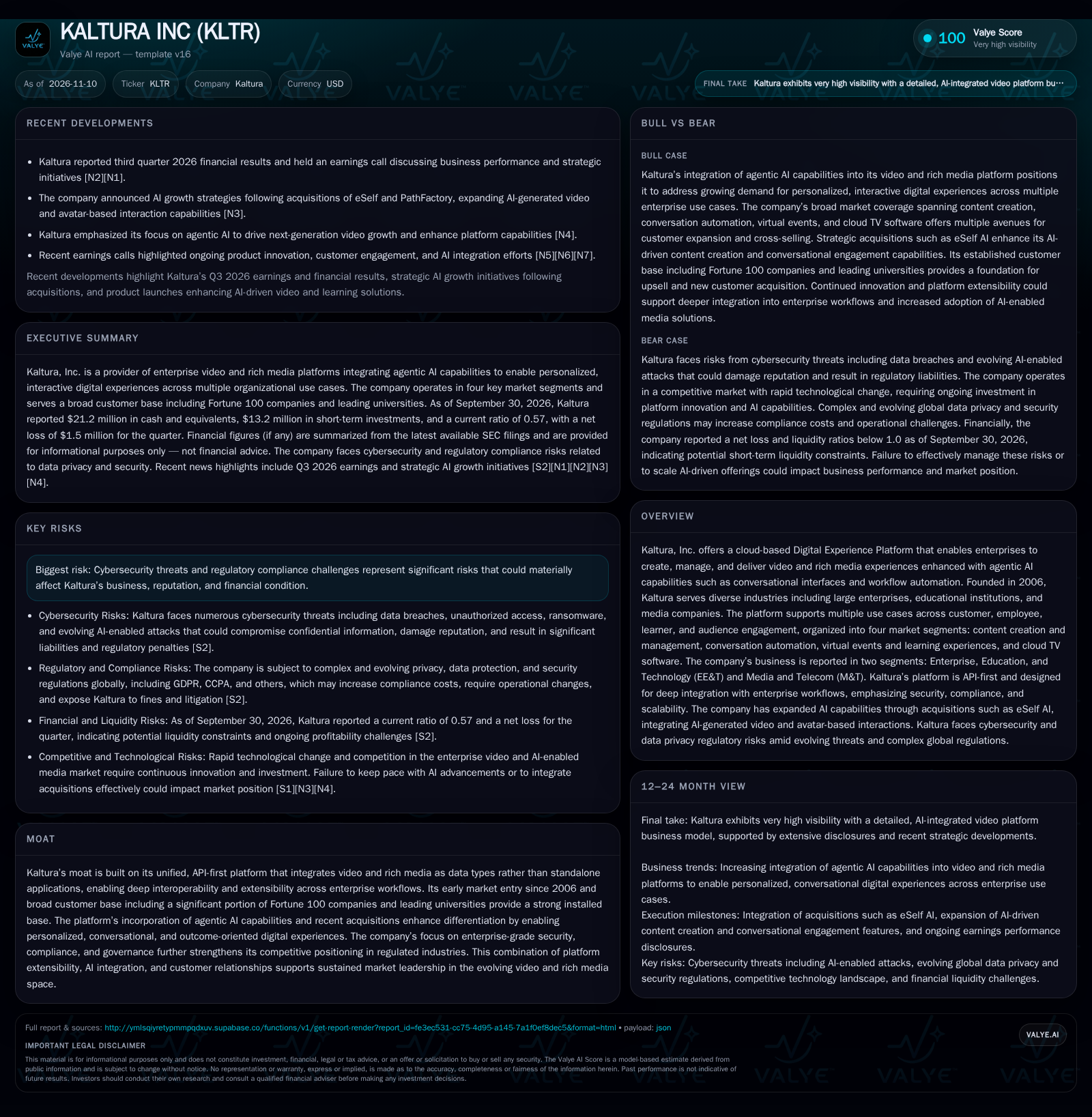
Kaltura is leveraging agentic AI to enhance its video and rich media platform, targeting broad enterprise adoption and deeper workflow integration. Regulatory and cybersecurity risks are mounting as AI capabilities expand. The next phase hinges on successful AI integration, customer upsell, and prudent financial management in a crowded, fast-evolving market. [S1] [S2] [N1] [N2] [N3] [N4]
Kaltura is positioning itself at the intersection of enterprise video, AI-driven engagement, and workflow automation. Its API-first, extensible platform has attracted a diverse customer roster, including leading corporations and academic institutions. However, recent financial disclosures highlight a net loss and a current ratio below 1.0, raising liquidity concerns just as the company undertakes ambitious AI integration initiatives. As Kaltura seeks to differentiate through agentic AI capabilities and personalized digital experiences, the challenge will be balancing innovation, compliance, and financial discipline in a highly competitive market.
Recent Financials and Strategic Moves Redefine Kaltura’s Opportunity—and Its Constraints
Kaltura’s Q3 2026 results reveal a net loss of $1.5 million, with cash and equivalents totaling $21.2 million and short-term investments of $13.2 million. The company reported cash and liquidity metrics for the period; these figures do not by themselves establish operating runway, investment capacity, financial flexibility, or financing capacity. [S2]
Strategically, Kaltura has doubled down on AI-driven video and conversational experiences, integrating capabilities from recent acquisitions such as eSelf AI and PathFactory. These moves underscore a pivot toward agentic AI as a growth engine and differentiator [N3] [N4]. The company continues to serve a diversified base—including a significant share of Fortune 100 companies and leading research universities—which offers both revenue stability and upsell potential [S1].
However, as AI integration deepens, Kaltura’s exposure to cybersecurity threats and regulatory compliance complexity is increasing. The company explicitly identifies risks from data breaches, evolving AI-enabled attacks, and tightening privacy regulations, which could materially impact both reputation and financial results [S2].
How Kaltura’s Platform Could Unlock Operating Leverage—If Adoption and Retention Follow
Kaltura’s business model is built around a cloud-based, API-first platform that supports a wide range of enterprise use cases—from virtual events and e-learning to conversation automation and cloud TV software [S1]. The company’s revenue is likely a mix of recurring SaaS contracts, usage-based fees, and possibly professional services, though the exact mechanics are not disclosed. Given the breadth of use cases and deep integration with customer workflows, the potential for high switching costs exists if Kaltura’s solutions become mission-critical for clients.
Operating leverage could materialize as more customers adopt AI-driven features and expand usage across organizational functions. The recent expansion into agentic AI—enabling conversational interfaces and automated video workflows—could support higher value per customer and facilitate cross-selling. If AI features drive greater user engagement and stickiness, Kaltura may see improved gross margins due to the scalable nature of its cloud infrastructure versus incremental support and R&D costs.
However, the capital requirements for ongoing product innovation, compliance investments, and AI integration remain significant. [S2] The company may need to pursue external financing, optimize its cost structure, or accelerate monetization of new AI offerings to bridge the gap.
Platform Extensibility and AI as Differentiators—But the Market Is Crowded and Fast-Moving
Kaltura’s competitive strengths include its unified, API-driven platform, early market entry (founded 2006), and a roster of high-value enterprise and education customers [S1]. The platform’s extensibility—treating video and rich media as data types integrated into broader workflows—offers a foundation for deep enterprise adoption and customization. The integration of agentic AI (via acquisitions and internal R&D) further differentiates Kaltura by enabling personalized, conversational, and outcome-oriented experiences.
Nonetheless, the enterprise video and digital experience market is intensely competitive and characterized by rapid technological change. Peer categories include large SaaS vendors, specialized video platforms, cloud service providers, and emerging AI-first content engagement startups. Many competitors offer their own AI features, and some benefit from larger R&D budgets or embedded distribution advantages.
Switching costs may be material for deeply integrated customers, but new customer acquisition and retention will hinge on Kaltura’s ability to stay ahead in AI features, security, compliance, and ease of integration. The risk is that, without continuous innovation and execution, even large installed bases can become vulnerable to displacement or pricing pressure.
AI-Driven Upsell and Workflow Integration Fuel Revenue Acceleration
If Kaltura successfully integrates agentic AI across its platform, it could unlock a new wave of upsell opportunities among existing enterprise and education customers. High-value features such as AI-generated video, conversational interfaces, and automated workflows may drive increased platform adoption, higher retention, and greater customer lifetime value. This scenario presumes that customers perceive tangible ROI from AI-enabled solutions and are willing to expand contracts or migrate additional workflows onto Kaltura’s platform.
The favorable chain would include rapid uptake of new AI modules, cross-segment expansion (e.g., from e-learning into marketing or internal comms), and demonstrable improvements in gross and operating margins as cloud-based revenue scales faster than incremental costs. The company might also achieve greater pricing power if its AI features become essential for regulated, security-conscious customers.
Evidence supporting this scenario would include reported acceleration in enterprise contract wins, expansion of average deal size, improved customer retention metrics (if disclosed), and rising gross margins.
Incremental AI Adoption with Tight Financial Management Defines the Near-Term Outlook
The most plausible scenario is that Kaltura sees gradual adoption of its new AI-driven features, with upsell and cross-sell occurring but at a measured pace consistent with large enterprise procurement cycles and regulatory due diligence. The company continues to serve a broad base of Fortune 100 companies and leading universities, but customer expansion and deeper workflow integration occur incrementally rather than explosively.
Financial discipline becomes paramount: Kaltura may need to carefully balance R&D and compliance investments against the backdrop of reported liquidity position and continued operating losses. The company could seek to optimize its cost structure, renegotiate customer contracts, or explore strategic partnerships to mitigate near-term funding pressure.
Confirmation of this scenario would come from stable or modestly growing revenue, neutral or narrowing operating losses, and evidence that AI features are being adopted by existing customers, even if not at breakout levels. Disconfirming evidence would include accelerating cash burn, loss of major customers, or inability to fund critical platform enhancements.
Liquidity Pressure and Regulatory Complexity Stall Innovation and Customer Retention
In a negative scenario, Kaltura’s liquidity constraints prove acute, forcing the company to curtail investment in AI, product innovation, or go-to-market initiatives. As competitors continue to advance their own AI and video offerings, Kaltura risks falling behind in feature parity, security, or compliance—particularly as evolving data privacy laws and cybersecurity threats raise the bar for enterprise vendors.
If major customers perceive heightened risk or diminishing value, churn could increase, and new customer acquisition could slow. The company may face unfavorable financing terms or be compelled to sell assets, dilute shareholders, or pursue strategic alternatives under duress.
Warning signs for this scenario would include deteriorating current ratio or cash position, missed product launch milestones, regulatory or security incidents, and public disclosures of customer losses or contract downgrades.
Milestones That Will Shape Kaltura’s AI Monetization and Platform Trajectory
Progress on integrating and monetizing AI-driven features acquired through eSelf AI and PathFactory—measured by new product launches, customer adoption, and revenue contribution (if disclosed).
Trends in customer retention, upsell, and average contract value, especially among Fortune 100 enterprises and top-tier universities—a useful metric would be renewal rates or net revenue retention, if provided.
Evolution of gross and operating margins as AI and cloud-based revenue mix increases—would help test whether scalability and operating leverage are materializing.
Liquidity and cash flow developments, including changes in current ratio, cash position, or any announced capital raising activity.
Incidence of cybersecurity events, regulatory actions, or compliance disclosures tied to data privacy or AI-driven platform complexity.
Pace and effectiveness of ongoing product innovation, including the launch of new conversational and workflow automation modules.
Competitive announcements or product launches from other enterprise video and AI engagement vendors, which may reset customer expectations or pricing dynamics.
Disclaimer: This is research-only, informational analysis and not investment advice. It may include AI-generated interpretation and general industry context. Always verify important details using primary sources.

Comments