
Kinsale Capital Expands Market Share and Navigates E&S Underwriting Volatility in Q1 2026
Kinsale Capital reports strong Q1 premium growth and maintains disciplined underwriting while managing expense ratio pressure in the niche excess and surplus lines market.
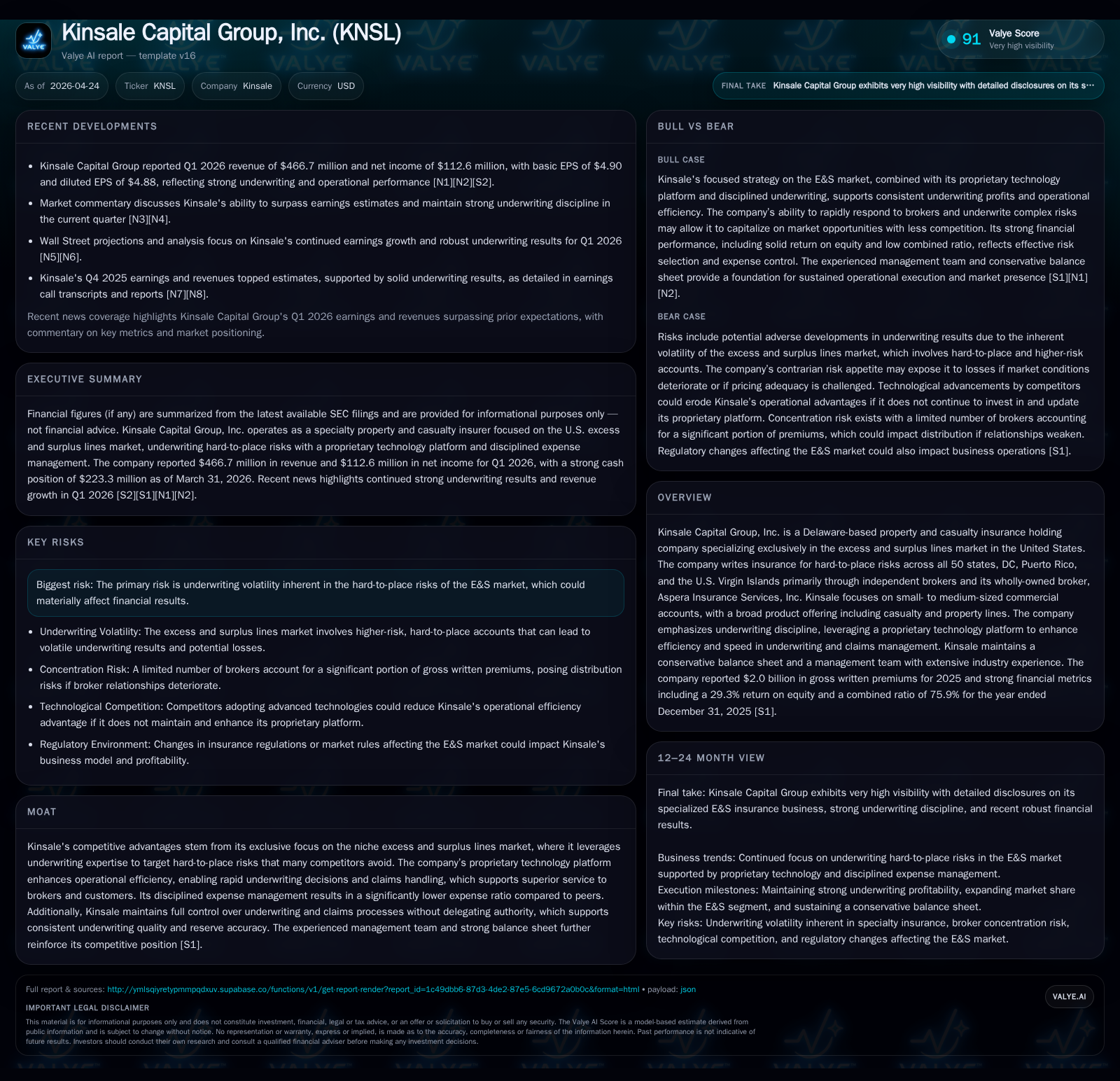
In Q1 2026, Kinsale Capital Group, Inc. reported a continued focus on growing its excess and surplus (E&S) lines business with 76% casualty and 24% property mix. The company faces modest expense ratio expansion driven by underwriting commission increases but sustains its competitive advantage through technology-enabled underwriting discipline and strong broker relationships. Its niche focus on hard-to-place risks supports sustainable market share growth despite inherent underwriting volatility in the E&S segment. Investors should watch upcoming reserve adequacy assessments, loss ratio trends, and capital deployment through share repurchases.
Recent Operating Update: Q1 2026 Highlights
Kinsale Capital Group's first-quarter 10-Q filing released on April 23, 2026 [S2] reveals sustained momentum in its core Excess & Surplus (E&S) lines insurance business. Gross written premiums for the quarter reflected an increasing tilt towards casualty risks (76%) compared to property lines (24%), with personal lines shrinking further to about 2.5%. The company's scale of operations extends across all US states plus Puerto Rico and the U.S. Virgin Islands, leveraging independent brokers and its wholly owned broker, Aspera Insurance Services.
Highlighting operational discipline amid industry challenges, the combined expense ratio increased to 21.1% for Q1 2026 versus 20.0% in Q1 2025 [S2]. This rise was mainly attributable to increased net commissions paid to brokers—10.8% of earned premiums versus 9.5% previously—while other underwriting expenses were actually slightly trimmed from 10.5% to 10.3%. The increase in commissions likely reflects competitive pricing pressures or efforts to incentivize broker engagement amidst elevated industry claims frequency.
Notably, the change in fair value of equity securities swung negatively by approximately $8.4 million this quarter compared to a positive swing last year, paralleling broader U.S. equity market fluctuations [S2]. This highlights that Kinsale’s investment portfolio remains influenced by public equity market volatility even as fixed-income securities comprise the majority of investments.
Business Model: Specialized Underwriting in Excess & Surplus Lines
Kinsale operates exclusively within the niche E&S market segment where it underwrites "hard-to-place" risks that standard insurers often avoid due to complexity or elevated risk profiles [S1]. These include smaller commercial accounts spanning casualty and property lines plus select personal homeowner policies.
Its revenue derives primarily from gross written premiums (GWP), which totaled approximately $2 billion for full-year 2025 (reflecting ~5.7% growth year over year) [F1], along with fee income from policy fees assessed directly on insureds [S1]. Premiums are typically earned pro rata over one-year policy terms.
The company's strategic strength lies in combining proprietary technology platforms with deep underwriting expertise — enabling rapid quoting, binding, and risk assessment without delegating underwriting authority to agents or brokers [S1]. This tight control minimizes erroneous risk selection and supports consistent pricing discipline critical for profitability given the unpredictability inherent in the E&S marketplace.
Another pillar is its extensive network of independent brokers augmented by Aspera Insurance Services, which is wholly owned by Kinsale — facilitating broad reach across all jurisdictions while maintaining close relationships central to successfully placing complex risks [S1].
Kinsale balances broad risk appetites across many casualty subsegments (excess casualty, construction, professional liability, products liability, etc.) with a concentrated focus on smaller account sizes that enable more granular underwriting distinctions [S2]. Such diversification helps mitigate volatility although hard-to-predict legal inflation and social factors remain persistent uncertainties impacting loss reserves [S1],[S18].
Industry Structure and Competitive Position
The U.S. E&S market represents roughly $130 billion annual direct written premiums according to industry sources cited by Kinsale [S1]. Within this sizable but fragmented sector, many incumbent carriers have retrenched due to tightening regulatory regimes or volatile loss experiences associated with emerging liability exposures.
Kinsale’s exclusive E&S focus along with its proprietary tech stack afford it operational advantages over competitors who may still rely on delegated authority or legacy manual processes. The company's no-delegation policy enables consistent loss control practices and reserve accuracy — a notable moat amid fluctuating claim severity scenarios common in excess lines coverage [S1].
Its A.M. Best rating of "A" (Excellent) further enhances Kinsale’s attractiveness among brokers seeking reliable partners capable of meeting obligations promptly [S16]. Strong financial ratings remain critical currency within insurance distribution ecosystems where agent reputation concerns weigh heavily.
Technological leadership translates into faster turnaround times on quoting and binding policies relative to more traditional players whose slower processes can deter brokers facing urgent client needs [S1]. Expense control emphasized at Kinsale produces comparatively lower expense ratios than peers operating at scale primarily through independent channels [S1].
Growth Drivers and Constraints
Growth potential stems largely from:
- Expanding penetration of a fragmented $129 billion+ E&S market where large incumbent insurers are selective or withdrawn.
- Enhancing broker loyalty through superior service levels backed by efficient digital platforms.
- Launching new differentiated product coverages aligned with evolving risk profiles within mid-market small business segments.
- Organic premium rate increases achievable via skilled underwriting that prices adequately for emerging inflationary claims trends.
However, growth is constrained by:
- The volatile nature of loss experience inherent to hard-to-place risks amplifies reserving uncertainty impacting earnings consistency.
- Industry-wide upward pressure on net commissions as brokers negotiate aggressively amid capacity constraints—evidenced by recent commission expansion.[S2]
- Regulatory scrutiny shaping permissible underwriting practices potentially constraining rapid product innovation or scaling certain high-risk lines.[S1],[S20]
- Capital limitations imposed by statutory surplus requirements restrict maximum sustainable insurance float absent raising fresh equity or debt capital.[S14]
- Dependence on reinsurance markets for catastrophe protection adds cost layers that may tighten margins during cycles.[S21]
What to Watch Next
Investors should monitor:
- Development patterns in loss reserves reported quarterly to gauge adequacy amid evolving social inflation and litigation trends [S12],[S18].
- Underwriting margin trends particularly commission rates relative to brokerage competition intensity reflected in new business premium flows [S2].
- Reinsurance renewal terms each year affecting risk retention levels and cost structures impacting underwriting results [S21].
- Execution on share repurchases given latest Board authorization of up to $250 million outstanding as of December 2025; $187.5 million remains available early 2026 following initial retirements in February [S2],[S6],[N2].
- Capital position including leverage metrics against debt maturities scheduled mid-decade related to senior notes issued in July 2022 and September 2023 totaling approximately $175 million principal balance outstanding last reported end-2025 [F1],[S4],[S5].
- Impact of macroeconomic factors like inflation or recessionary pressures on claim frequency/severity dynamics affecting underwriting profit cycles [S18],[N1].
Financial Profile (Supporting Evidence)
Kinsale’s balance sheet remains robust entering mid-2026:[F1][S2]
Historical performance (annual)
| FY | Rev ($mm) | Net ($mm) | CFO ($mm) | Capex ($mm) | Rev YoY | Net YoY |
|---|---|---|---|---|---|---|
| 2025 | 1874 | 504 | 1044 | 54 | +18.0% | +21.4% |
| 2024 | 1588 | 415 | 976 | 24 | +29.7% | +34.6% |
| 2023 | 1224 | 308 | 860 | 7 | +49.5% | +93.6% |
| 2022 | 819 | 159 | 558 | 7 |
Source: SEC companyfacts cache [F1].
Capital returns and efficiency (annual)
| FY | Div ($mm) | Buybacks ($mm) | FCF ($mm) |
|---|---|---|---|
| 2025 | 16 | 90 | 990 |
| 2024 | 14 | 10 | 952 |
| 2023 | 13 | 853 | |
| 2022 | 12 | 551 |
Source: SEC companyfacts cache [F1].
Operational cash flow exceeded $1 billion in FY25 generating strong free cash flow even after elevated capex spending tied partly to new corporate HQ completion [$53M capex YOY increase] (F1). Return on equity calculated by dividing FY25 net income by FY25 equity (~$2 billion end period) approximates healthy profitability consistent with prior years indicating durable shareholder value creation.
During Q1’26, Kinsale's expense management came under slight pressure evidenced by a rise in net commissions as a percentage of earned premiums partially offsetting reductions elsewhere in costs leading overall expense ratio up by ~110 bps YoY at quarter-end [S2]. This suggests management will need vigilance maintaining cost efficiency relative to competitive premiums environment.
On capital return programs, initial repurchases reached over $60 million year-to-date leaving ~$187 million room under Board authorization—highlighting ongoing commitment to returning capital when operational results permit without impairing growth funding capacity [S2],[S6].
Debt maturities extend beyond near-term horizon providing flexibility though the company monitors compliance with covenants limiting restricted payments ensuring strategic optionality amid evolving capital needs[S4,S7,S14]. Securities portfolio retains substantial investment-grade rating quality aligned with conservative balance sheet philosophy[S15,S16].
This analysis reflects information available from SEC filings through April 23, 2026 ([S2], [S3], [S1]) supplemented by year-end company facts data ([F1]) without any investment recommendations or price predictions.
Disclaimer: This is research-only, informational analysis and not investment advice. It may include AI-generated interpretation and general industry context. Always verify important details using primary sources.

Comments