
LaFayette Acquisition Corp.: Assessing Prospects and Risks Ahead of Business Combination
The latest quarterly report underscores LaFayette Acquisition’s readiness for a business combination while spotlighting structural strengths and inherent SPAC risks.
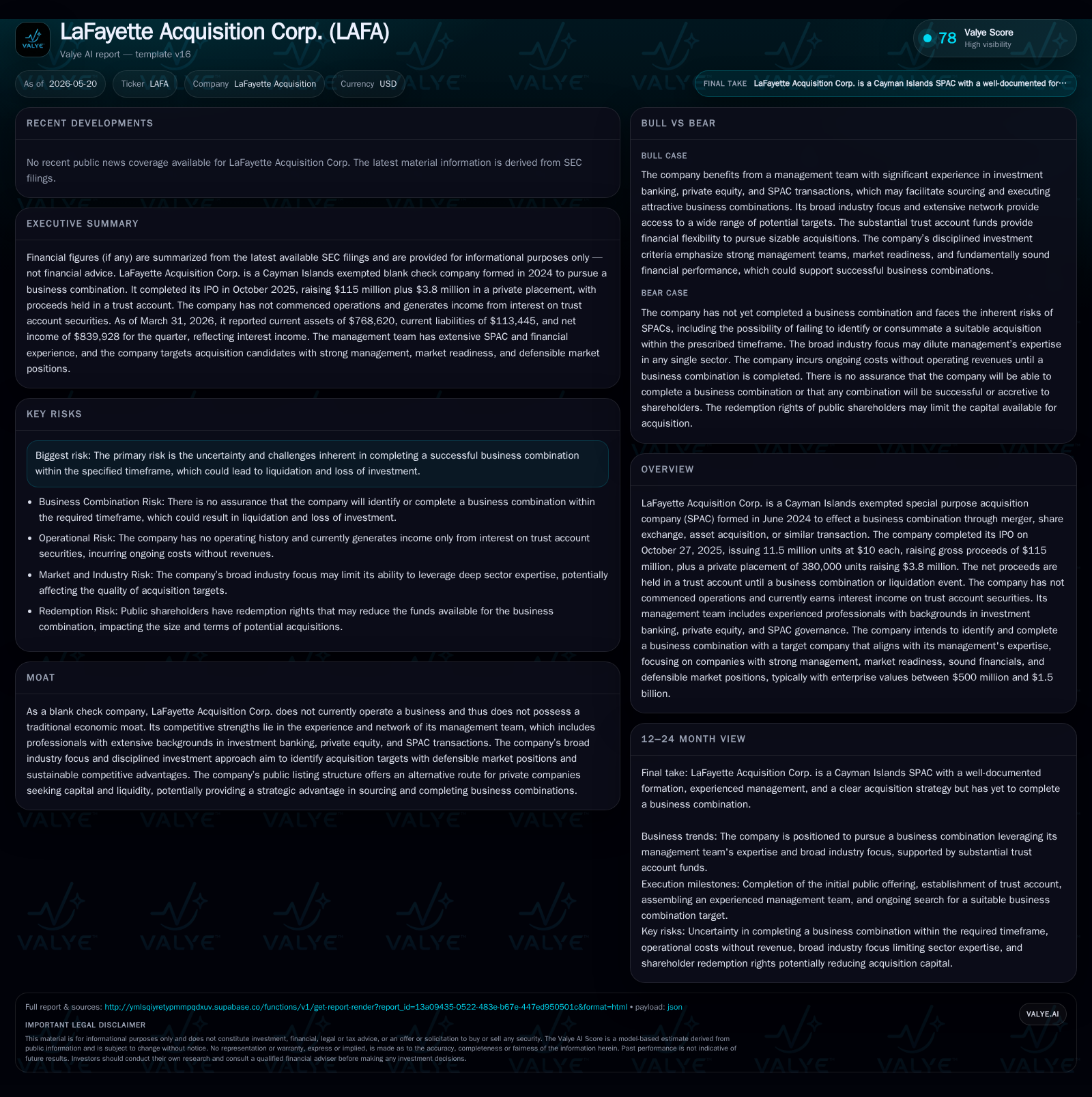
LaFayette Acquisition Corp. remains in its initial phase as a Cayman Islands SPAC, holding gross IPO proceeds of $115 million plus $3.8 million from a private placement securely in a trust account. Its recent quarterly filing confirms no operational activity yet but stable financial footing supported by interest income on trust assets and minimal liabilities. Management’s expertise is central to the company's plan to identify and consummate a business combination with targets exhibiting defensible competitive advantages. While the SPAC model offers an alternative path for private companies seeking liquidity, risks persist around deal execution within defined timeframes and shareholder redemption dynamics.
Latest Quarterly Operating Developments Highlight Status on Business Combination Efforts
LaFayette Acquisition Corp.'s May 2026 10-Q filing reaffirms the company’s position as a blank check acquisition vehicle that has yet to commence operations beyond preparatory and compliance activities [S2]. The company continues to hold all net IPO and private placement proceeds—totaling approximately $118.8 million—in a trust account, which functions as its primary asset base and source of funding for an initial business combination. Importantly, there have been no material changes to previously disclosed risk factors as per the annual report issued earlier this year [S2]. No revenues have been generated yet since LaFayette only earns interest income on the trust account securities. Operating expenses are limited to public company administration and due diligence related costs associated with seeking suitable merger opportunities [S1].
This stable financial position underpins management's ability to maintain operational readiness as they continue identifying prospective targets without immediate financing pressures.
Business Model Insights: Structure and Mechanics of LaFayette as a Special Purpose Acquisition Company
LaFayette Acquisition operates as a Cayman Islands exempted special purpose acquisition company (SPAC), formed in June 2024 with the express purpose of effecting a business combination through merger, asset acquisition or similar transaction [S1][S5]. Its business model lacks operating revenues until a successful business combination occurs; instead, it derives non-operating income exclusively from interest earned on funds held in a segregated trust account established post-IPO [S1].
The SPAC raised gross proceeds of $115 million via an October 2025 IPO where it issued 11.5 million units at $10 each and concurrently completed a private placement generating another $3.8 million. After offering-related expenses exceeding $6.7 million, these proceeds were placed in the trust account for public shareholders' benefit, held under trustee control until consummation or liquidation [S1][S5]. Funds outside the trust—primarily cash from interest income—are allocated toward ongoing administrative expenses, legal compliance, due diligence for target evaluation, travel, and other preparatory activities [S1].
With no current business operations or revenues outside trust earnings, LaFayette's intrinsic value before combination hinges largely on management’s ability to deploy capital effectively into a promising target that yields shareholder value post-merger.
Management Expertise and Strategic Focus: The Team Driving Target Selection
The competitive strength of LaFayette Acquisition lies predominantly in its management team’s credentials. The assembled professionals bring deep investment banking, private equity, private credit, entrepreneurial, and SPAC governance experience [S3]. This collective expertise facilitates disciplined target screening aligned with strategic criteria emphasizing fundamentally sound financial performance metrics such as visibility into revenue growth, positive cash flow profiles, and enterprise valuations typically ranging between $500 million and $1.5 billion [S25].
Management seeks targets exhibiting sustainable competitive advantage realized through strong intellectual property, differentiated technology platforms or recognized brand equity suitable for expansion under public capital markets [S25]. Moreover, their broad industry mandate coupled with fluid geographical parameters provides flexibility to chase attractive opportunities globally while maintaining strict valuation discipline.
Their network potentially enhances sourcing quality deal flow ahead of competing SPACs or traditional IPO candidates. However, until actual deal announcements occur, this advantage is largely latent.
SPAC Industry Positioning: Competitive Dynamics and Alternative IPO Pathways
As an exempted Cayman Islands jurisdiction entity categorized as an emerging growth company (EGC), LaFayette positions itself within the broader SPAC ecosystem offering private companies an expedited route to U.S. public equity markets that bypasses protracted traditional IPO processes [S4][S20]. This alternative appeals especially where speed to market and reduced disclosure requirements under EGC status offer transactional efficiencies.
LaFayette units initially traded bundled shares plus rights (LAFAU) before being eligible for separation into distinct ordinary share (LAFA) and rights (LAFAR) components on NASDAQ early after IPO closing [S3]. This structural design provides liquidity across multiple security forms but also introduces complexities related to shareholder redemption rights upon business combination proposals.
The SPAC market faces unique structural challenges such as managing redemptions which can diminish retained capital available for acquisition consideration if high opt-outs occur at shareholder votes [S1]. Moreover, regulatory oversight including SEC views on accounting treatments for rights instruments influences investor perception potentially affecting aftermarket unit pricing dynamics.
At the same time, LaFayette competes for attractive targets not only against peer SPAC vehicles but also against traditional IPO pipelines and alternative capital raising methods that may dilute its potential deal flow.
Growth Drivers: Navigating the Path to a Successful Initial Business Combination
The fundamental growth catalyst for LaFayette Acquisition is the identification and consummation of an initial business combination that satisfies both management’s strategic criteria and shareholder approval thresholds [S1]. Failure results in liquidation returning pro-rata trust account net asset value less fees.
- Redemption Risk: Public shareholders retain rights to redeem shares upon deal announcements subject to tender offer rules potentially reducing transaction funding capacity.
- Market Volatility: As an emerging growth company electing certain reduced disclosures under JOBS Act provisions [S4], transparency limitations could impact secondary trading liquidity or valuation perceptions adversely.
- Deal Uncertainty: The nascent stage means no announced combinations exist yet; unsuccessful deal sourcing would erode investor confidence.
- Legal/Liability Exposure: While indemnities protect against some financial claims relating to underwriting or auditors [S6], due diligence costs incurred prior to deal cancellation represent sunk expenses impacting working capital sustainability.
Continuous review of SEC filings combined with exchange trading data forms essential inputs for assessing trajectory towards consummation or alternative scenarios.
Financial Overview: Liquidity, Trust Account Status, and Capital Allocation
Although devoid of operating revenues pre-business combination completion, LaFayette sustains robust financial health anchored by its trust account balances approximating $115 million dedicated solely for acquisition deployment [F1][S2]. The latest balance sheet snapshot details current assets near $769 thousand largely comprising cash held outside trust accounts intended for working capital needs versus liabilities around $113 thousand yielding a strong current ratio near 6.78 reflecting ample short-term liquidity buffer [F1].
Total debt remains limited around $150 thousand composed primarily of unsecured promissory notes extended by sponsors facilitating administrative cost coverage prior to any capital raising needs beyond existing funds [F1][S6]. Interest income generated from invested trust securities supplements nominal losses incurred from reporting compliance expenditures enabling preservation of net asset value until active operational phases commence [S1][S6].
Going forward, efficient cost management along with timely utilization of working capital will be instrumental in sustaining viability during target vetting until consummation or alternate outcomes unfold.
This analysis synthesizes factual disclosures from SEC filings up through May 2026 alongside contextual industry understanding pertinent to special purpose acquisition companies (SPACs). The assessment refrains from speculative forecasts or investment research views focusing strictly on grounded operating realities and structural positioning observable today.
Disclaimer: This is research-only, informational analysis and not investment advice. It may include AI-generated interpretation and general industry context. Always verify important details using primary sources.

Comments