
Liberty Broadband Corp’s Strategic Transition Through Charter Merger and GCI Divestiture
A detailed analysis of Liberty Broadband’s evolution from equity holder to integrated Charter entity amid governance and liquidity challenges.
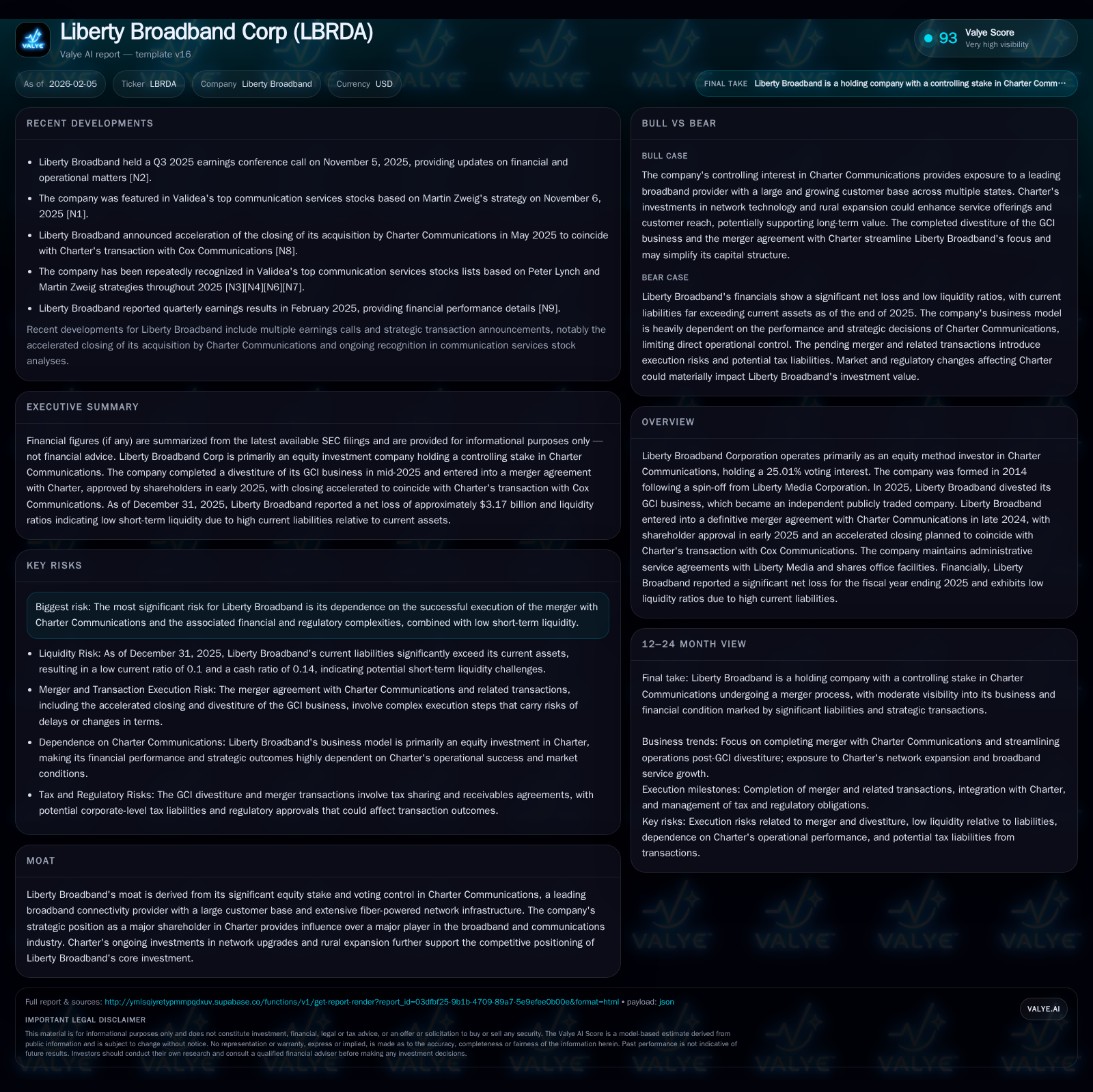
Liberty Broadband was created as a spin-off in 2014 with a focused equity stake in Charter Communications. Recent years have seen pivotal structural moves including the divestiture of its GCI business in mid-2025 and an accelerated definitive merger agreement with Charter in late 2024, approved by shareholders in early 2025. While Liberty Broadband maintains influence through its 25.01% voting stake in Charter, it is navigating tight liquidity constraints and complex governance issues during this transition. The merger’s timing aligns with Charter’s strategic transaction with Cox Communications, creating potential operational synergies but also layering financial and regulatory risks.
From Spin-Off to Strategic Investor: Liberty Broadband’s Evolution
In May 2014, Liberty Media Corporation initiated a plan that culminated in the spin-off of Liberty Broadband Corporation to its stockholders, establishing it as a distinct entity predominantly defined by its significant equity investment in Charter Communications [S1]. This design framed Liberty Broadband less as an operating company and more as a strategic investment holding vehicle focused on consolidating influence over Charter—currently commanding a robust 25.01% voting stake.
Over time, Liberty Broadband expanded its portfolio through acquisitions such as the assimilation of prior GCI Liberty in late 2020 [S1]. However, this diversification was temporary; the early to mid-2020s marked a reversal toward a concentrated strategy by divesting GCI assets in mid-2025. This trajectory illustrates an evolution from diversified holdings back toward the core investment thesis centered on Charter.
Anatomy of the Charter Deal: Terms, Timing, and Shareholder Alignment
A critical strategic milestone occurred on November 12, 2024, when Liberty Broadband entered into a definitive merger agreement whereby Charter Communications would acquire all outstanding shares of Liberty Broadband [S1]. This transaction specified that holders of Liberty Broadband common stock would receive approximately 0.236 shares of Charter Class A common stock per share held, with fractional shares settled in cash. Additionally, holders of preferred stock would be exchanged for newly issued preferred securities mirroring previous terms.
Shareholder endorsement came swiftly; by February 26, 2025, requisite approval was secured at a special meeting [S1]. Notably, the closing was accelerated to synchronize with Charter's concurrent strategic transaction involving Cox Communications—leveraging synergies between complex telecom consolidation efforts.
This merger not only consolidates ownership but also aligns governance mechanisms via amendments to existing stockholder agreements aimed at maintaining regulated control levels alongside enhanced operational scale [S1].
GCI Divestiture: Streamlining Focus or Signaling Risk?
As a precursor condition to enabling the flagship merger with Charter, Liberty Broadband executed an internal reorganization followed by the July 14, 2025 divestiture of its GCI broadband business into an independently traded entity named GCI Liberty [S1]. This separation was accompanied by taxable consequences borne principally by Charter post-merger closure.
While framed as necessary to comply with regulatory or transactional prerequisites, this divestiture arguably signals both an effort to sharpen corporate focus exclusively on the premier broadband platform represented by Charter and a mitigation step against potential conflicts or duplicative operations within overlapping market footprints.
Illuminating Liberty’s Financial Tightrope: Liquidity Constraints Amid Debt
The fiscal year ending December 31, 2025 cast a stark spotlight on Liberty Broadband’s financial fragility. Reported net losses exceeded $3.17 billion while cash balances hovered near $57 million vis-à-vis nearly $987 million in current liabilities [F1][S1]. The resultant current ratio plummeted toward an alarming ~0.1—indicative of profound short-term liquidity strain.
This imbalance reveals crucial structural risks: while operating as an equity holder without direct operating revenues outside distributions or stock repurchases from Charter constrains cash inflows. The company relies heavily on contractual monthly share repurchases or loans arranged through amended shareholder agreements to navigate these pressures [S1]. Such dependence undermines flexibility and intensifies exposure to broader market or counterpart performance volatility.
Governance and Affiliated Interests: How Overlapping Directors Shape Strategy
Complex governance overlays emerge from overlapping board memberships and executive roles shared among Liberty Broadband, its siblings GCI Liberty and Liberty Live Holdings, and parent-legacy structures retained from Liberty Media [S1]. These interconnections raise potential conflicts around prioritizing corporate strategies and negotiating fairness in inter-company agreements established during periods of common control.
While some arrangements are enduring for continuity—such as service contracts or tax-sharing agreements—their legacy origins challenge full arms-length clarity. Stakeholders must consider how these affiliations impact fiduciary duties amid transactional upheavals like the merger.
Moat and Market Positioning Through Charter’s Network Advantage
Despite structural complexity and financial headwinds, Liberty Broadband's enduring competitive advantage is tethered directly to Charter's status as one of America's foremost broadband service providers [valye_report_excerpt].
Charter’s expansive fiber-powered network underpins almost every facet of value embedded in Liberty’s equity interest—from broad customer reach across urban-rural divides to continuous investment upgrading infrastructure resilience and capacity. These ongoing enhancements strengthen subscriber loyalty and market penetration barriers facing smaller rivals or new entrants.
Thus, though indirect, Liberty Broadband effectively 'rides' on the robust technological moat crafted by Charter's capital intensity and innovation trajectory within telecom connectivity.
Risk Vectors in a Complex Web: Regulatory, Financial, and Operational Challenges
Multiple intertwined risk dimensions temper excitement over strategic mergers. Paramount are execution risks linked to consummating the deal amid regulatory scrutiny given combined market power concerns [S1]. LibBroadband's perilous liquidity profile further exacerbates susceptibility to unfavorable event swings.
Operational risks afflict both sides with competition intensifying amid shifting consumer demands for digital content delivery and broadband speeds. Cybersecurity threats loom large given network complexities [S1]. Moreover, nascent AI-related legal/regulatory frameworks could expose either entity to unpredictable costs or restrictions.
Financial leverage remains elevated on both balance sheets complicating refinancing options amidst rate environments that threaten variable debt servicing burdens. These factors collectively stress-test resilience beyond simple balance sheet metrics.
Looking Ahead: Potential Outcomes Post-Merger Closure
Upon closing—scheduled contemporaneously with the Cox-Cox Enterprises transaction—the combined entity realizes expanded scale advantages potentially unlocking cost synergies and broader market influence [S1][valye_report_excerpt].
However, absorptive capacity will be tested: integration risks encompass cultural alignment issues plus sustaining consistent governance transparency despite losing separate identity status for Liberty Broadband. Financially constrained conditions raise questions about managing debt load without compromising capital allocation toward growth initiatives.
Ultimately pragmatic trade-offs will shape how shareholders realize merged strategic visions against inherent consolidation vulnerabilities.
Administrative and Structural Dynamics: Service Agreements and Shared Facilities
Prior to full integration, operational housekeeping remains layered through administrative service agreements linking Liberty Broadband with Liberty Media [S1]. Shared office space usage at corporate headquarters reflects cost efficiencies but also underscores latent entanglements complicating post-merger disentanglement plans.
Tax sharing arrangements inherited from predecessor deals—particularly involving entities like QVC Group—add further complexity requiring attentive management during transitional phases to forestall unexpected liabilities or disputes [S1]. These backstage dealings influence overhead dynamics beyond typical standalone corporate frameworks.
This analysis aims to distill key dimensions shaping Liberty Broadband Corporation’s current crossroads amid its absorption into Charter Communications. While clearly positioned atop substantial network moats powered by fiber infrastructure leadership, financial tightness coupled with layered governance overlays enforce practical caution. Borrowing from public disclosures ensures objectivity free from speculative extrapolation. Readers should consider the company within its evolving broader telecom ecosystem context without interpreting this narrative as investment guidance.
Disclaimer: This is research-only, informational analysis and not investment advice. It may include AI-generated interpretation and general industry context. Always verify important details using primary sources.

Comments